

Main decision tree
Measles exposure: vaccine or immune globulin?
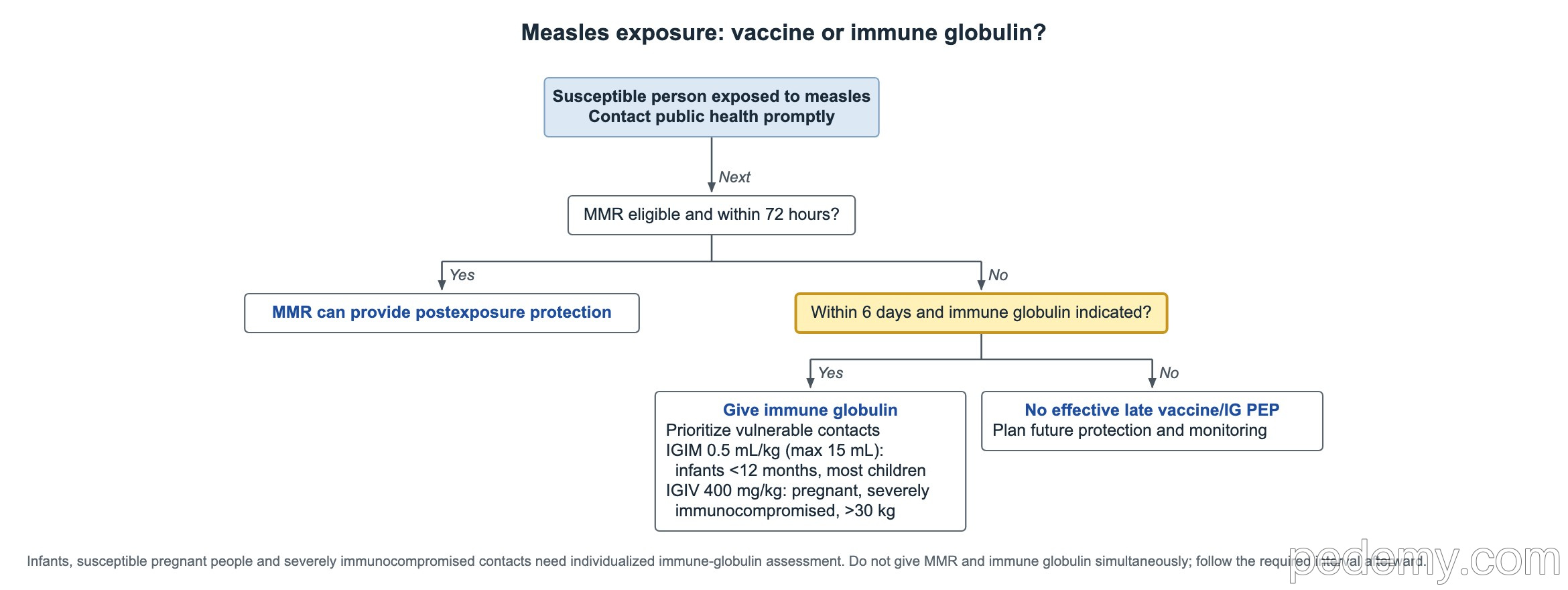
At a glance
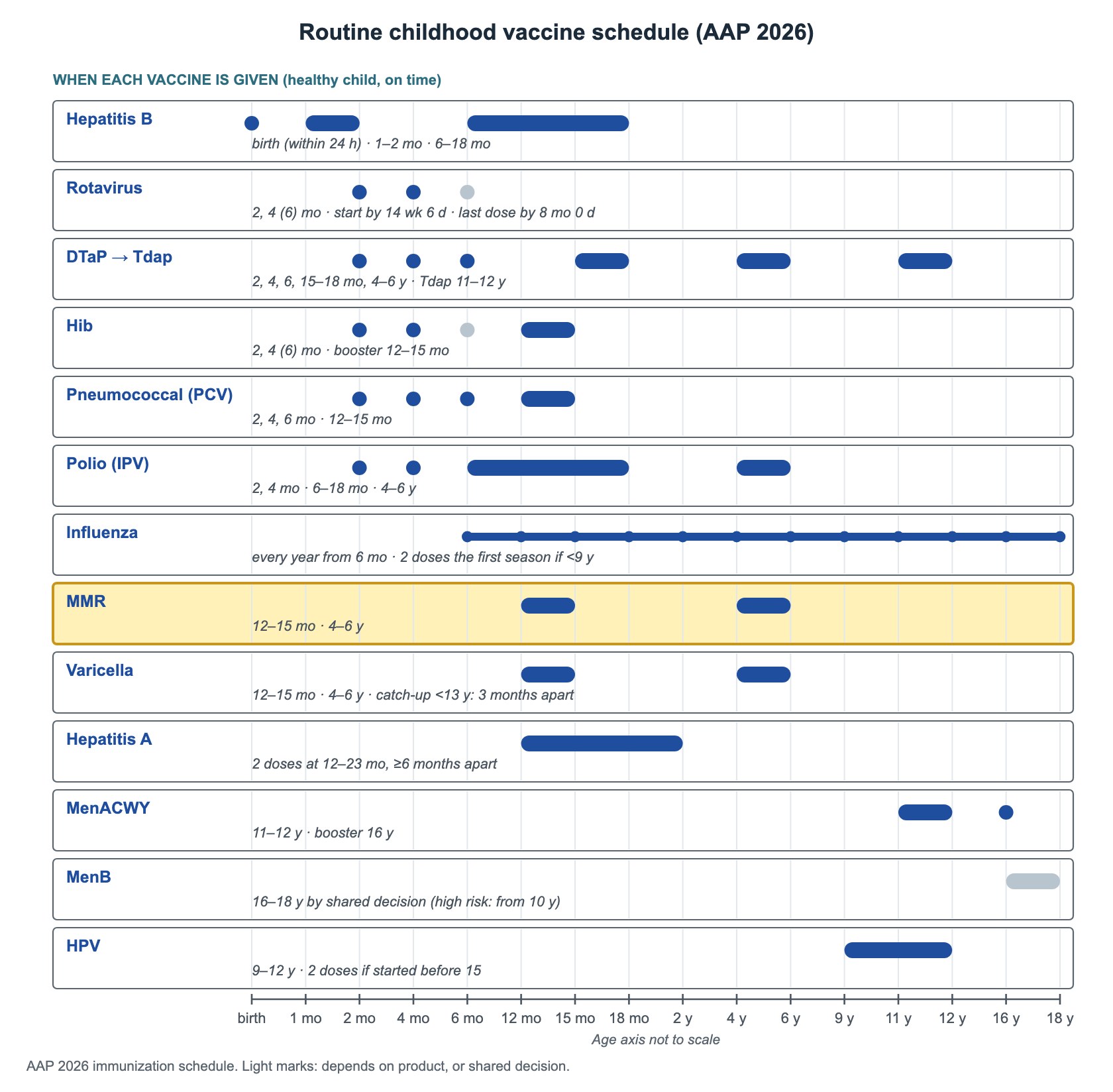
- Routine: 2 doses, at 12–15 months and 4–6 years. The second dose can be given any time from 28 days after the first.
- A dose given before 12 months does not count; the child still needs 2 doses from 12 months.
- Infants 6–11 months travelling abroad get 1 early dose at least 2 weeks before departure; children 12 months and older get 2 doses 28 days apart before travel.
- After measles exposure: MMR within 72 hours, or immune globulin within 6 days for people who cannot have MMR.
- Do not give MMR in pregnancy or to people with severe immunodeficiency; they get immune globulin after an exposure.
- Egg allergy is not a reason to avoid MMR.
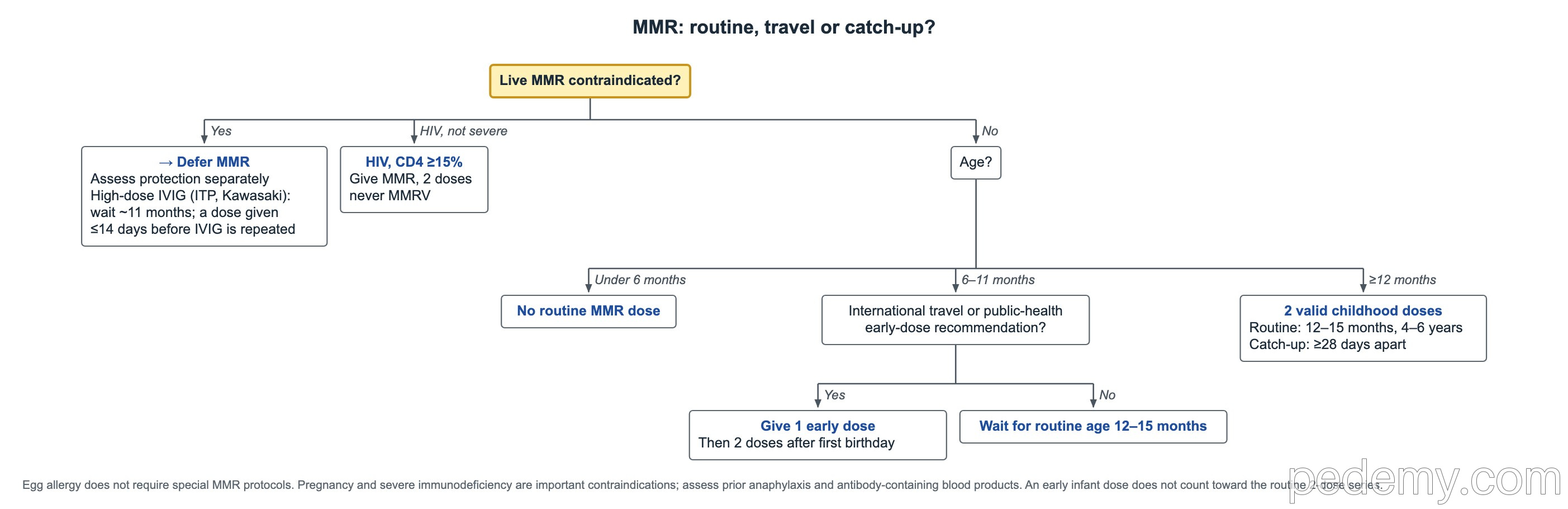
- A tuberculin skin test can be done on the same day as MMR, or 4 weeks after it.
More decision trees
From Pedemy's flashcards. Tap a tree to open it full size.
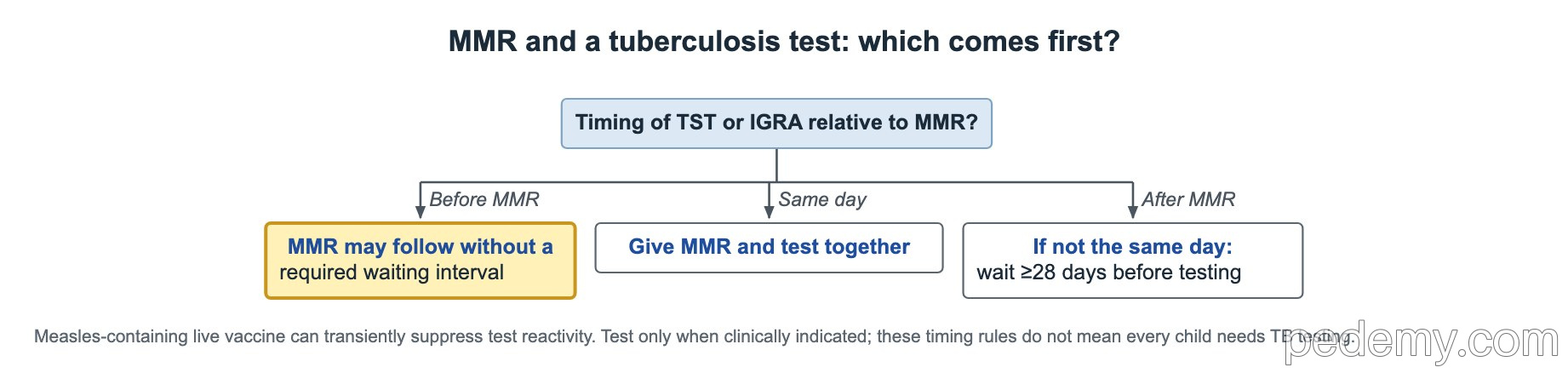
MMR: routine, travel or catch-up?
Another version 1 · Another version 2 · Another version 3 · Another version 4
Routine childhood vaccine schedule (AAP 2026) — schedule graph
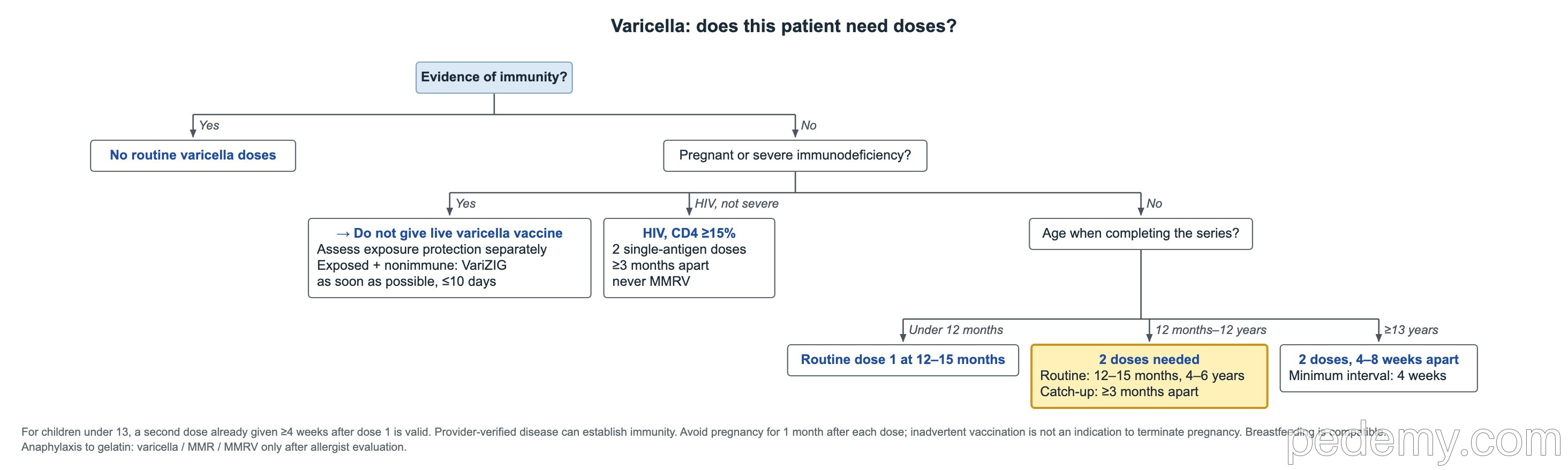
Varicella: does this patient need doses?
Routine schedule
- Dose 1 at 12–15 months.
- Dose 2 at 4–6 years, or any time from 28 days after dose 1.
- For dose 1 at 12–47 months, giving MMR and varicella as separate shots is preferred over the combined MMRV, because MMRV causes slightly more febrile seizures.
- MMR and varicella are both live vaccines: give them on the same day or at least 28 days apart.
Catch-up rules
- Minimum age is 12 months; a dose given more than 4 days before the first birthday does not count.
- Children and teens who are behind need 2 doses at least 28 days apart.
- Never restart the series: count every valid dose already given.
- Teens and young adults going to college, or working in healthcare, need 2 documented doses or lab proof of immunity.
Travel and measles exposure
| Situation | What to give | Timing |
|---|---|---|
| Infant 6–11 months, travel abroad | 1 early MMR dose (does not count) | At least 2 weeks before departure |
| Child 12 months or older, travel abroad | 2 MMR doses, 28 days apart | Before departure |
| Exposed, eligible for MMR, not immune | MMR | Within 72 hours |
| Exposed infant under 12 months | IGIM 0.5 mL/kg (or MMR within 72 hours from 6 months) | Within 6 days |
| Exposed, pregnant without immunity, or severely immunocompromised | IGIV 400 mg/kg | Within 6 days |
Who should not get it, or should wait
- Do not give after anaphylaxis to a previous dose or a component such as neomycin or gelatin.
- Do not give in pregnancy; avoid pregnancy for 4 weeks after a dose.
- Do not give with severe immunodeficiency: blood cancers, chemotherapy, congenital immunodeficiency, transplant drugs, or HIV with CD4 below 15%.
- After high-dose steroids (2 mg/kg/day or 20 mg/day of prednisone or more) for 14 days or longer, wait 1 month after stopping.
- After immune globulin or blood products, wait 3–11 months depending on the product and dose.
- A past low platelet count after MMR is a precaution; check measles IgG before giving another dose.
- Egg allergy is not a contraindication. A mild illness is not a reason to delay.
Side effects
- Fever, sometimes high, 7–12 days after the dose.
- A mild, non-contagious rash about a week later.
- Febrile seizures are rare and more likely with MMRV than with separate shots.
- Temporary low platelets in about 1 in 30,000–40,000 doses.
- Joint pain 1–3 weeks later, mostly in teen girls and women, from the rubella part.
- MMR does not cause autism; large studies have shown this repeatedly.
Common questions
Can a baby get the MMR vaccine before 12 months?
Yes, from 6 months before international travel or after a measles exposure. That early dose does not count, so the child still needs 2 doses from 12 months.
What should I do if my child was exposed to measles?
Call your doctor the same day. A child who is not immune can get MMR within 72 hours, or immune globulin within 6 days if they are under 12 months or cannot have MMR.
Can the second MMR dose be given early?
Yes. It can be given any time at least 28 days after the first dose, and it then counts as the final dose.
Can a child with egg allergy get MMR?
Yes. Egg allergy, even severe, is not a reason to avoid or delay MMR.
Can MMR be given in pregnancy?
No. MMR is a live vaccine. A pregnant person without immunity who is exposed to measles gets IV immune globulin, and MMR after delivery.
Sources
- CDC: Measles vaccine recommendations
- CDC/ACIP: Prevention of measles, rubella and mumps (MMWR 2013, includes post-exposure prophylaxis)
- CDC: Measles and travel
- CDC: Child and adolescent immunization schedule and catch-up guidance
- CDC: Contraindications and precautions (General Best Practice Guidelines)
Written for Pedemy in our own words from the sources above; checked October 2026. For education only, not medical advice. Pedemy is independent and not affiliated with or endorsed by the organizations cited.