

Main decision tree
PCV • 1. Age and vaccination history
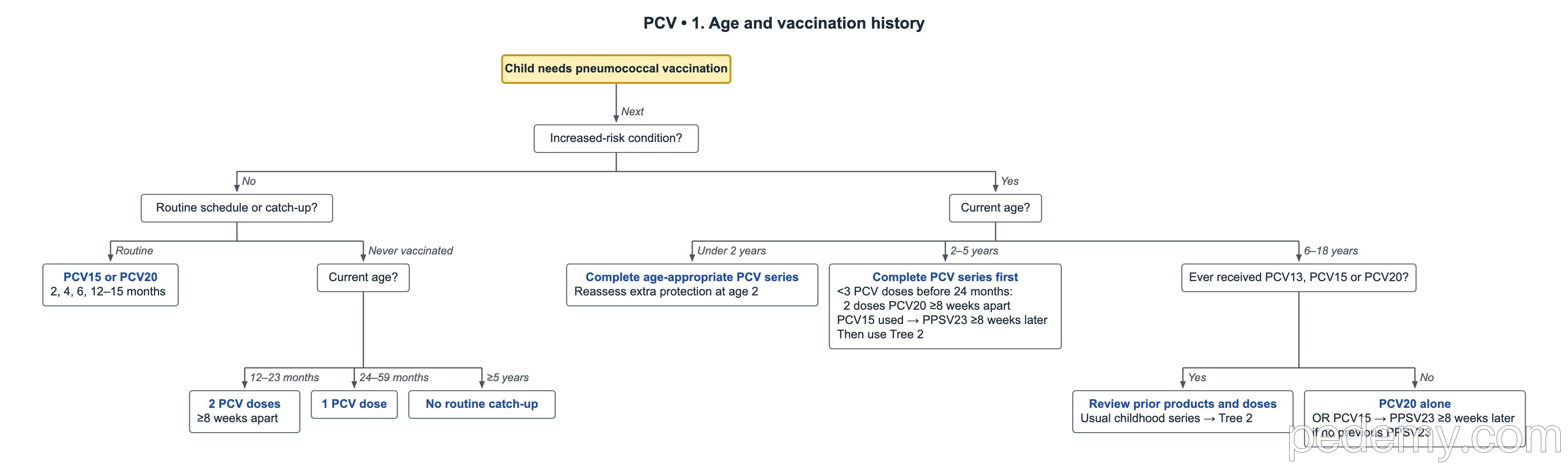
At a glance
- Routine PCV15 or PCV20: 4 doses at 2, 4, 6 and 12–15 months.
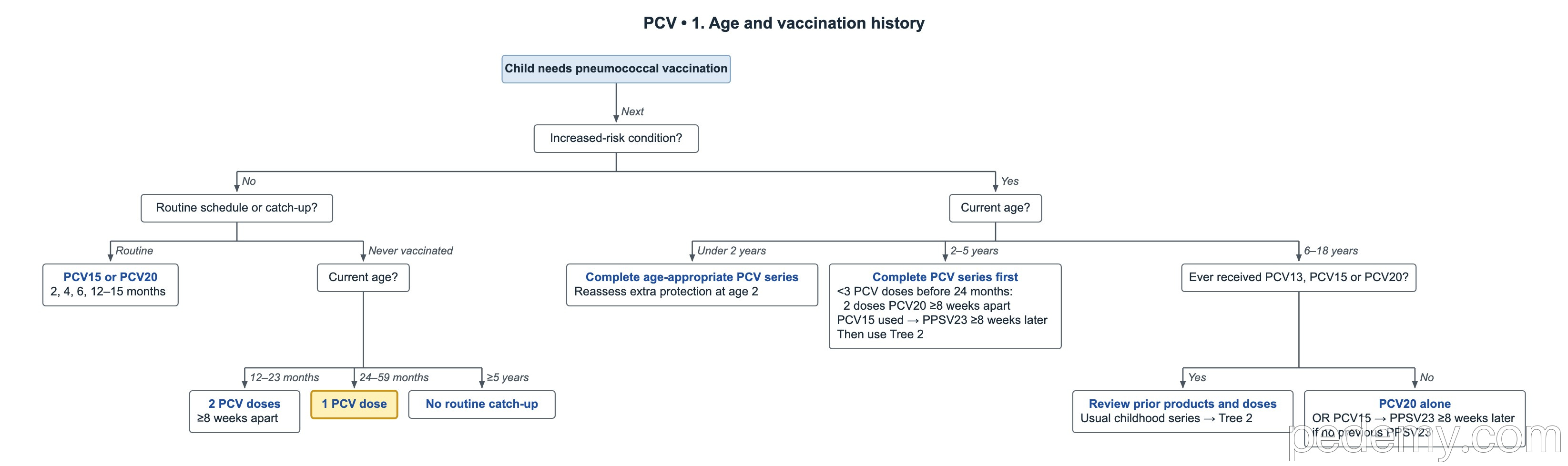
- A healthy child aged 24–59 months who is not complete needs only 1 more dose.
- Healthy children 5 years and older need no pneumococcal vaccine, even if they never had any.
- Children 2–18 years with a risk condition who never got PCV20 need 1 dose of PCV20 or PPSV23, at least 8 weeks after the last PCV.
- PPSV23 is never used before 2 years and is not needed after PCV20.
- Risk conditions include sickle cell disease, asplenia, HIV, immunosuppression, cochlear implant, CSF leak, diabetes and chronic heart, lung or kidney disease.
- Do not give after anaphylaxis to a previous dose or to any diphtheria-toxoid–containing vaccine.
More decision trees
From Pedemy's flashcards. Tap a tree to open it full size.
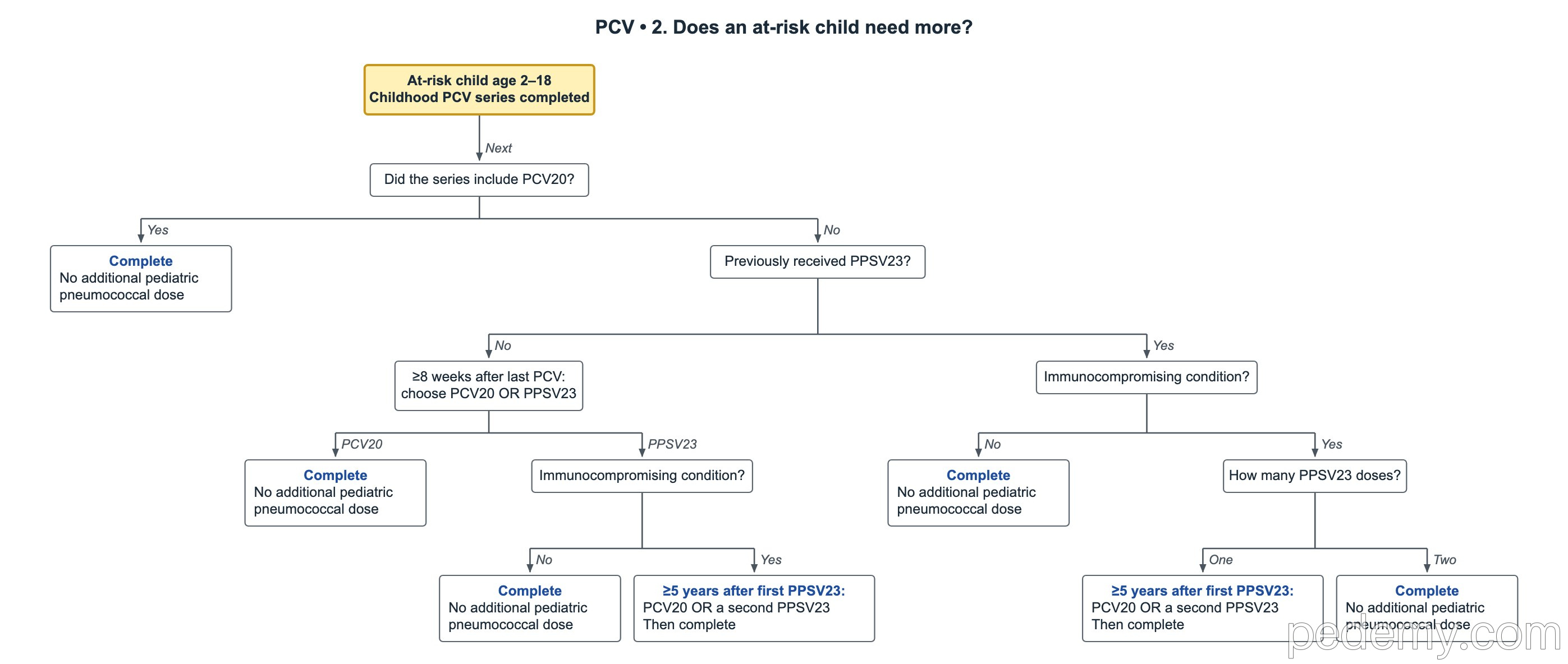
PCV • 2. Does an at-risk child need more?
Another version 1 · Another version 2 · Another version 3 · Another version 4 · Another version 5 · Another version 6
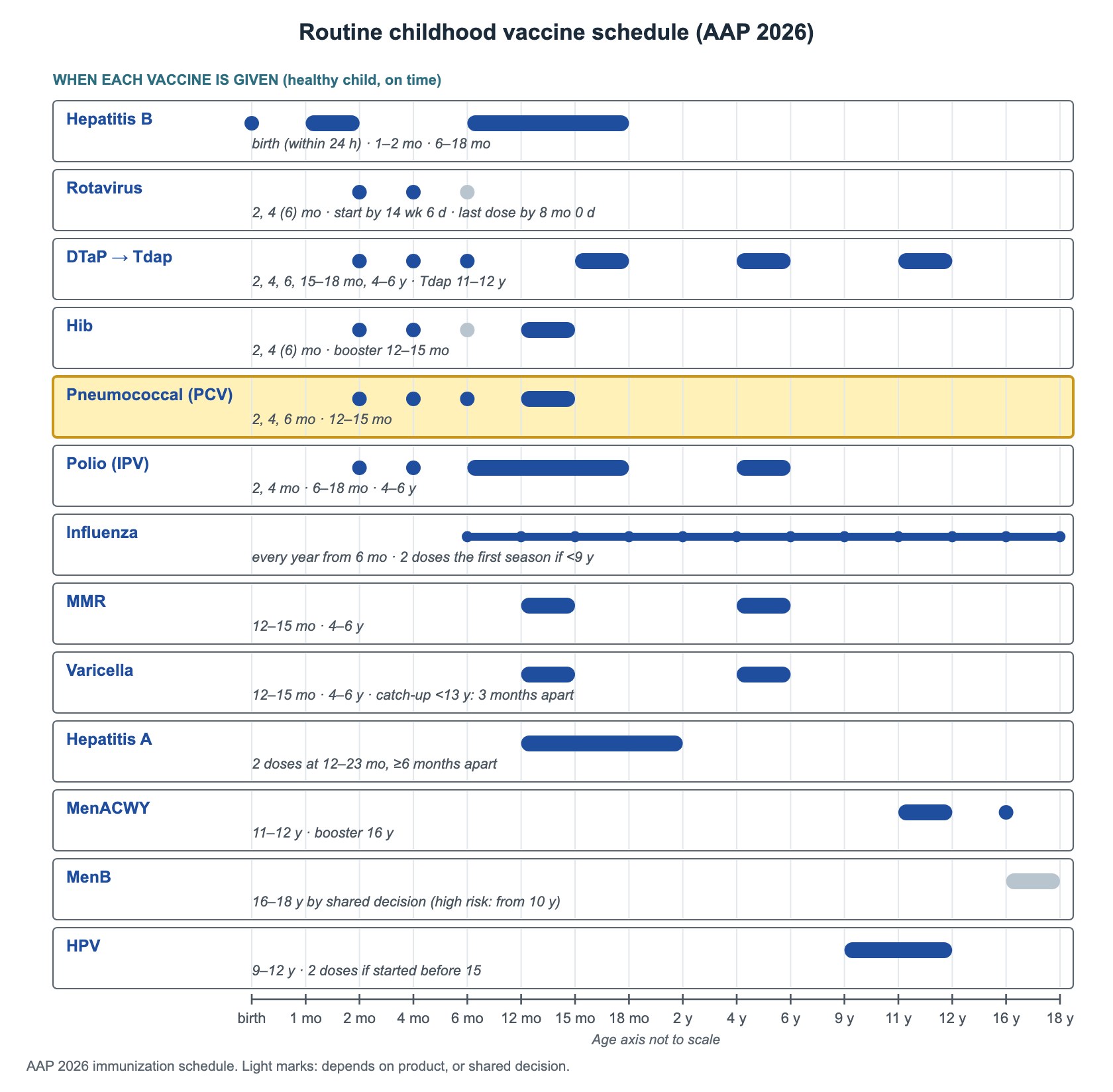
Routine childhood vaccine schedule (AAP 2026) — schedule graph
Vaccines for asplenia, complement deficiency, HIV and nephrotic syndrome
PCV15, PCV20 and PPSV23: which one?
| Vaccine | Used for | Notes |
|---|---|---|
| PCV15 (Vaxneuvance) | Routine infant series and catch-up | Conjugate vaccine; works from 6 weeks of age |
| PCV20 (Prevnar 20) | Routine infant series and catch-up | Conjugate vaccine; covers 5 more serotypes, so PPSV23 is not needed after it |
| PPSV23 (Pneumovax 23) | Only high-risk children 2 years and older who did not get PCV20 | Polysaccharide vaccine; weak in children under 2 years; always after PCV, never instead of it |
Routine schedule
- PCV15 or PCV20 at 2, 4, 6 and 12–15 months.
- The two products can be mixed; count every PCV dose given.
- Healthy children need no pneumococcal vaccine after 59 months.
- Children with a risk condition are reviewed at 2 years for extra doses.
Catch-up rules
- Minimum age is 6 weeks; doses before 12 months are at least 4 weeks apart.
- First dose at 7–11 months: 3 doses in total, the last at 12 months or older.
- First dose at 12–23 months: 2 doses, 8 weeks apart.
- Healthy child 24–59 months who is not complete: 1 dose, and done.
- A dose given at 24 months or older completes the series for a healthy child.
Children with a risk condition
- Under 2 years: give the routine series; no extra doses yet.
- 2–5 years: complete the series (2 doses if fewer than 3 given, 1 dose if 3 given), at least 8 weeks after the last dose.
- 2–18 years: if no dose was PCV20, give 1 dose of PCV20 or PPSV23 at least 8 weeks after the last PCV.
- 6–18 years with no PCV ever: 1 dose of PCV20, or PCV15 followed by PPSV23 8 weeks later.
- Immunocompromised children who got PPSV23 need one more dose of PCV20 or PPSV23 5 years later.
- Before a planned splenectomy, cochlear implant or immunosuppressive treatment, give due doses at least 2 weeks before.
Who should not get it, and side effects
- Do not give PCV after anaphylaxis to a previous PCV dose or to a diphtheria-toxoid–containing vaccine.
- Do not give PPSV23 after anaphylaxis to a previous PPSV23 dose or a component.
- A moderate or severe acute illness is a reason to delay; a mild cold is not.
- Common: pain and swelling at the site, fever, fussiness, sleepiness and poor appetite for a day or two.
Common questions
What is the difference between PCV20 and PPSV23?
PCV20 is a conjugate vaccine that works in babies and gives lasting protection against 20 serotypes. PPSV23 is a polysaccharide vaccine used only from 2 years in high-risk children who did not get PCV20.
Does a 3-year-old who missed pneumococcal shots need the whole series?
No. A healthy child aged 24–59 months who is not complete needs just 1 dose of PCV15 or PCV20.
Does a healthy 6-year-old need a pneumococcal vaccine?
No. Healthy children 5 years and older do not need PCV or PPSV23, even if they were never vaccinated.
Does a child with sickle cell disease need PPSV23?
Only if no PCV dose was PCV20. Then give 1 dose of PCV20 or PPSV23 from 2 years, at least 8 weeks after the last PCV; if PPSV23 is used, one more dose of PCV20 or PPSV23 follows 5 years later.
Can PCV15 and PCV20 be mixed in the same series?
Yes. A series can be completed with either product; count every PCV dose already given.
Sources
- CDC: Child and adolescent immunization schedule and catch-up guidance
- CDC: Child and adolescent schedule notes (pneumococcal vaccination)
- CDC: Pneumococcal vaccine recommendations
- AAP: Immunization schedule (aap.org)
Written for Pedemy in our own words from the sources above; checked October 2026. For education only, not medical advice. Pedemy is independent and not affiliated with or endorsed by the organizations cited.