

Medical Ethics flashcards
41 cards · 1 topic · 2% of the board exam
41 free Medical Ethics flashcards for pediatric board review and rotations, written in our own words with public guideline sources. Topics: Consent & Confidentiality. Medical Ethics is 2% of the board exam.
Sample Medical Ethics cards
-
Consent & Confidentiality
New foster child → may you get prior records and registry data without a signed authorization? […]
Show answer
New foster child → may you get prior records and registry data without a signed authorization? Yes (HIPAA treatment use)
Why: HIPAA needs no authorization for treatment, payment and operations, so earlier records, data-sharing systems and immunization registries can be used for direct care. A release is not needed before the entry visit. Hook: Treatment opens the file.
Source: HIPAA Privacy Rule, 45 CFR 164.502 and 164.512 (HHS Office for Civil Rights, text in force 2026). Rewritten for Pedemy in our own words, November 2026.
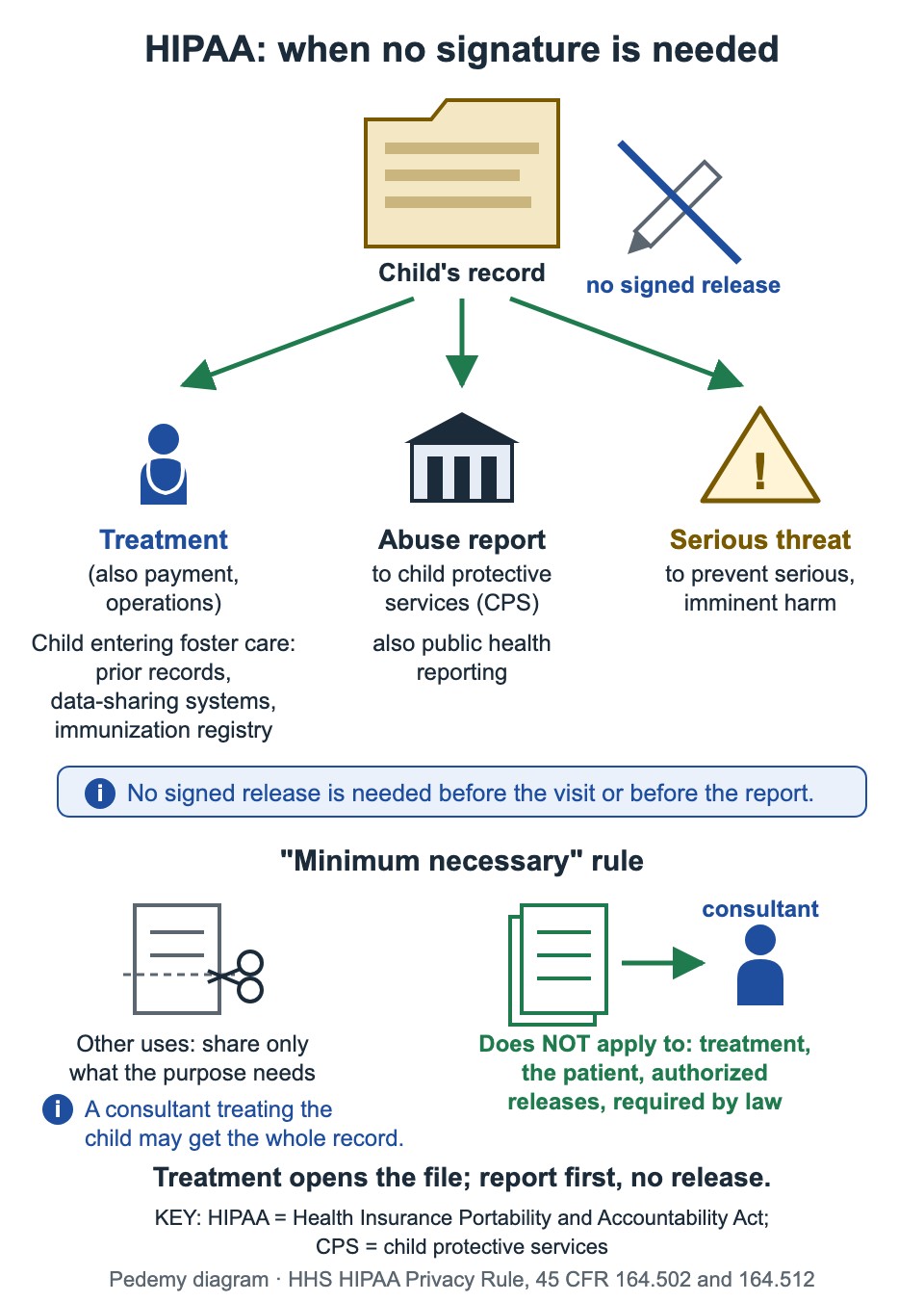
HIPAA: when no signature is needed -
Consent & Confidentiality
Teen asks you to keep everything secret → promise full confidentiality? […]
Show answer
Teen asks you to keep everything secret → promise full confidentiality? No; explain its limits first
Why: Confidentiality is kept whenever law allows, but breaks for serious risk of harm to self or others and for abuse that must be reported; say this at the start and share only what is needed. Absolute secrecy cannot be promised. Hook: Promise privacy, not secrecy.
Source: AAP policy statement: Confidentiality in the Care of Adolescents (Chung RJ, Lee JB, Hackell JM, Alderman EM; Pediatrics 2024). Rewritten for Pedemy in our own words, November 2026.
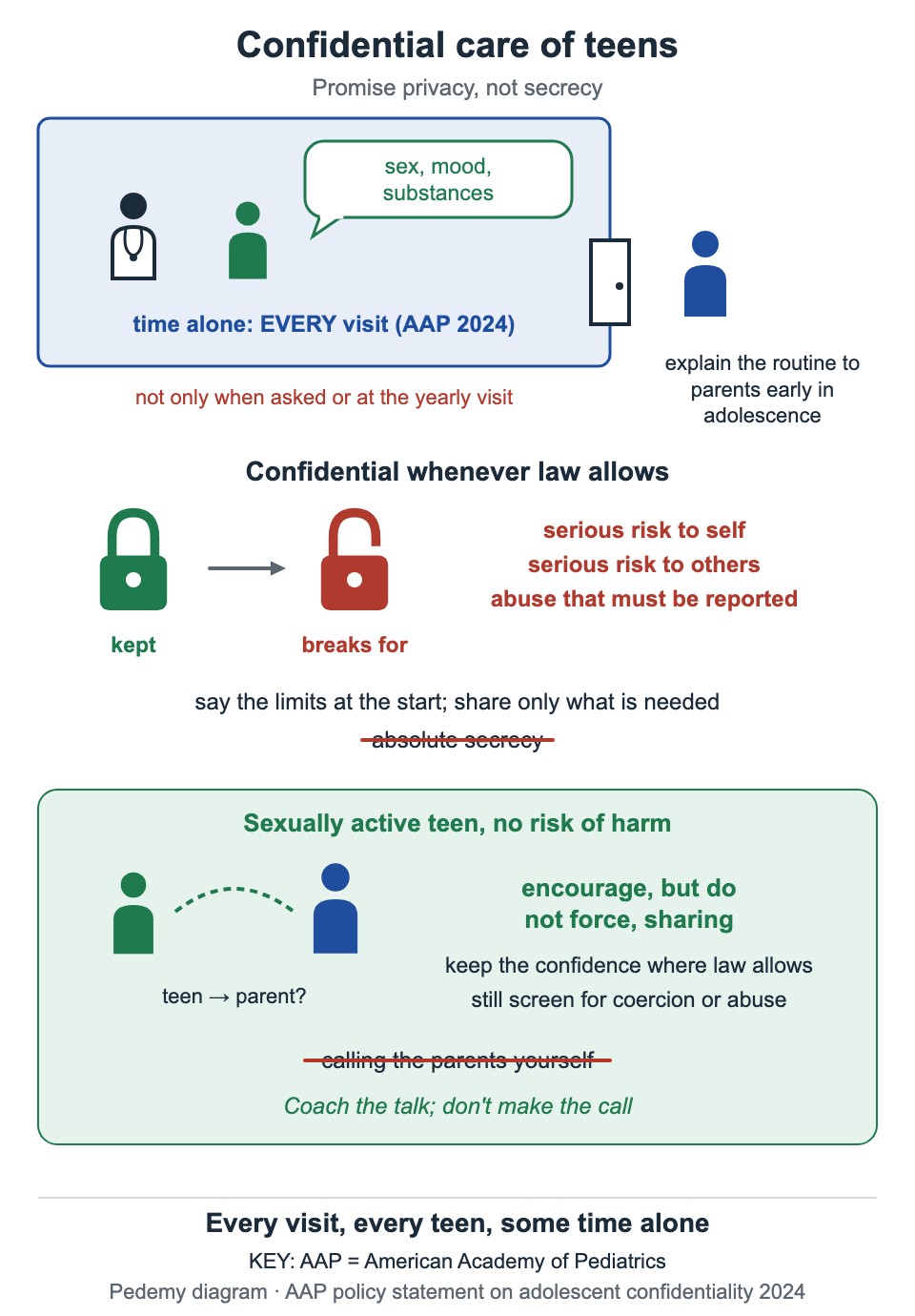
Confidential care of teens -
Consent & Confidentiality
Minor lawfully consents alone to a service such as STI care → who controls that part of the record? […]
Show answer
Minor lawfully consents alone to a service such as STI care → who controls that part of the record? The minor
Why: HIPAA also gives the minor control when a court consented or the parent agreed to confidentiality; whether parents may still be told follows state law. A parent's role as guardian does not give access to records of care the minor consented to alone. Hook: Who consents, controls.
Source: HIPAA Privacy Rule, 45 CFR 164.502 and 164.512 (HHS Office for Civil Rights, text in force 2026); AAP policy statement: Confidentiality in the Care of Adolescents (Chung RJ, Lee JB, Hackell JM, Alderman EM; Pediatrics 2024). Rewritten for Pedemy in our own words, November 2026.
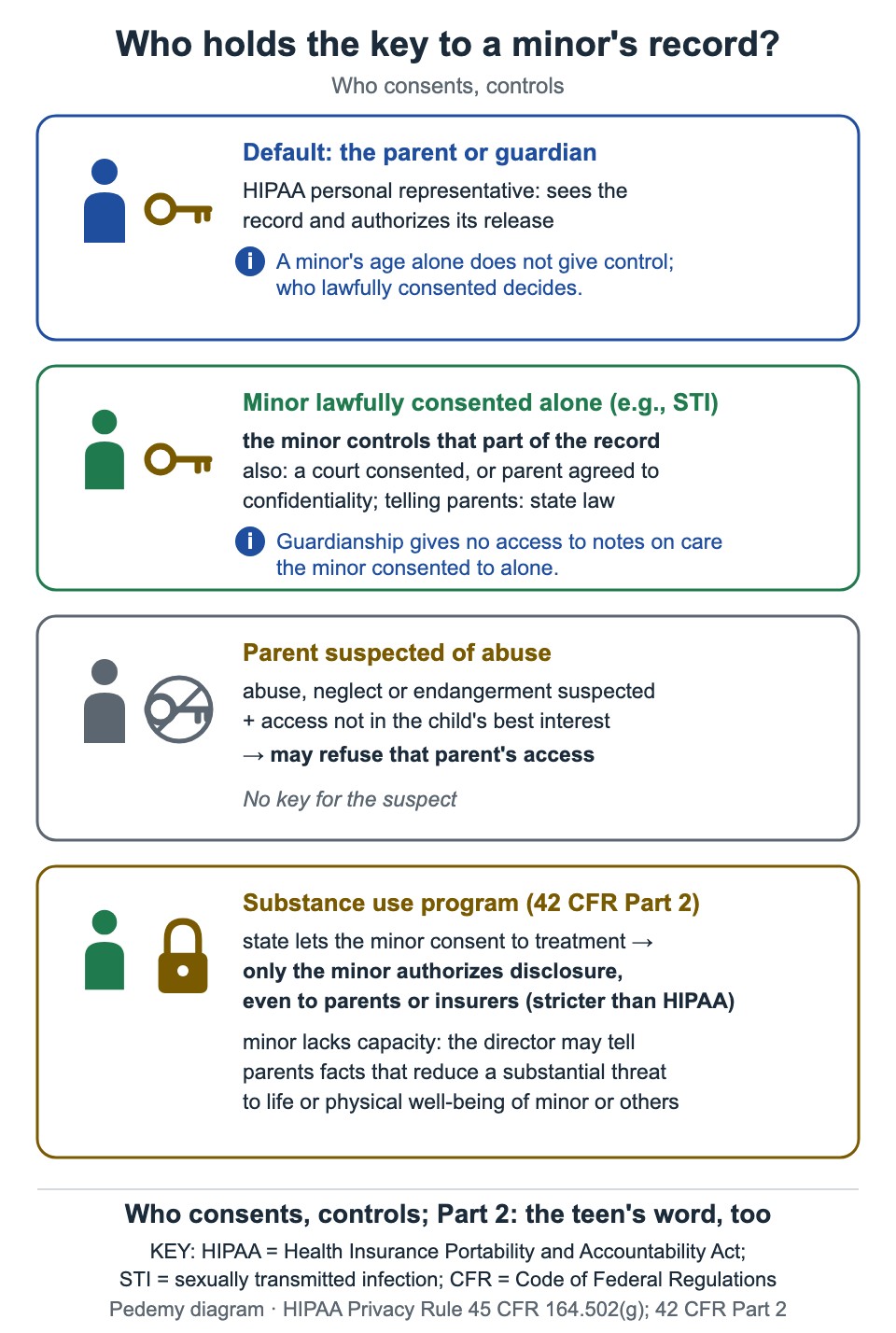
Who holds the key to a minor's record? -
Consent & Confidentiality
Parents refuse curative chemotherapy for leukemia and talks fail → route to treatment? […]
Show answer
Parents refuse curative chemotherapy for leukemia and talks fail → route to treatment? Report medical neglect to CPS (court order)
Why: When refusing effective care risks death or serious harm, the state may step in: report suspected medical neglect so child protective services or a court can authorize treatment. Missed care alone is not neglect: first remove barriers such as transport or health literacy. Discharging the family or only documenting the refusal leaves the child untreated. Hook: Neglect goes to CPS; the judge signs.
Source: AAP policy statement: Conflicts Between Religious or Spiritual Beliefs and Pediatric Care: Informed Refusal, Exemptions, and Public Funding (Committee on Bioethics, Pediatrics 2013); AAP clinical report: Recognizing and Responding to Medical Neglect (Rosado N et al., Pediatrics 2026). Rewritten for
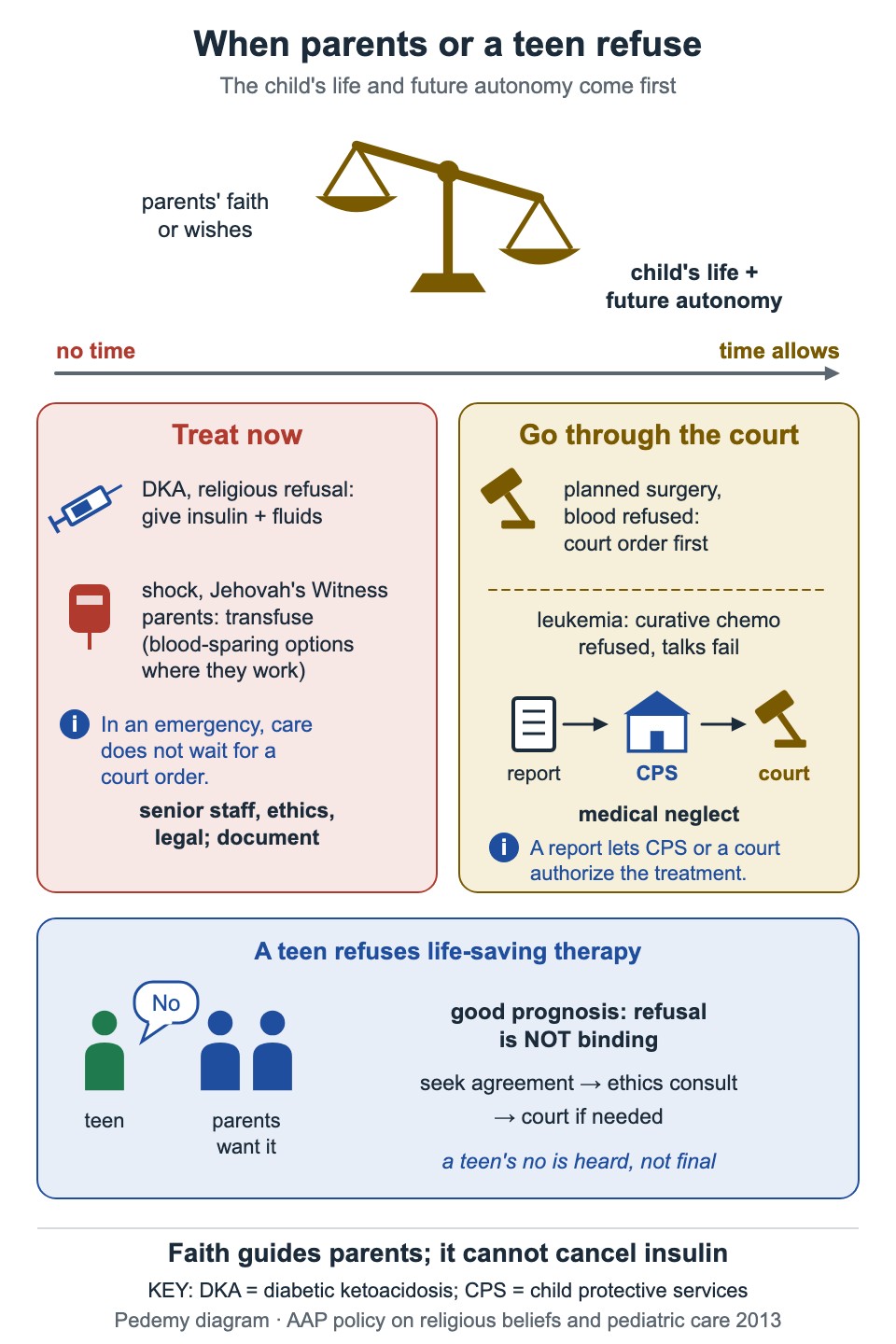
When parents or a teen refuse -
Consent & Confidentiality
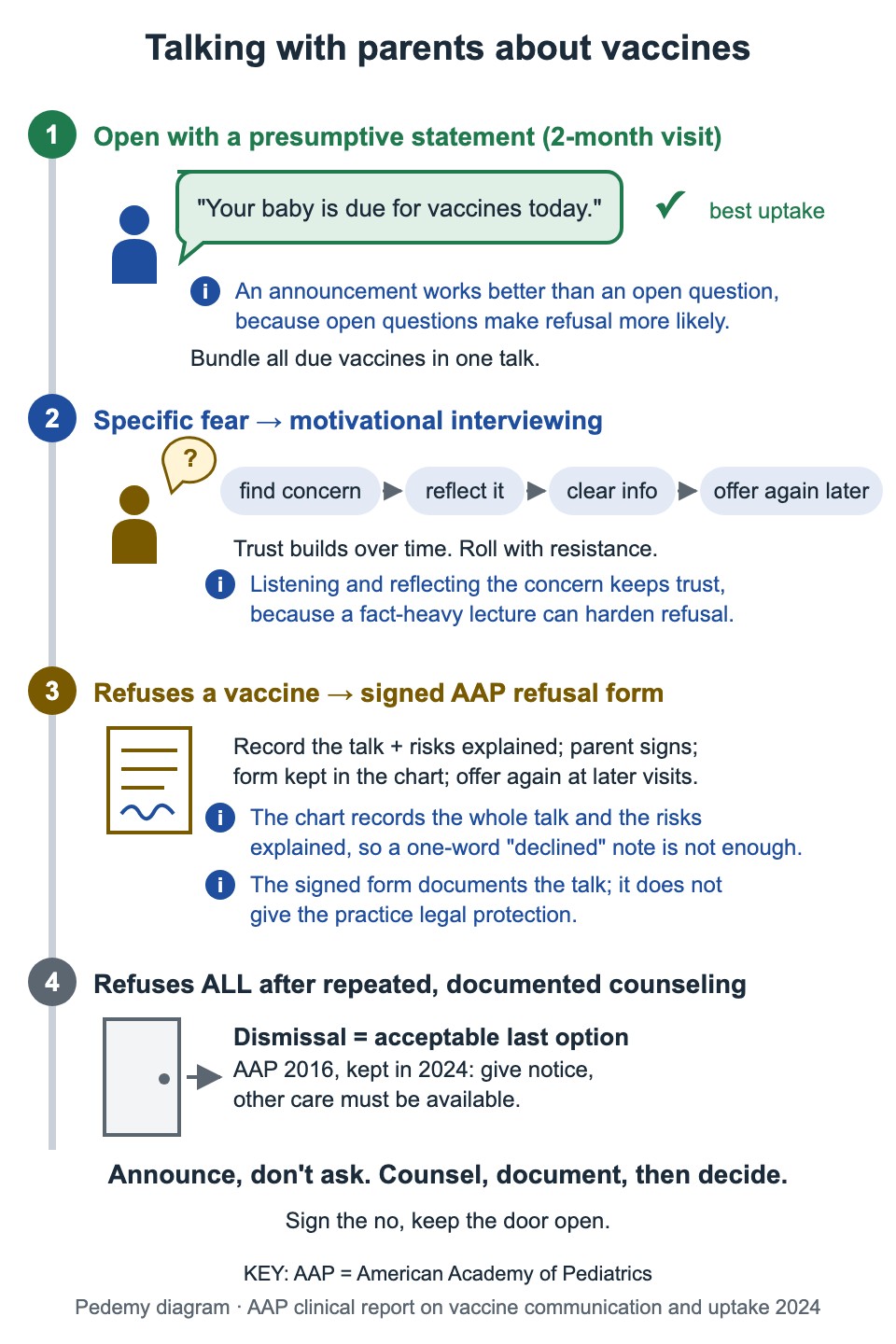
Parents refuse all vaccines despite repeated, documented counseling → dismissal allowed? […]
Show answer
Parents refuse all vaccines despite repeated, documented counseling → dismissal allowed? Yes, as an acceptable last option
Why: AAP (2016, kept in 2024): dismissal is acceptable only after repeated counseling fails, with notice and other care available. Before that: open presumptively, use motivational interviewing and record each refusal on a signed form. Hook: Counsel, document, then decide.
Source: AAP clinical report: Strategies for Improving Vaccine Communication and Uptake (O'Leary ST, Opel DJ, Cataldi JR et al.; Pediatrics 2024). Rewritten for Pedemy in our own words, November 2026.
Talking with parents about vaccines -
Consent & Confidentiality
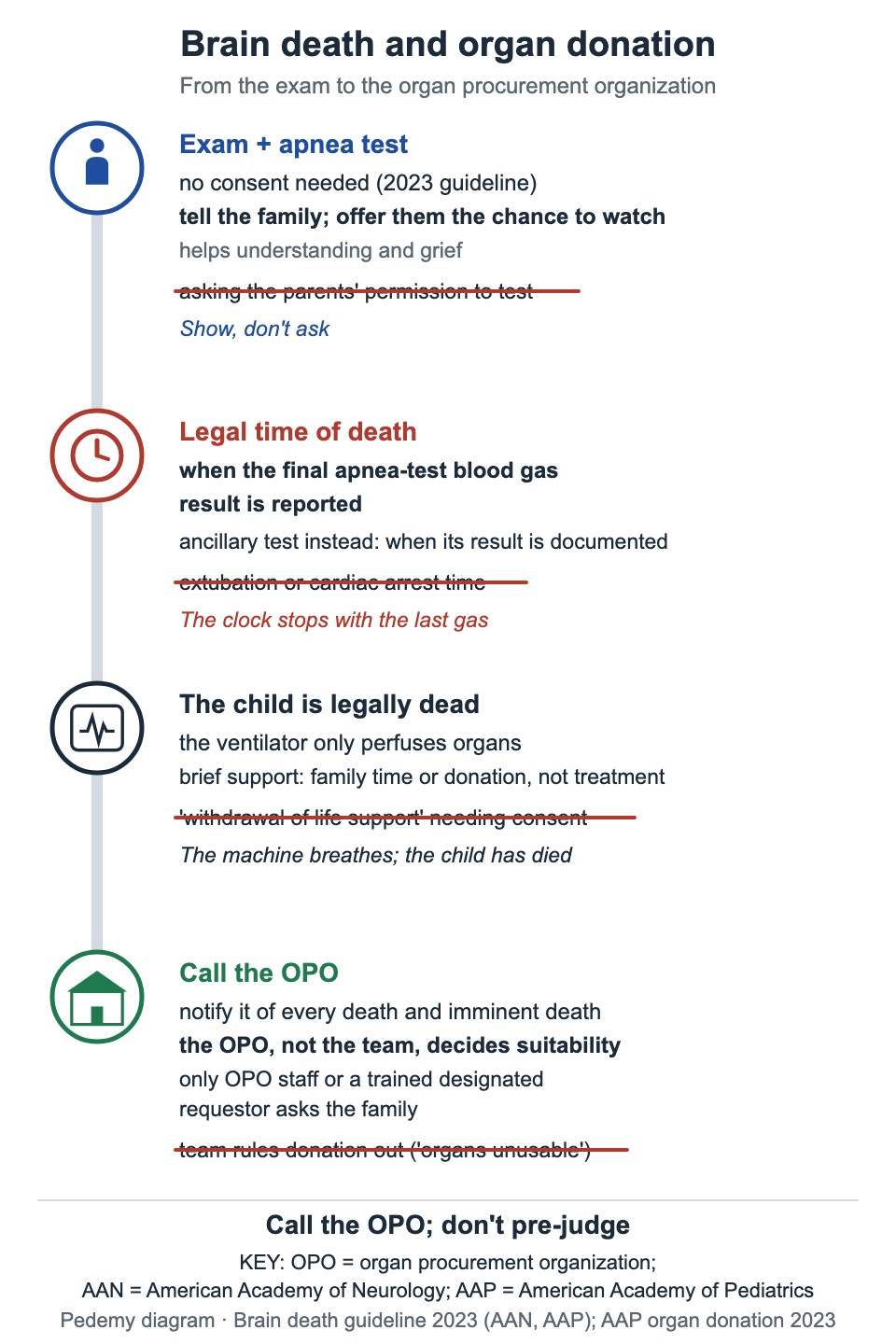
Child declared brain dead; parents ask if he is still alive on the ventilator → answer? […]
Show answer
Child declared brain dead; parents ask if he is still alive on the ventilator → answer? No; he is legally dead
Why: Death by neurologic criteria is death; the ventilator only perfuses organs, so support continues briefly for family time or donation, not as treatment. Legal time of death is when the final apnea-test blood gas is reported. Stopping the ventilator after this declaration is not withdrawal of life support and needs no consent for withdrawal. Hook: The machine breathes; the child has died.
Source: AAN/AAP/CNS/SCCM consensus guideline: Pediatric and Adult Brain Death/Death by Neurologic Criteria Determination (Greer DM et al., Neurology 2023). Rewritten for Pedemy in our own words, November 2026.
Brain death and organ donation -
Consent & Confidentiality
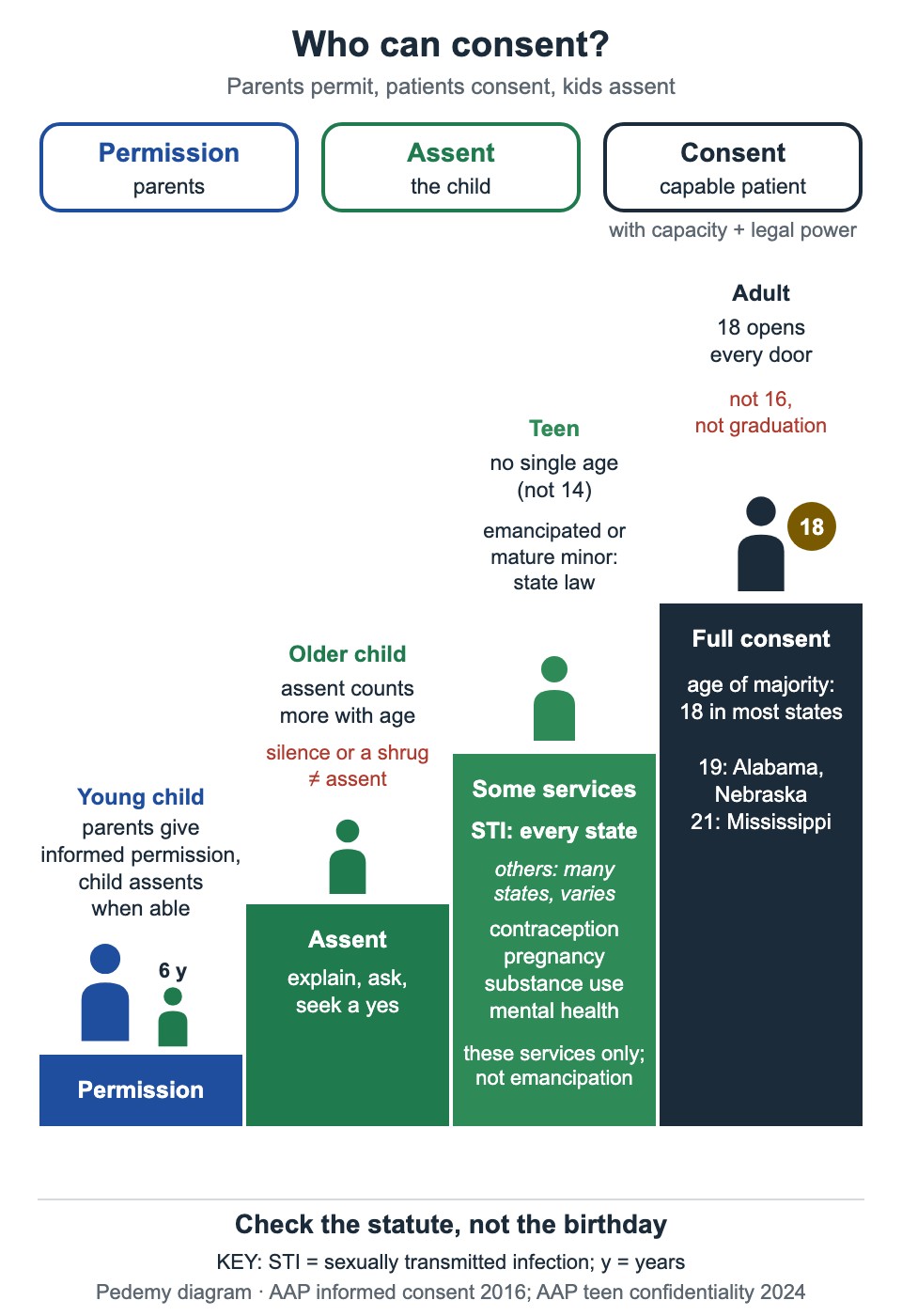
Minor-consent laws → services a teen can usually get alone? […]
Show answer
Minor-consent laws → services a teen can usually get alone? STI, contraception, pregnancy, substance use, mental health care
Why: Every state lets minors consent to STI testing and treatment; many also cover contraception, pregnancy care, substance use and outpatient mental health care, with ages and limits set by each state. These laws cover specific services and do not emancipate the teen for all care. Hook: the sensitive five.
Source: AAP policy statement: Confidentiality in the Care of Adolescents (Chung RJ, Lee JB, Hackell JM, Alderman EM; Pediatrics 2024); Guttmacher Institute: An Overview of Consent to Reproductive Health Services by Young People (2023). Rewritten for Pedemy in our own words, November 2026.
Who can consent? -
Consent & Confidentiality
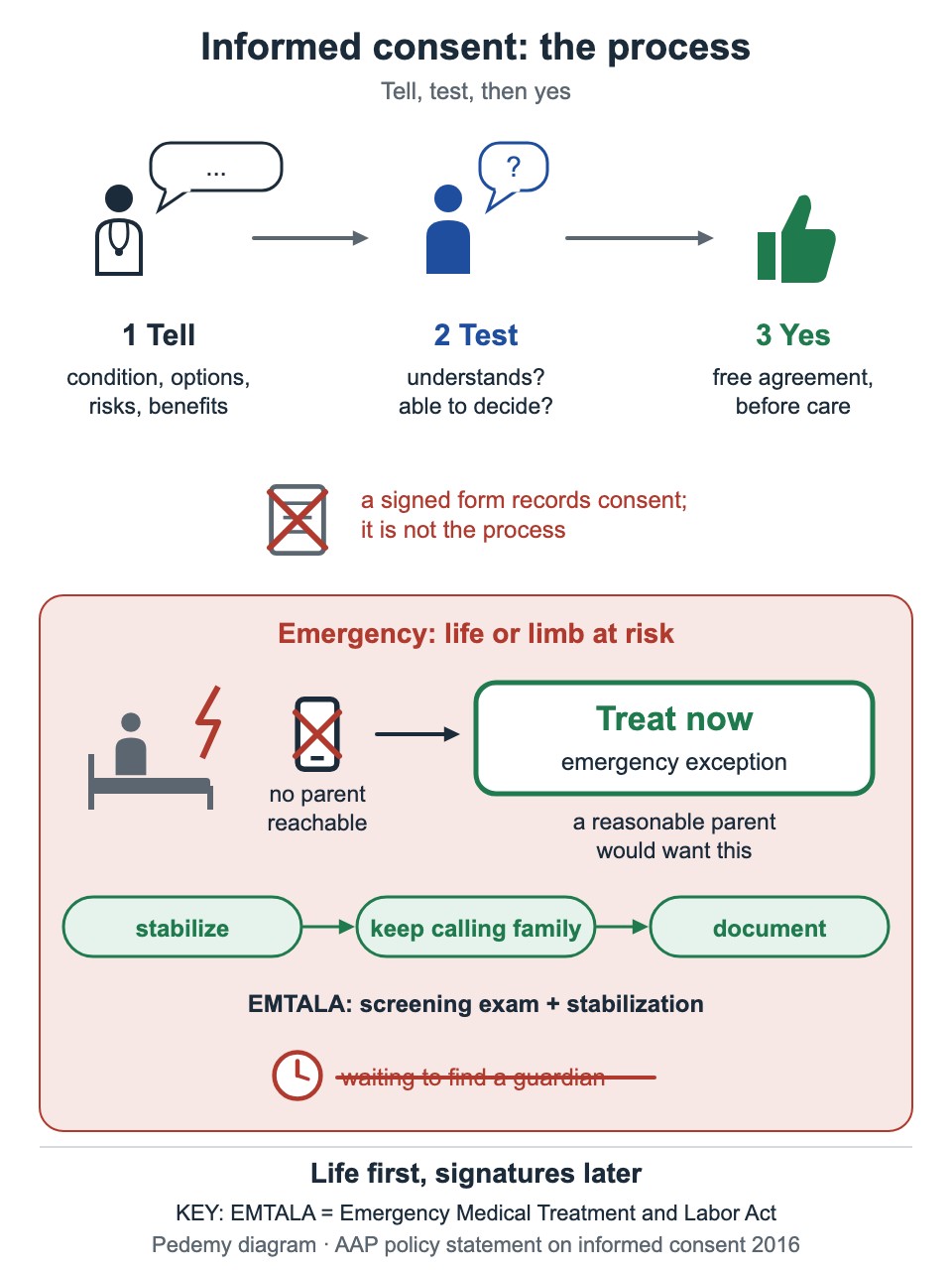
Life- or limb-threatening emergency, no parent reachable → wait for consent? […]
Show answer
Life- or limb-threatening emergency, no parent reachable → wait for consent? No; treat now (emergency exception)
Why: Treatment is presumed to be what a reasonable parent would want, so stabilize first, keep trying to reach the family and document; EMTALA also requires a screening exam and stabilization. Delaying care to find a guardian risks the child's life or limb. Hook: Life first, signatures later.
Source: AAP policy statement: Consent for Emergency Medical Services for Children and Adolescents (Committee on Pediatric Emergency Medicine, Committee on Bioethics; Pediatrics 2011); AAP policy statement and technical report: Informed Consent in Decision-Making in Pediatric Practice (Katz AL, Webb SA; Pedi
Informed consent: the process
Topics in Medical Ethics
Medical Ethics study guides
Sample cards in other subjects
- Growth & Development
- Immunizations & Post-exposure Prevention
- Nutrition
- Well-Child Care & Prevention
- Emergency Medicine
- Infectious Disease
- ENT
- Mental Health
- Ophthalmology
- Adolescent Medicine
- Cardiology
- Gastroenterology
- Pulmonology
- Dermatology
- Musculoskeletal & Sports Medicine
- Neonatology
- Neurology
- Allergy & Immunology
- Behavioral
- Endocrinology
- Hematology
- Nephrology
- Oncology
- Urology
- Biostatistics & Epidemiology
- Genetics
- Metabolic Disorders
- Patient Safety & Quality Improvement
- Rheumatology
- Pharmacology
Free to study without an account. Sign up free to save your spaced-repetition schedule across devices. For education only; check current guidelines before clinical use.