

Growth & Development flashcards
293 cards · 10 topics · 12% of the board exam, shared with Nutrition, Immunizations & Well-Child Care
293 free Growth & Development flashcards for pediatric board review and rotations, written in our own words with public guideline sources. Topics: Cognitive Milestones, Developmental Screening & Delay, Growth Faltering, Head Growth & Skull and 6 more. Growth & Development is 12% of the board exam, shared with Nutrition, Immunizations & Well-Child Care.
Sample Growth & Development cards
-
Cognitive Milestones
Counts to 10, names some letters and numbers 1–5, pays attention 5–10 minutes → CDC age? […]
Show answer
Counts to 10, names some letters and numbers 1–5, pays attention 5–10 minutes → CDC age? 5 years
Why: These are 5-year school-readiness skills. Time words (yesterday, tomorrow) also appear. Short attention at 3 years is normal, but at 5 years it deserves a closer look. Hook: 5 = count to 10.
Source: Reworded for focused recall. Reviewed 14 October 2026.www.cdc.gov
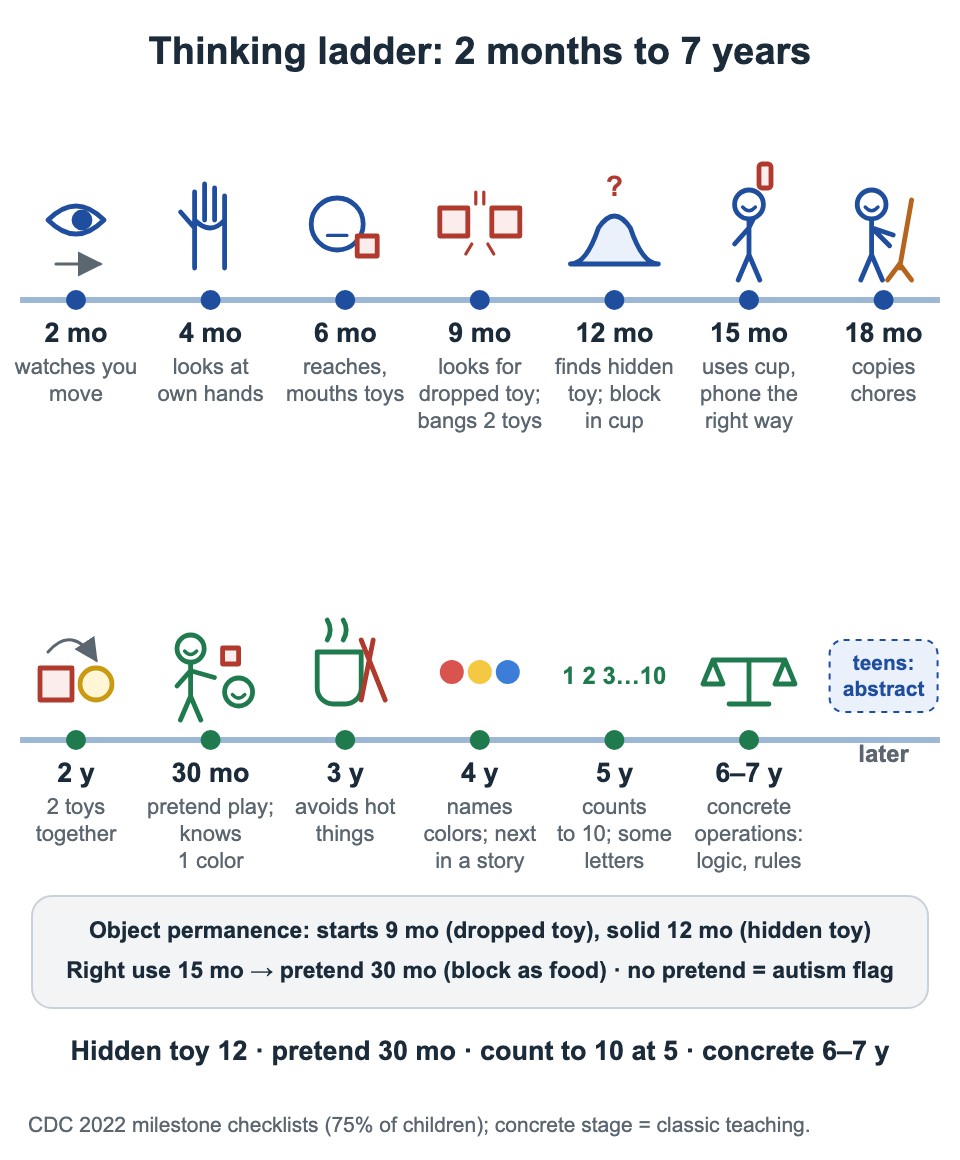
Thinking ladder — diagram -
Developmental Screening & Delay
Speech delay alone (good eye contact, points, plays) → enough to diagnose autism? […]
Show answer
Speech delay alone (good eye contact, points, plays) → enough to diagnose autism? No
Why: Autism needs social-communication deficits plus restricted or repetitive behavior. A late talker who points, shares and plays does not meet criteria. Hearing should still be tested and speech referral made. Hook: late talk ≠ autism.
Source: Hyman SL et al., AAP clinical report: Identification, Evaluation, and Management of Children With Autism Spectrum Disorder (Pediatrics 2020). Reviewed 14 October 2026.
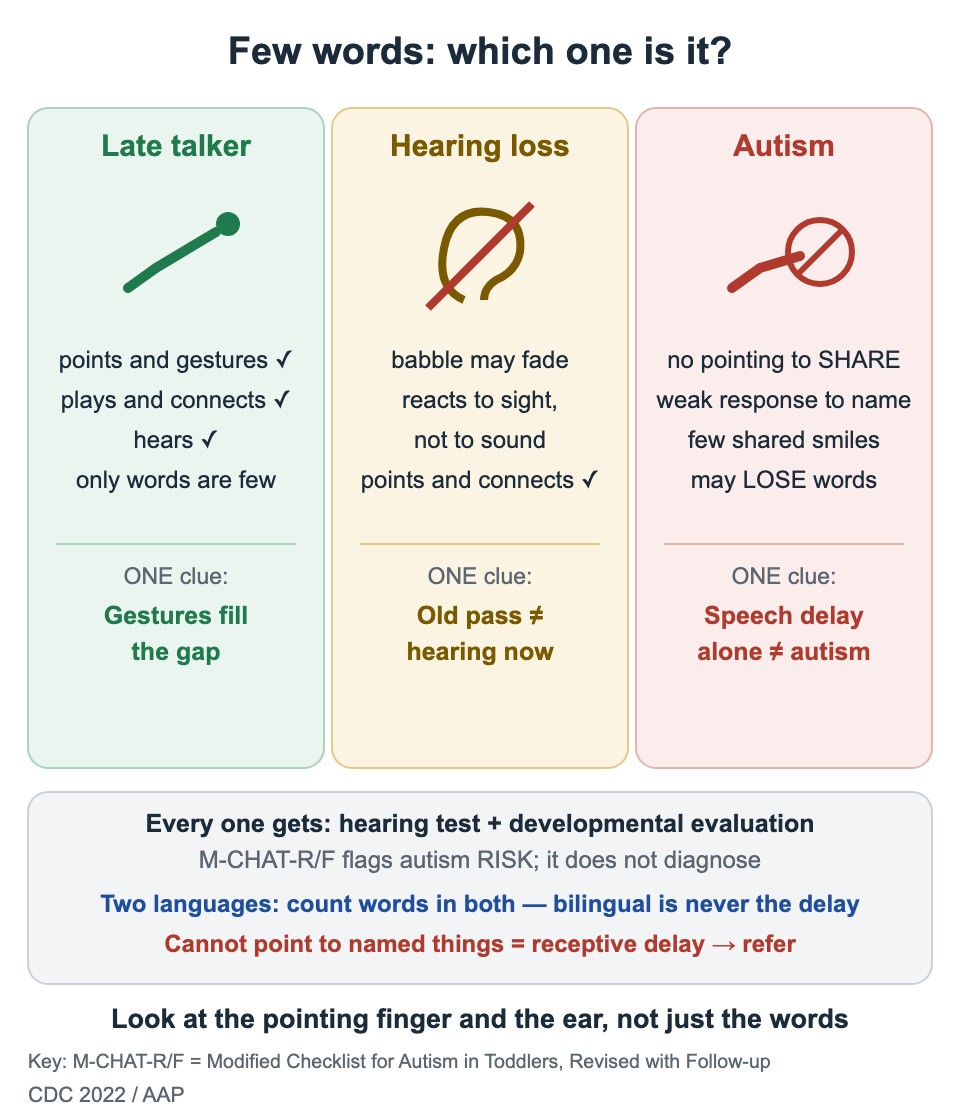
Late talker, hearing loss or autism — diagram -
Growth Faltering
Faltering weight definition, child under 2 years → weight-gain velocity cutoff? […]
Show answer
Faltering weight definition, child under 2 years → weight-gain velocity cutoff? Below −2 z scores for age
Why: Velocity is used only under 2 years, when growth is fast enough to measure a slow-down over weeks. The other two criteria are weight-for-length or BMI-for-age below -1.65 z and a fall of 1 or more z scores. The cutoffs differ: -2 z is for velocity, -1.65 z is for weight-for-length. Any one criterion qualifies; not all must be present. Hook: velocity -2 z, length -1.65 z.
Source: Reworded for focused recall. Reviewed 14 October 2026.publications.aap.orgwww.aap.org
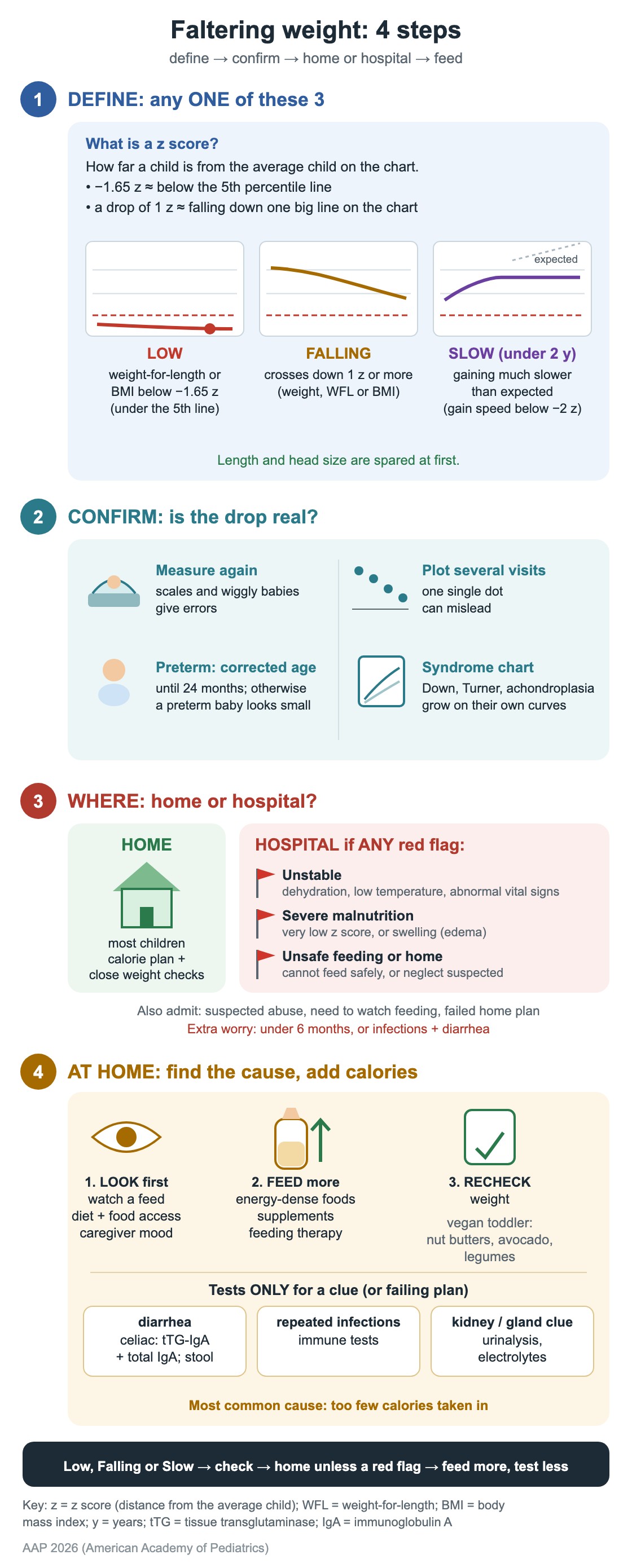
Faltering weight — diagram -
Head Growth & Skull
Premature suture fusion → how does skull growth change? […]
Show answer
Premature suture fusion → how does skull growth change? Growth perpendicular to the suture stops
Why: The skull then grows parallel to the fused suture to make room for the brain (Virchow's law). A fused sagittal suture gives a long, narrow head; fused coronal sutures give a short, wide head. The skull does not stop growing in all directions. Hook: growth stops across the suture.
Source: Reworded for focused recall. Reviewed 14 October 2026.publications.aap.org
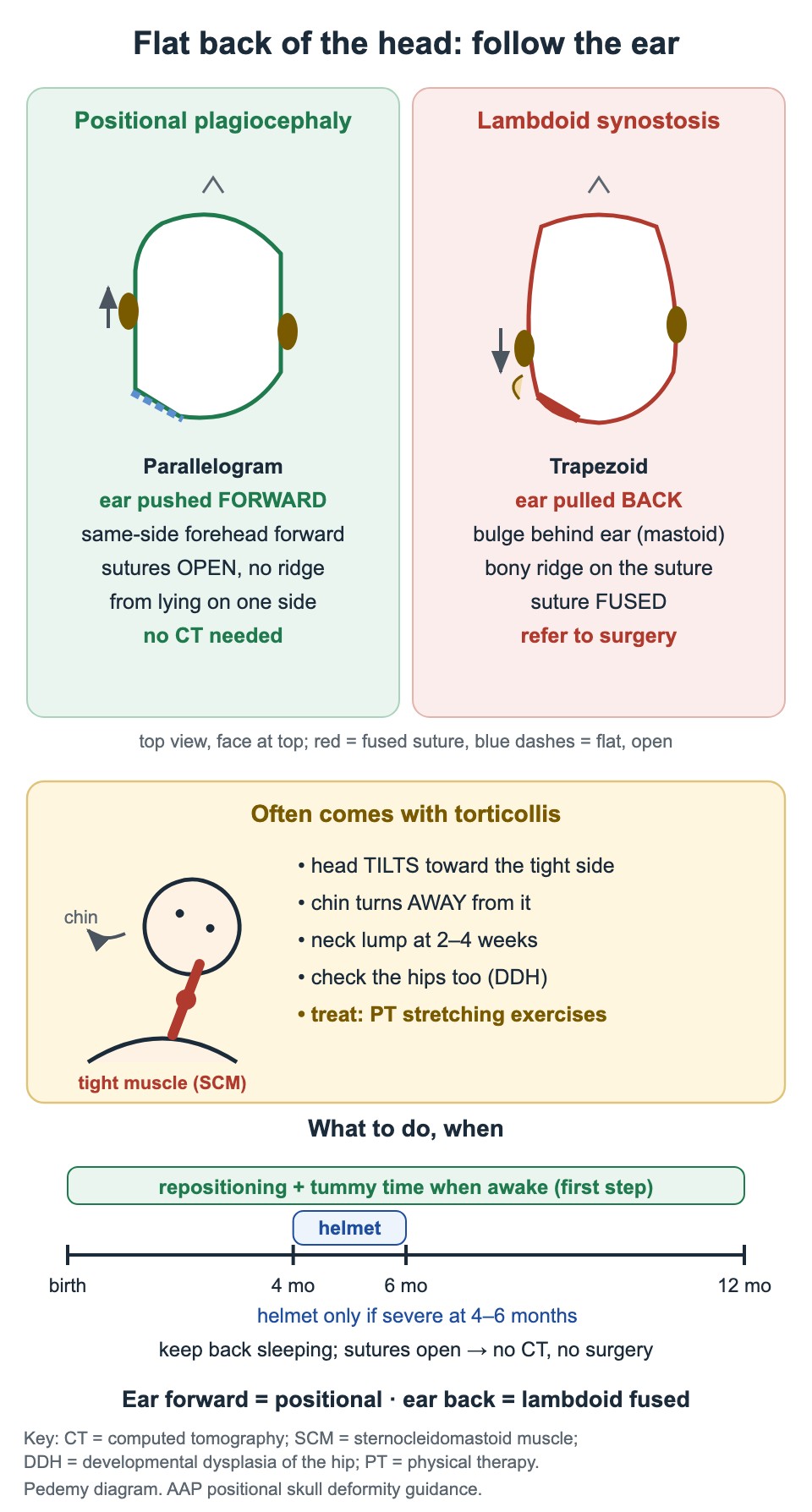
Flat back of the head: follow the ear — diagram -
Language & Social Milestones
Takes turns making sounds with you, blows raspberries, squeals → CDC age? […]
Show answer
Takes turns making sounds with you, blows raspberries, squeals → CDC age? 6 months
Why: Taking turns making sounds, blowing raspberries and squealing are 6-month sound skills, and turn-taking is the first step of conversation. A full laugh is also a 6-month skill, but chuckling is 4 months. Hook: 6 = raspberries.
Source: Reworded for focused recall. Reviewed 14 October 2026.www.cdc.gov
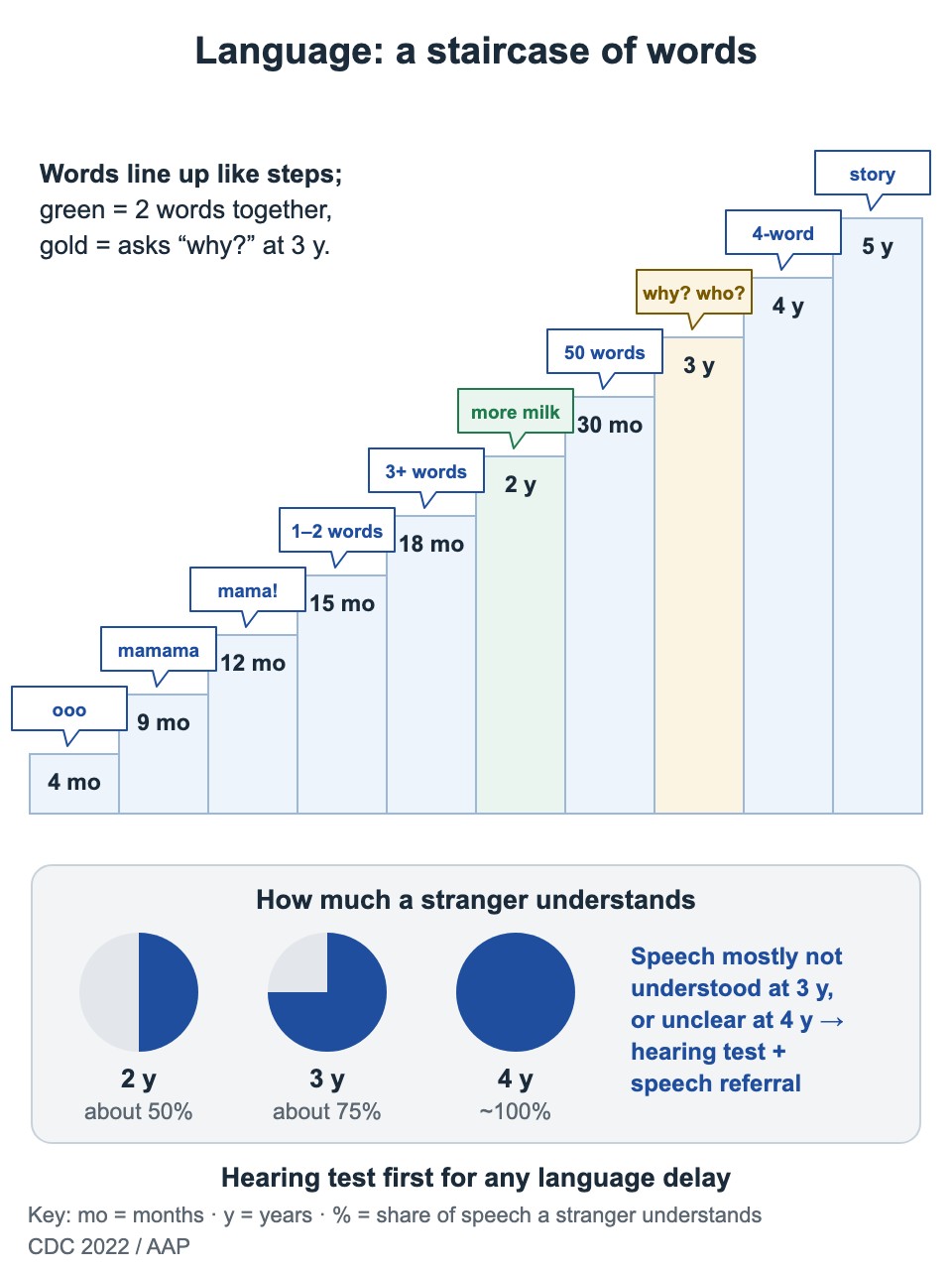
Language milestones — diagram -
Motor Skills & Reflexes
Lying on the tummy, lifts the head up → CDC age? […]
Show answer
Lying on the tummy, lifts the head up → CDC age? 2 months
Why: Lifting the head on the tummy is the first motor checkpoint, because head control comes before everything else (head-to-toe order). A steady head while held upright is the 4-month skill. Hook: 2 = up on the tummy.
Source: Reworded for focused recall. Reviewed 14 October 2026.www.cdc.govwww.cdc.govwww.cdc.govwww.cdc.govwww.cdc.govwww.cdc.govwww.cdc.govwww.cdc.govwww.cdc.govwww.cdc.gov
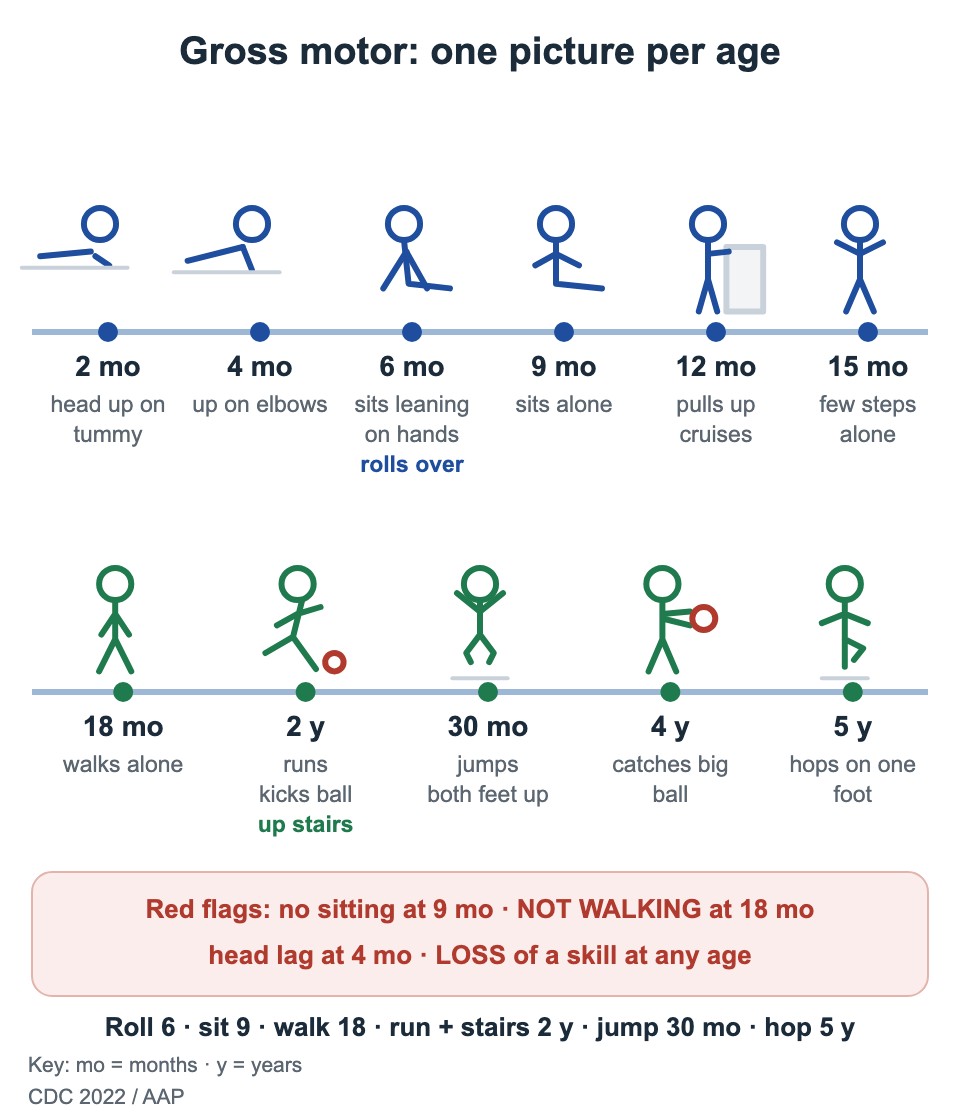
Gross motor milestones — diagram -
Physical Growth
US growth charts recommended before age 2 years? […]
Show answer
US growth charts recommended before age 2 years? WHO growth standards
Why: CDC recommends the WHO growth charts for children under 2. They show how healthy breastfed infants grow in good conditions (a standard), while the CDC charts describe a mostly formula-fed US sample (a reference). On WHO charts the cut-offs are the 2.3rd and 97.7th percentiles (±2 SD). A breastfed infant plotted on the CDC chart can look falsely like slow weight gain after 3 months. Hook: under 2 = WHO.
Source: CDC: Use of World Health Organization and CDC growth charts for children aged 0-59 months in the United States (MMWR 2010). Rewritten for Pedemy in our own words, November 2026.
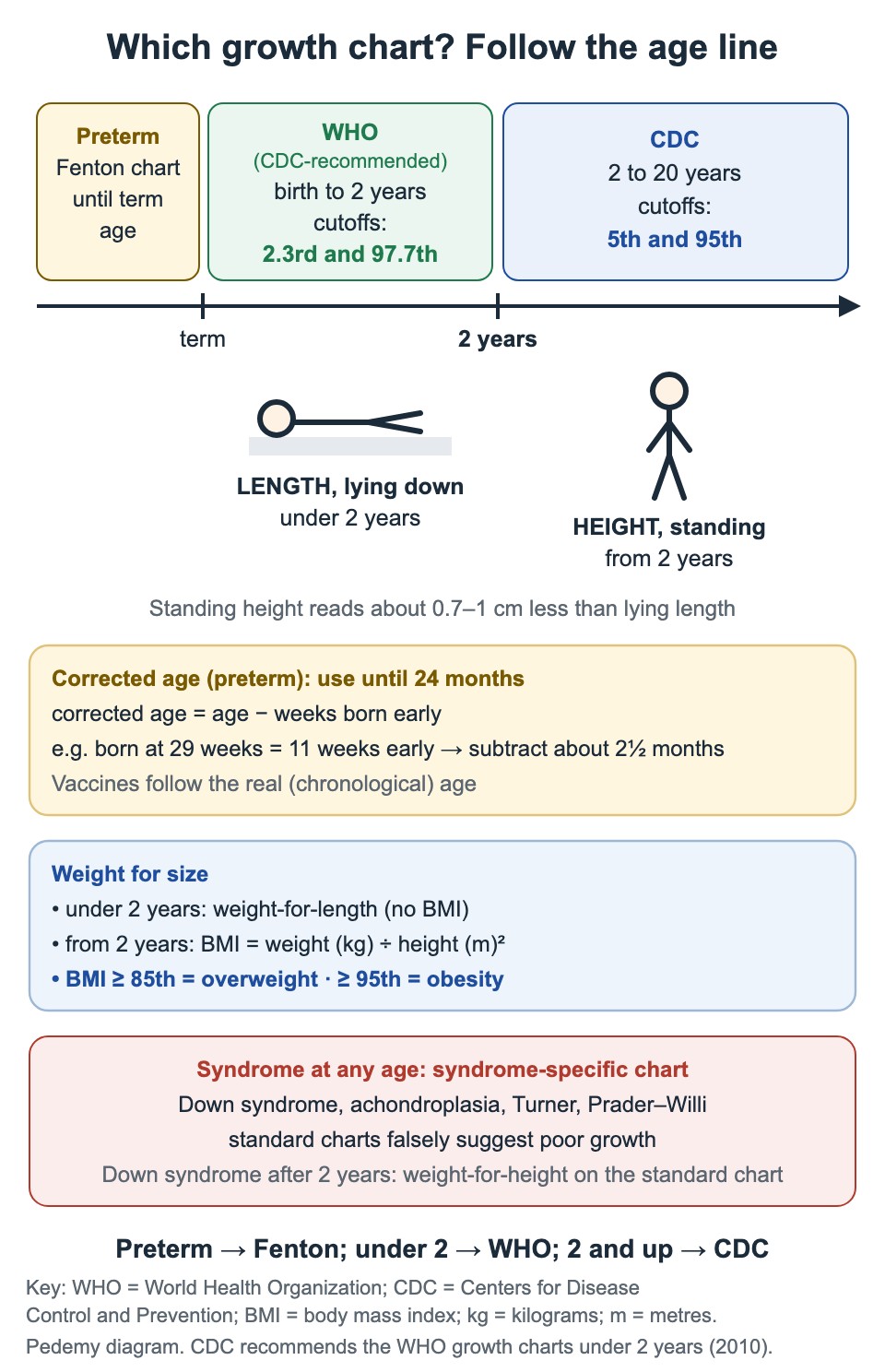
Which growth chart, and corrected age — diagram -
School Support & Learning
IEP eligibility under IDEA → which two conditions? […]
Show answer
IEP eligibility under IDEA → which two conditions? Qualifying disability + need for special instruction
Why: First, the child must fit one of the 13 IDEA categories (for example autism, specific learning disability, other health impairment). Second, the disability must hurt school performance so that specially designed instruction is needed. A disability without that need gets a 504 plan.
Source: Reworded for focused recall. Reviewed 14 October 2026.sites.ed.gov
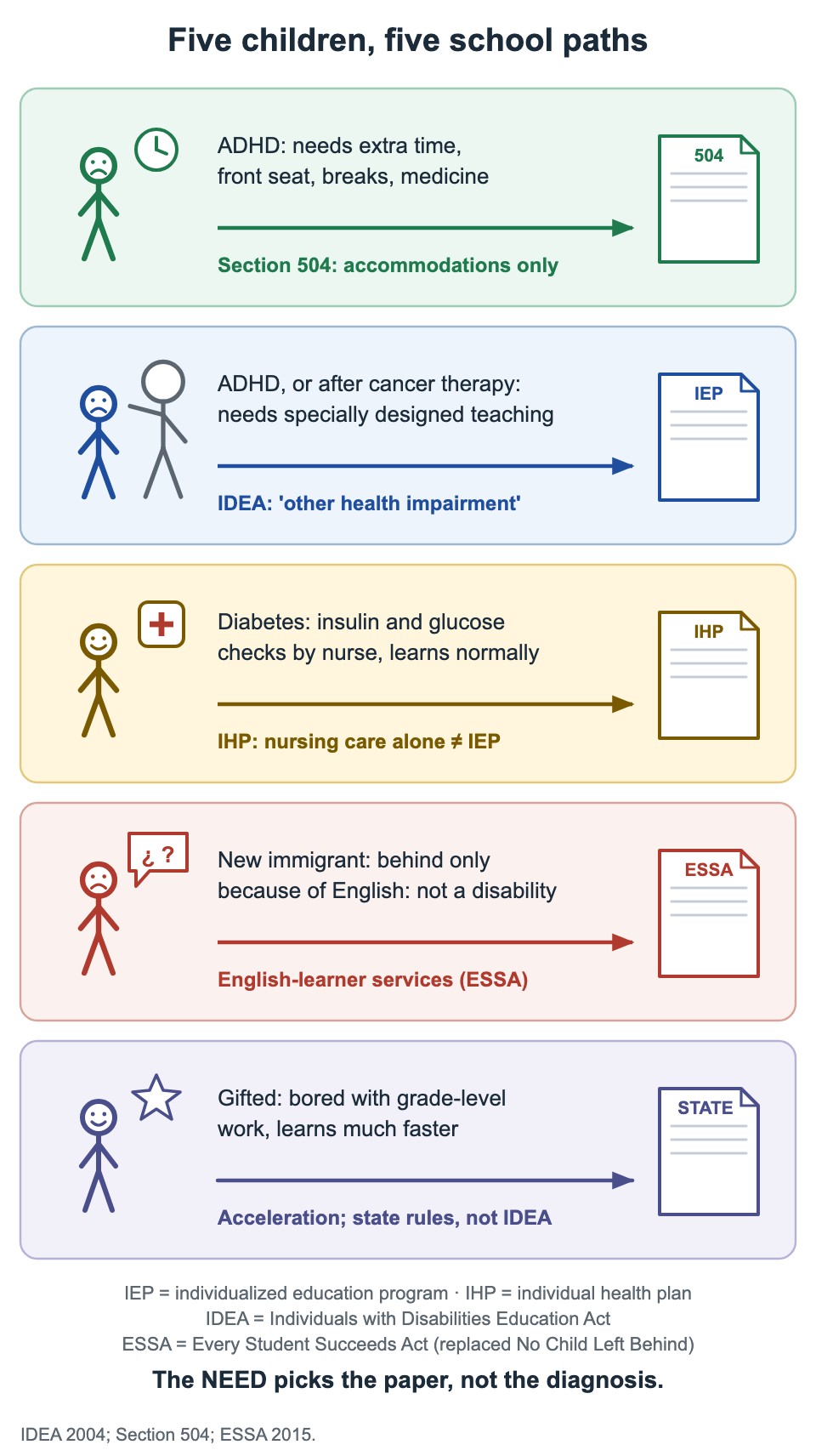
Four children, four school papers — diagram
Topics in Growth & Development
- Cognitive Milestones13
- Developmental Screening & Delay41
- Growth Faltering21
- Head Growth & Skull34
- Language & Social Milestones31
- Milestone Cases14
- Motor Skills & Reflexes37
- Physical Growth21
- School Support & Learning24
- Toilet Training & Elimination13
Growth & Development study guides
- Cognitive milestones
- Developmental screening and delay
- Faltering weight (failure to thrive)
- Head growth and skull shape
- Language and social milestones
- Milestone cases: find the delayed domain
- Motor milestones and primitive reflexes
- Physical growth in children
- School support and learning plans
- Toilet training and toilet refusal
Clinical tools for Growth & Development
Sample cards in other subjects
- Immunizations & Post-exposure Prevention
- Nutrition
- Well-Child Care & Prevention
- Emergency Medicine
- Infectious Disease
- ENT
- Mental Health
- Ophthalmology
- Adolescent Medicine
- Cardiology
- Gastroenterology
- Pulmonology
- Dermatology
- Musculoskeletal & Sports Medicine
- Neonatology
- Neurology
- Allergy & Immunology
- Behavioral
- Endocrinology
- Hematology
- Nephrology
- Oncology
- Urology
- Biostatistics & Epidemiology
- Genetics
- Medical Ethics
- Metabolic Disorders
- Patient Safety & Quality Improvement
- Rheumatology
- Pharmacology
Free to study without an account. Sign up free to save your spaced-repetition schedule across devices. For education only; check current guidelines before clinical use.