

Behavioral flashcards
91 cards · 3 topics · 3% of the board exam (psychosocial)
91 free Behavioral flashcards for pediatric board review and rotations, written in our own words with public guideline sources. Topics: Family,School & Media, Parenting,Discipline & Toddler Behavior, Sleep. Behavioral is 3% of the board exam (psychosocial).
Sample Behavioral cards
-
Family,School & Media
Teen with new type 1 diabetes; parents want her home from school and sports → advice? […]
Show answer
Teen with new type 1 diabetes; parents want her home from school and sports → advice? Keep school and sports, with a 504 plan
Why: School, friends and sports protect mood and development; a 504 plan gives glucose checks, snacks and nurse access (an IEP only if she needs special teaching). Keep the same rules and screen yearly for mental-health problems. Extra leniency or limiting activities does not help adjustment. Hook: Diagnosis changes the plan, not the rules.
Source: AAP Bright Futures Guidelines, 4th ed. (Children and Youth With Special Health Care Needs); US Department of Education: Section 504 of the Rehabilitation Act. Rewritten for Pedemy in our own words, November 2026.
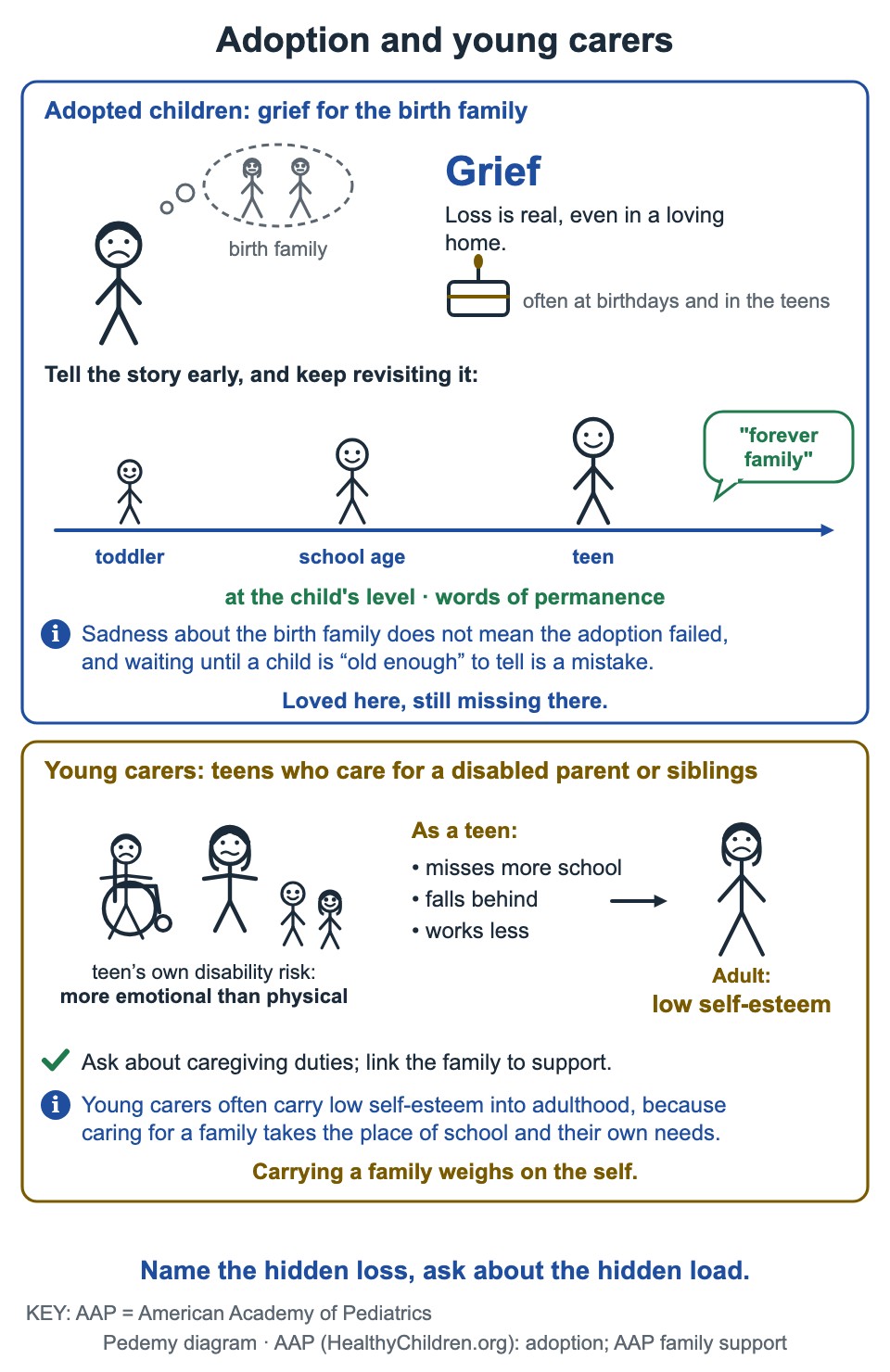
Adoption and young carers -
Parenting,Discipline & Toddler Behavior
“Breath-holding” spell with no trigger, in sleep or exercise, or family sudden death → first test? […]
Show answer
“Breath-holding” spell with no trigger, in sleep or exercise, or family sudden death → first test? ECG for long QT syndrome
Why: Typical spells always follow a trigger. No trigger, duration over 1 minute, occurrence during sleep or exercise, or a family history of sudden death or fainting suggests an arrhythmia or seizure, so check an ECG for long QT syndrome. Long stiffening or confusion afterward calls for an EEG. Reassurance alone is unsafe in these cases. Hook: No trigger? Check the ticker.
Source: StatPearls (NCBI Bookshelf): Breath-Holding Spells (2023). Rewritten for Pedemy in our own words, November 2026.
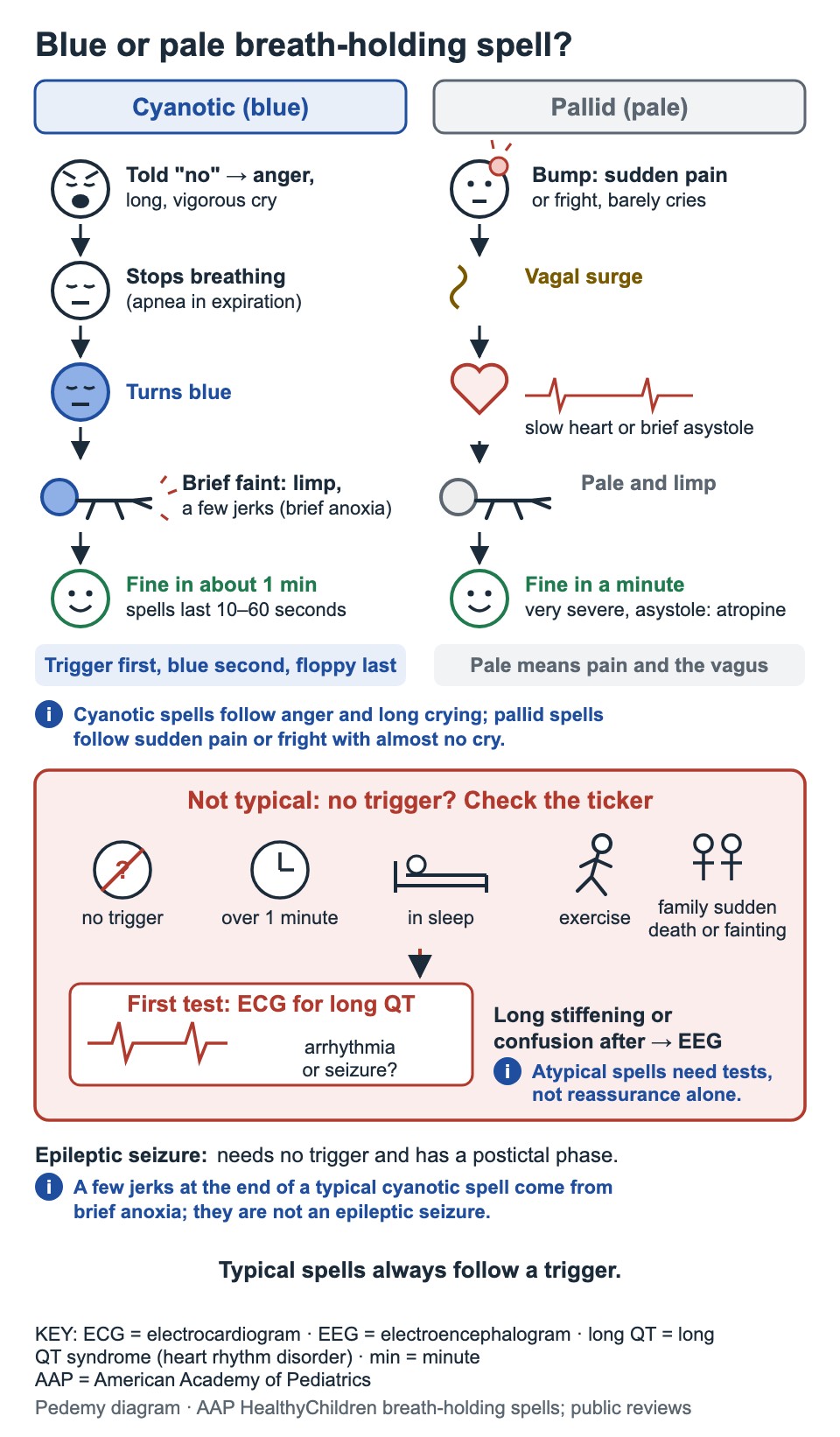
Blue or pale breath-holding spell? -
Sleep
Recommended sleep per 24 hours for a 13–18-year-old → […]
Show answer
Recommended sleep per 24 hours for a 13–18-year-old → 8–10 hours
Why: AASM 2016 (AAP endorsed): 4–12 months 12–16 h, 1–2 years 11–14 h, 3–5 years 10–13 h (naps count), 6–12 years 9–12 h. Short sleep is linked to poor attention, injuries, obesity, depression and self-harm thoughts. The 9–12 hour range belongs to school-age children, not teens. Hook: Teens eight-to-ten.
Source: AASM Consensus Statement: Recommended Amount of Sleep for Pediatric Populations (Paruthi et al., J Clin Sleep Med 2016;12(6):785–786). Rewritten for Pedemy in our own words, November 2026.
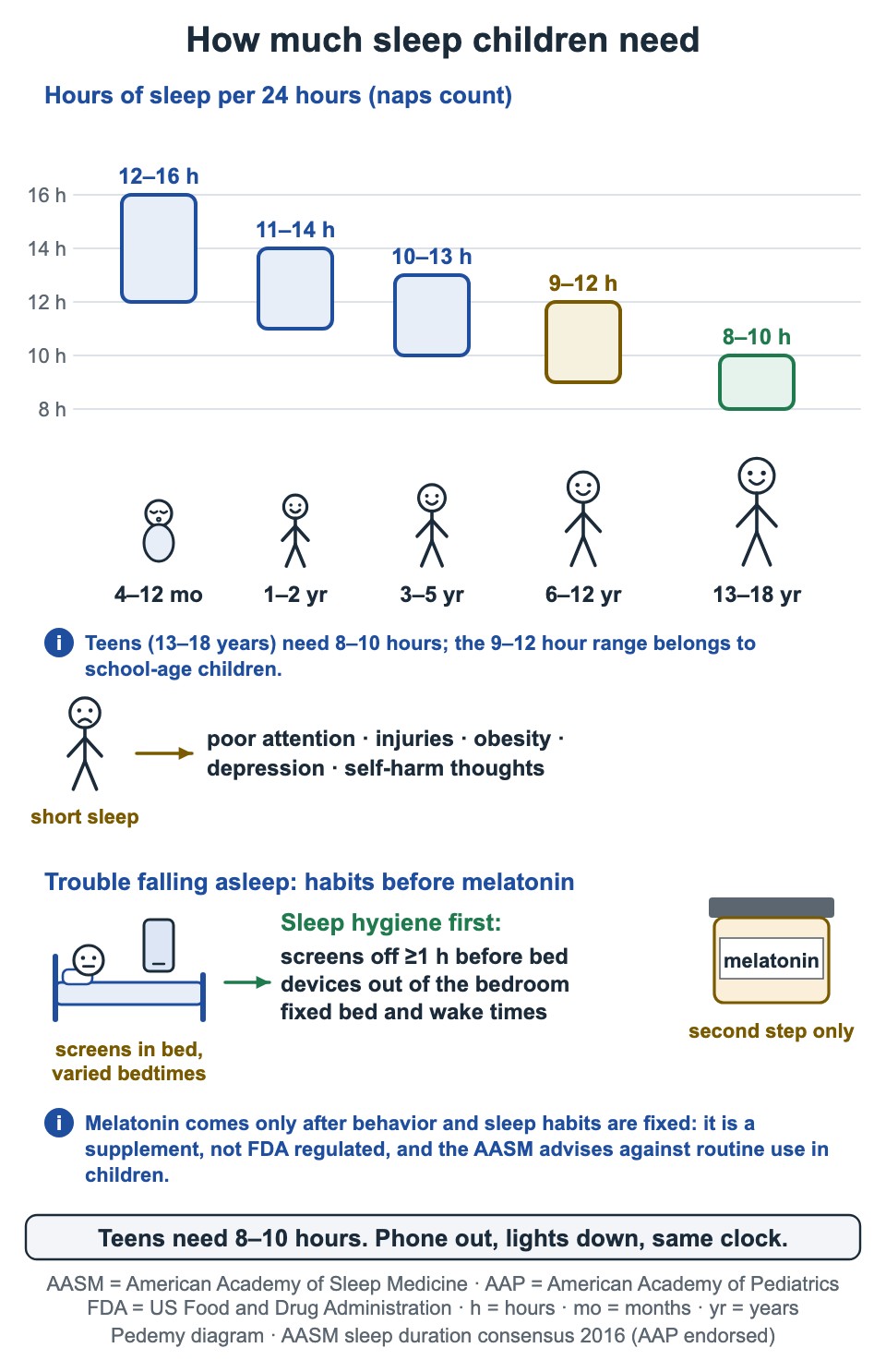
How much sleep children need -
Family,School & Media
Mother's EPDS is 14 at the 1-month visit, no thoughts of harm → next step? […]
Show answer
Mother's EPDS is 14 at the 1-month visit, no thoughts of harm → next step? Discuss it today and refer her for care, with follow-up
Why: A positive screen needs a plan at that visit: talk, link her to her own clinician or mental-health services, and follow up; mood swings only in the first 2 weeks are baby blues. Reassurance alone is not enough, and the pediatrician does not start the mother's antidepressant. Thoughts of harming herself or the baby need same-day emergency care. Hook: Positive screen, same-visit plan.
Source: AAP Clinical Report: Incorporating Recognition and Management of Perinatal Depression Into Pediatric Practice (Earls et al., Pediatrics 2019;143(1):e20183259). Rewritten for Pedemy in our own words, November 2026.
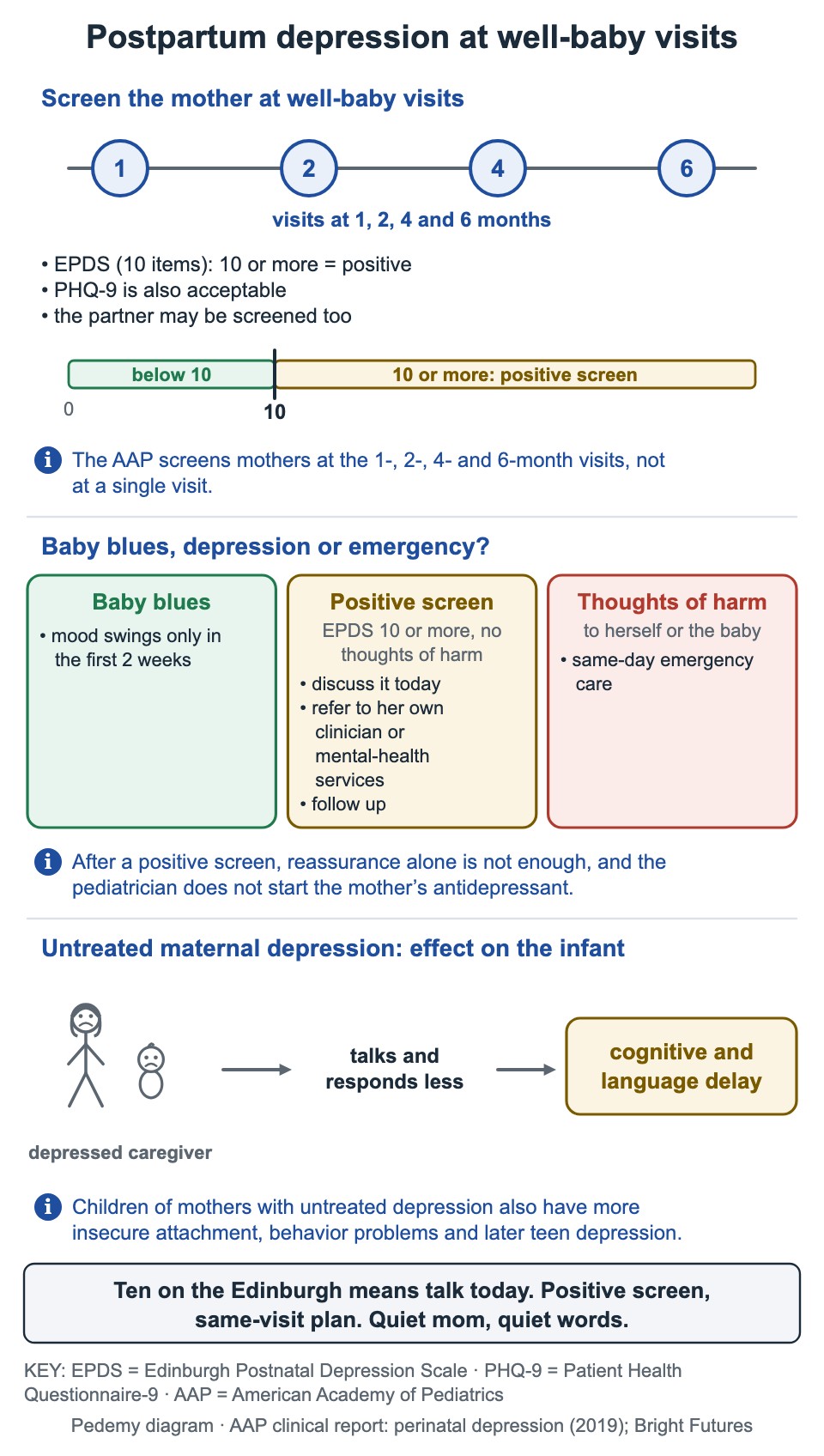
Postpartum depression at well-baby visits -
Parenting,Discipline & Toddler Behavior
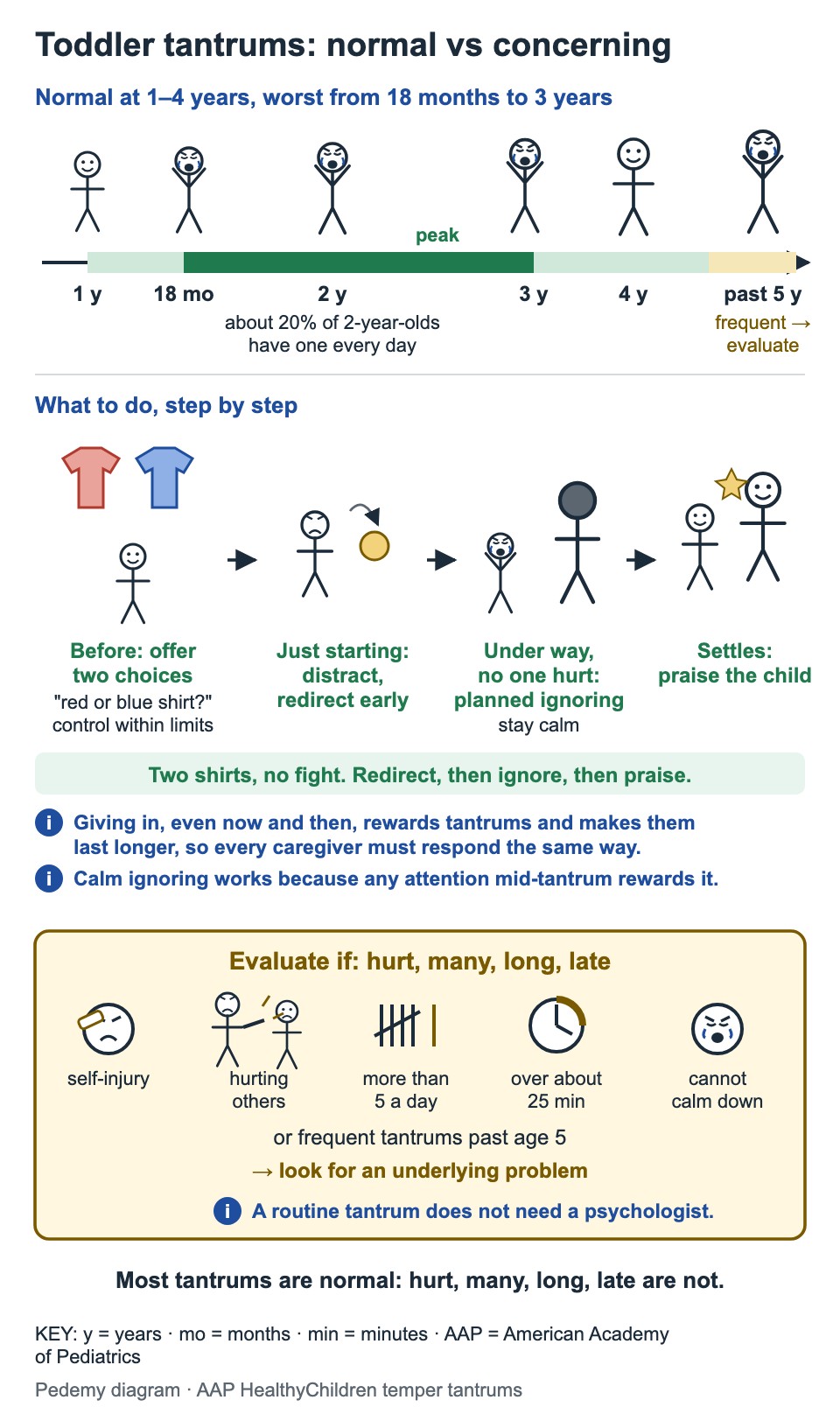
Toddler tantrums → features that call for evaluation? […]
Show answer
Toddler tantrums → features that call for evaluation? Self-injury, hurting others, >5/day, very long, no self-calming, past 5 y
Why: Most tantrums are normal and peak at 18 months-3 years. Self-injury, aggression to others, more than 5 a day, episodes over about 25 minutes, no ability to calm down or frequent tantrums after age 5 suggest an underlying problem. A routine tantrum does not need a psychologist. Hook: Hurt, many, long, late.
Source: AAP Clinical Report: Effective Discipline to Raise Healthy Children (Sege & Siegel, Pediatrics 2018;142(6):e20183112); AAP HealthyChildren.org; Belden et al., J Pediatr 2008 (tantrum severity markers). Rewritten for Pedemy in our own words, November 2026.
Toddler tantrums: normal or not? -
Sleep
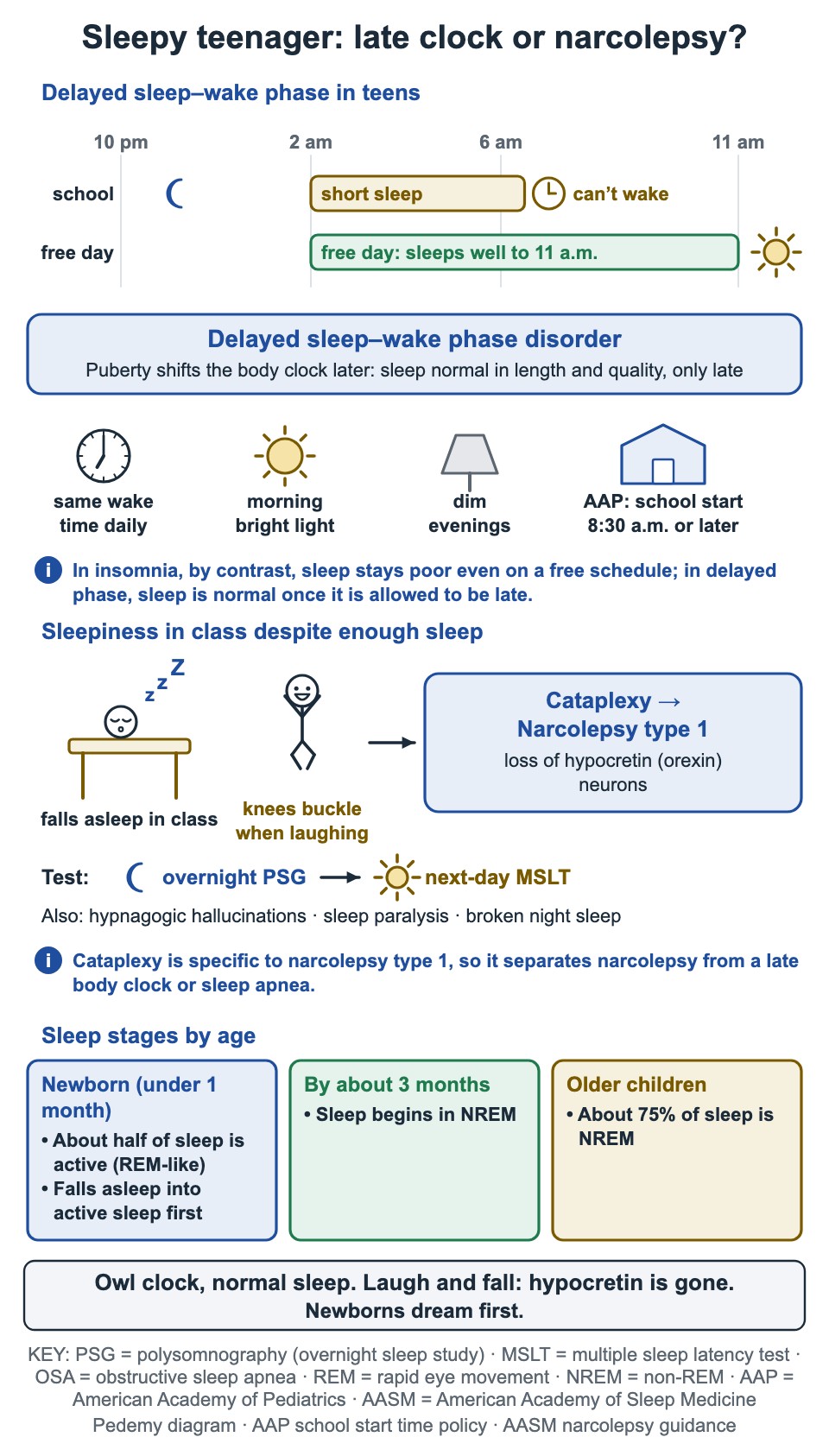
Teen falls asleep in class despite enough sleep; knees buckle when laughing → diagnosis? […]
Show answer
Teen falls asleep in class despite enough sleep; knees buckle when laughing → diagnosis? Narcolepsy (type 1, with cataplexy)
Why: Cataplexy (sudden weakness with emotion) points to narcolepsy type 1, from loss of hypocretin (orexin) neurons. Test with overnight polysomnography, then a next-day multiple sleep latency test. Other signs: hypnagogic hallucinations, sleep paralysis, broken night sleep. Cataplexy does not occur in delayed sleep phase or obstructive sleep apnea, and the MSLT is not the test for apnea. Hook: Laugh and fall: hypocretin is gone.
Source: AASM International Classification of Sleep Disorders, 3rd ed., text revision (ICSD-3-TR, 2023). Rewritten for Pedemy in our own words, November 2026.
Sleepy teenager: late clock or narcolepsy? -
Family,School & Media
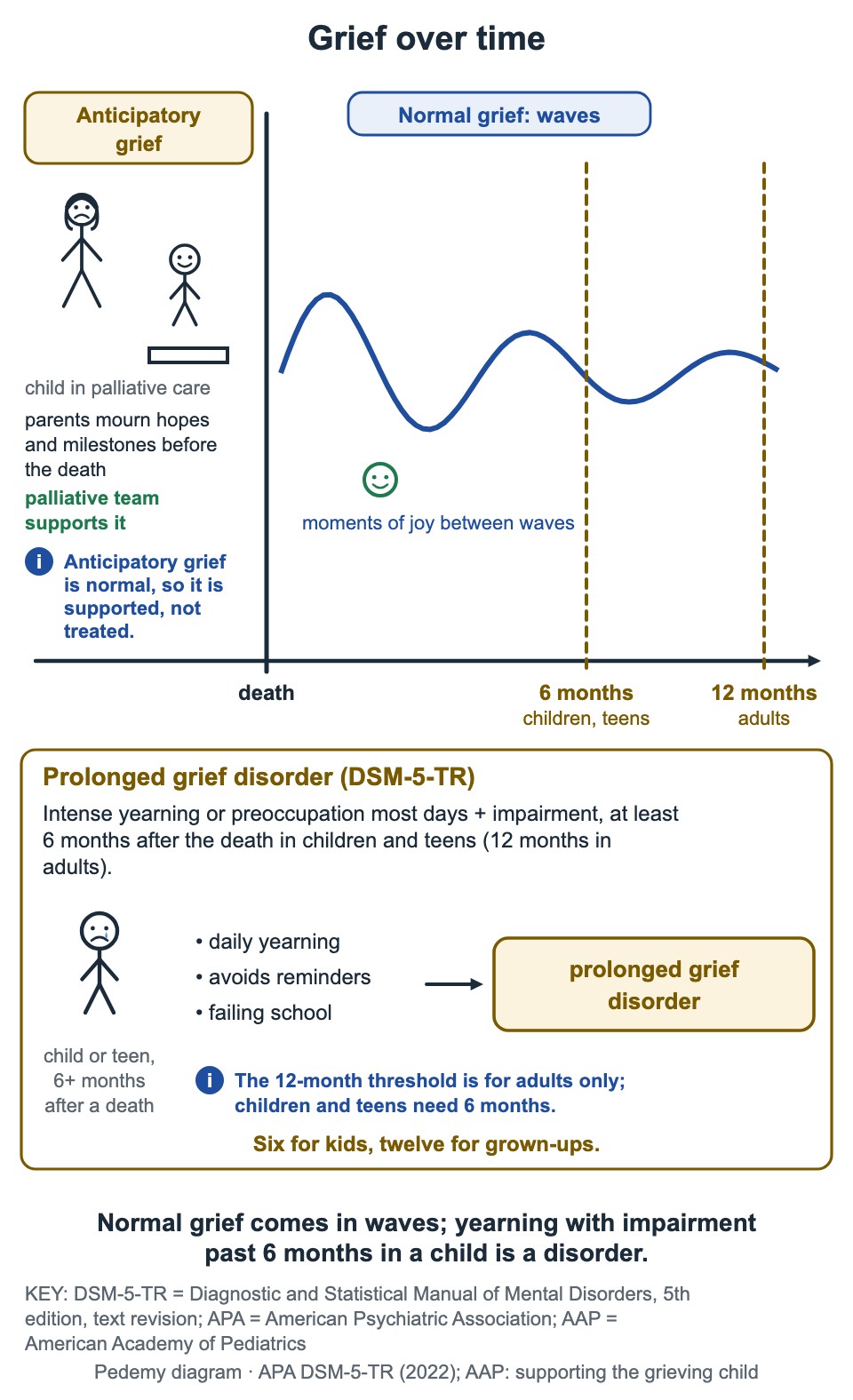
10-year-old, father died 8 months ago: daily yearning, avoids reminders, failing school → diagnosis? […]
Show answer
10-year-old, father died 8 months ago: daily yearning, avoids reminders, failing school → diagnosis? Prolonged grief disorder
Why: DSM-5-TR: intense yearning or preoccupation most days with impairment, at least 6 months after the death in children and teens (12 months in adults). Normal grief comes in waves with moments of joy. Hook: Six for kids, twelve for grown-ups.
Source: APA DSM-5-TR (2022): Prolonged Grief Disorder; AAP Clinical Report: Supporting the Grieving Child and Family (Schonfeld, Demaria, Nasir & Kumar, Pediatrics 2024;154(1):e2024067212). Rewritten for Pedemy in our own words, November 2026.
Grief over time -
Parenting,Discipline & Toddler Behavior
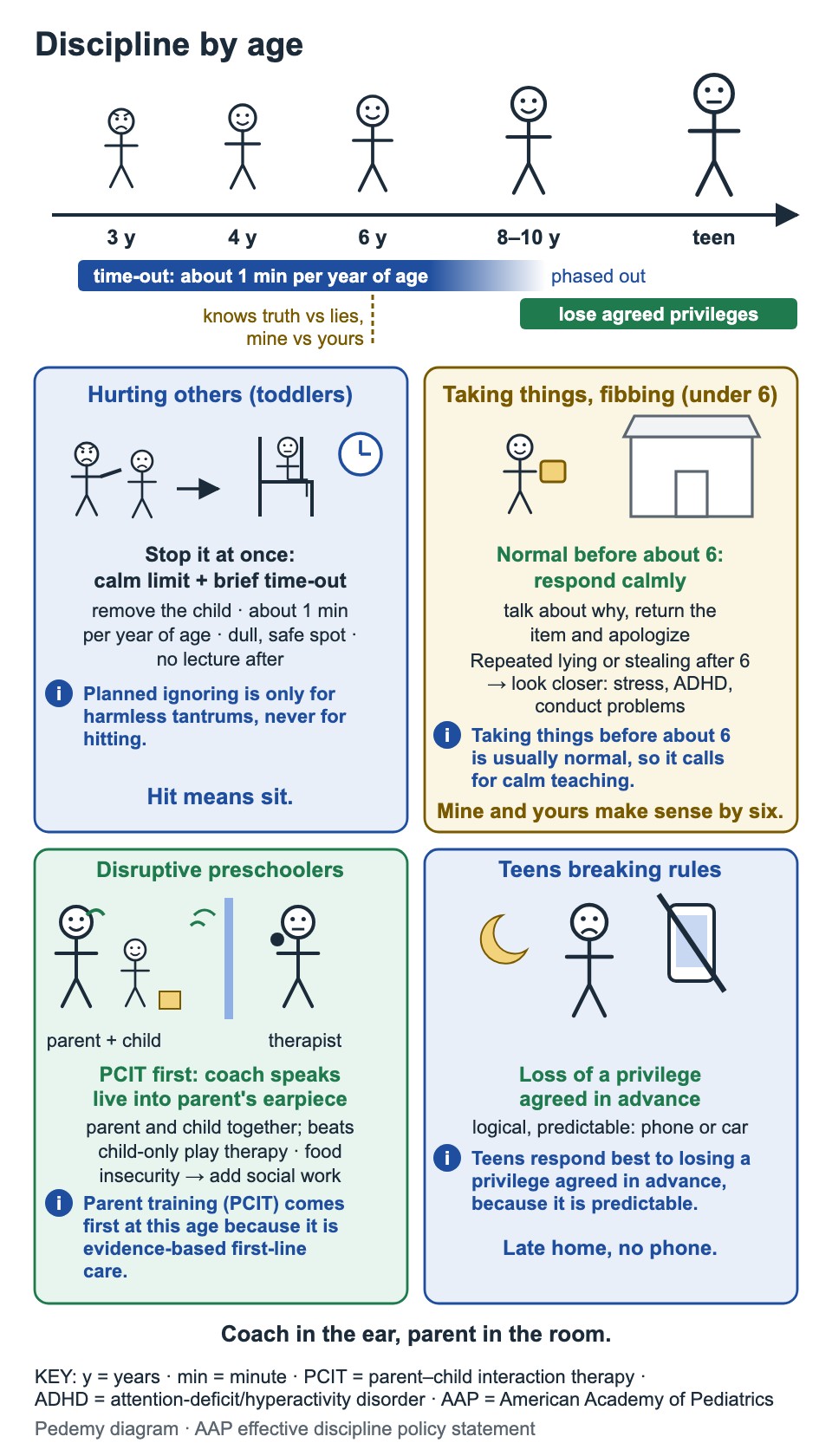
4-year-old takes a toy from a store; parents fear stealing → normal? Children know truth vs lies and ownership by about […]
Show answer
4-year-old takes a toy from a store; parents fear stealing → normal? Children know truth vs lies and ownership by about 6 years
Why: Before about 6, taking things and fibbing are usually normal development. Respond calmly: talk about why, return the item and apologize. Repeated lying or stealing after 6 deserves a closer look (stress, ADHD, conduct problems). A preschooler should not be labeled with conduct disorder or punished harshly. Hook: Mine and yours make sense by six.
Source: AAP Clinical Report: Effective Discipline to Raise Healthy Children (Sege & Siegel, Pediatrics 2018); HealthyChildren.org (AAP): lying and stealing. Rewritten for Pedemy in our own words, November 2026.
Discipline by age
Topics in Behavioral
Behavioral study guides
Sample cards in other subjects
- Growth & Development
- Immunizations & Post-exposure Prevention
- Nutrition
- Well-Child Care & Prevention
- Emergency Medicine
- Infectious Disease
- ENT
- Mental Health
- Ophthalmology
- Adolescent Medicine
- Cardiology
- Gastroenterology
- Pulmonology
- Dermatology
- Musculoskeletal & Sports Medicine
- Neonatology
- Neurology
- Allergy & Immunology
- Endocrinology
- Hematology
- Nephrology
- Oncology
- Urology
- Biostatistics & Epidemiology
- Genetics
- Medical Ethics
- Metabolic Disorders
- Patient Safety & Quality Improvement
- Rheumatology
- Pharmacology
Free to study without an account. Sign up free to save your spaced-repetition schedule across devices. For education only; check current guidelines before clinical use.