

Musculoskeletal & Sports Medicine flashcards
200 cards · 9 topics · 4% of the board exam
200 free Musculoskeletal & Sports Medicine flashcards for pediatric board review and rotations, written in our own words with public guideline sources. Topics: Ankle & Soft Tissue, Bone Lesions, Foot & Rotational Variants, Hip & Limp and 5 more. Musculoskeletal & Sports Medicine is 4% of the board exam.
Sample Musculoskeletal & Sports Medicine cards
-
Ankle & Soft Tissue
Salter-Harris types that cross the joint surface, usually need surgery and risk growth arrest? […]
Show answer
Salter-Harris types that cross the joint surface, usually need surgery and risk growth arrest? Types III and IV
Why: Types III and IV split the epiphysis into the joint, so they need exact (often operative) reduction; type V crush also risks arrest. Type I runs only through the physis, II (most common) adds metaphysis and rarely disturbs growth. Hook: SALTR, the higher the letter, the worse.
Source: StatPearls (NCBI Bookshelf): Salter-Harris Fractures; AAOS OrthoInfo: Growth Plate Fractures. Rewritten for Pedemy in our own words, November 2026.
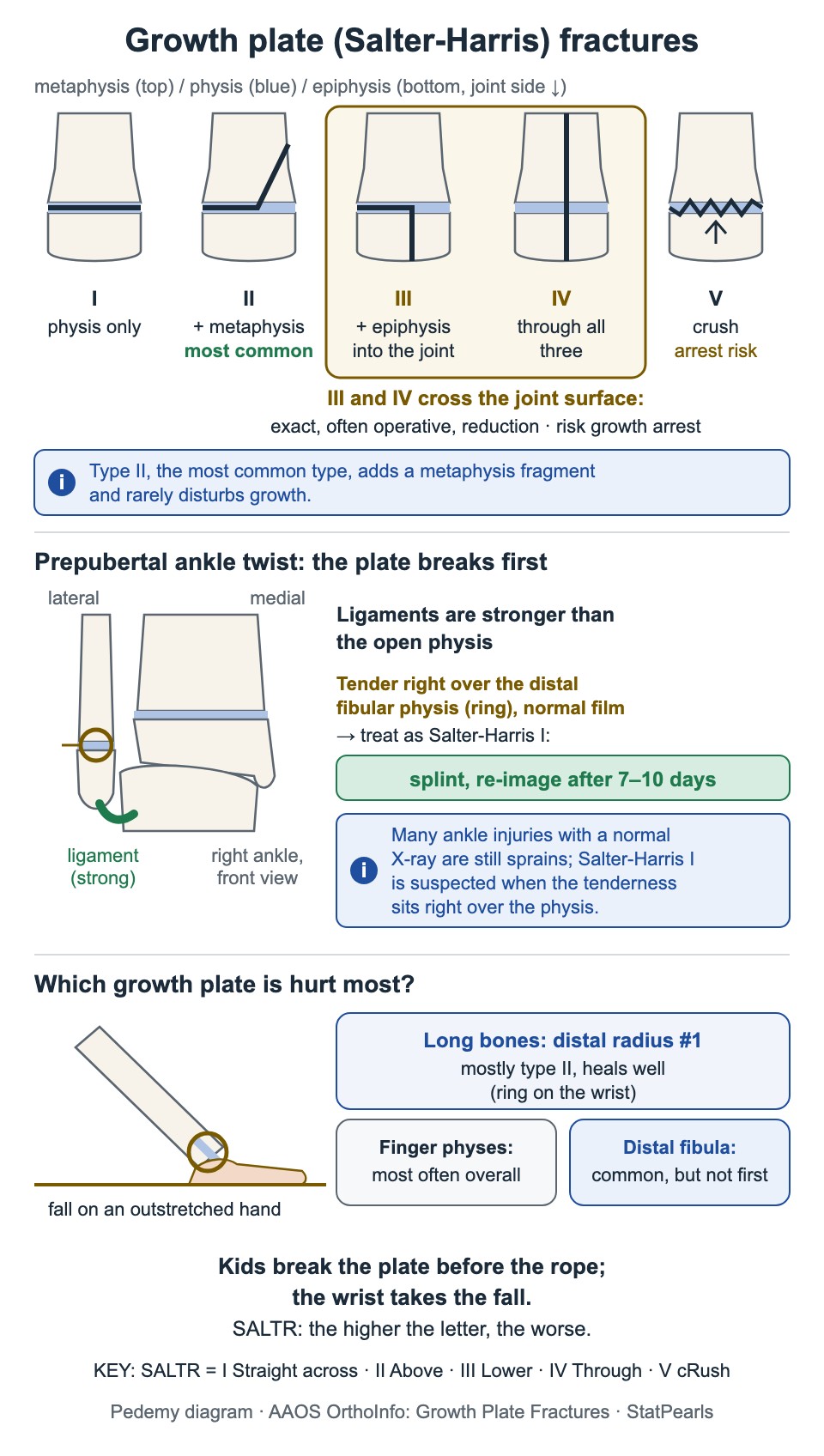
Growth plate (Salter-Harris) fractures -
Bone Lesions
Ground-glass lucent lesion in a long-bone shaft with pathologic fracture risk → […]
Show answer
Ground-glass lucent lesion in a long-bone shaft with pathologic fracture risk → Fibrous dysplasia
Why: Normal bone is replaced by fibrous tissue and woven bone; femur, tibia, ribs and skull are common sites. Many lesions plus café-au-lait spots and peripheral precocious puberty = McCune-Albright syndrome. A simple bone cyst has clear fluid and a sharp rim, unlike this frosted lesion. Hook: frosted glass in the bone.
Source: NIH NIAMS: Fibrous Dysplasia; StatPearls (NCBI Bookshelf): Fibrous Dysplasia; McCune-Albright Syndrome. Rewritten for Pedemy in our own words, November 2026.
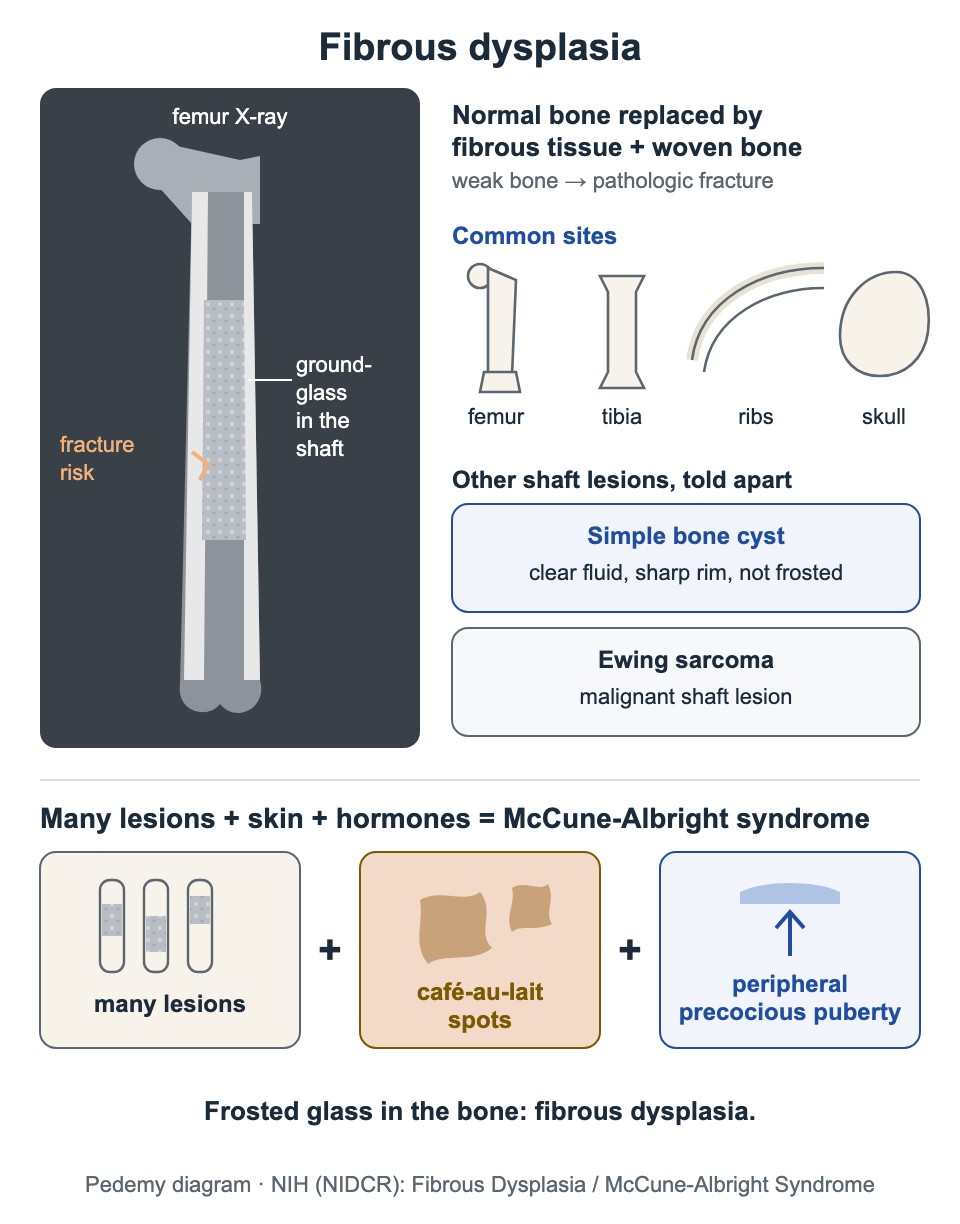
Fibrous dysplasia -
Hip & Limp
Child 9 months–3 years, unseen fall, won't bear weight, oblique tibial line → mechanism? […]
Show answer
Child 9 months–3 years, unseen fall, won't bear weight, oblique tibial line → mechanism? Twisting force (toddler's fracture)
Why: The hairline spiral fracture may show only on an oblique view; if films are normal, immobilize and repeat X-rays in 1–2 weeks. It heals in 3–4 weeks with a short time in a boot or cast, or no immobilization. A twisting force causes it, not compression (buckle) or a direct blow (nightstick); abuse concern is for children not yet walking. Hook: toddlers twist, tibias split.
Source: Wang Y et al. The Toddler's Fracture (Pediatr Emerg Care 2022); AAFP: Evaluation of the Acutely Limping Child (Am Fam Physician 2000). Rewritten for Pedemy in our own words, November 2026.
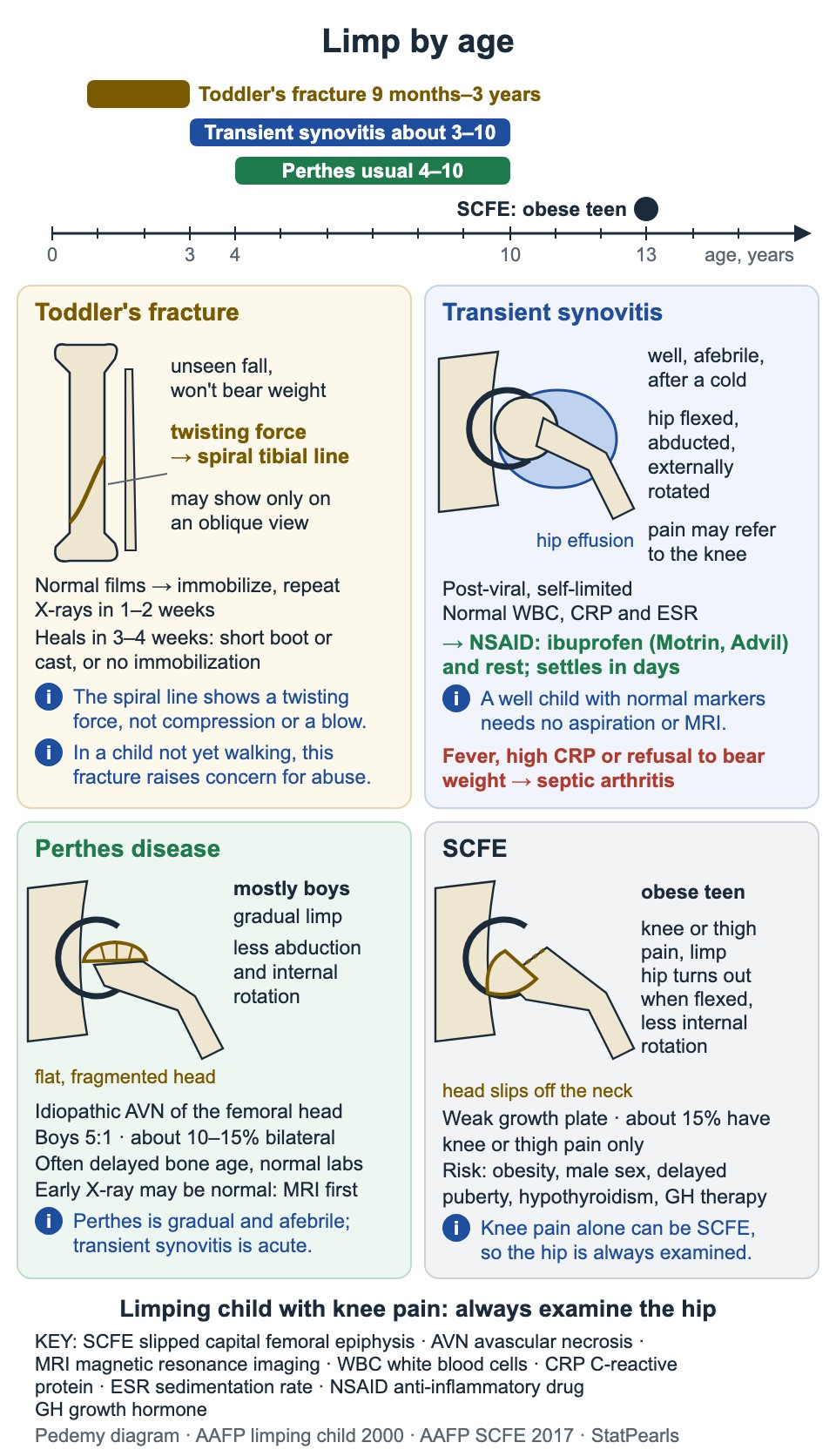
Limp by age -
Knee & Overuse
Fall or dashboard blow onto the front of a flexed knee, tibia sags backward, positive posterior drawer → injury? […]
Show answer
Fall or dashboard blow onto the front of a flexed knee, tibia sags backward, positive posterior drawer → injury? PCL tear
Why: A front-to-back force on the bent knee drives the tibia posteriorly and tears the posterior cruciate. Anterior drawer and Lachman test the ACL; a planted-foot twist injures the meniscus. Hook: dashboard pushes the shin back.
Source: AAOS OrthoInfo: Common Knee Injuries; StatPearls (NCBI Bookshelf): Posterior Cruciate Ligament Knee Injuries. Rewritten for Pedemy in our own words, November 2026.
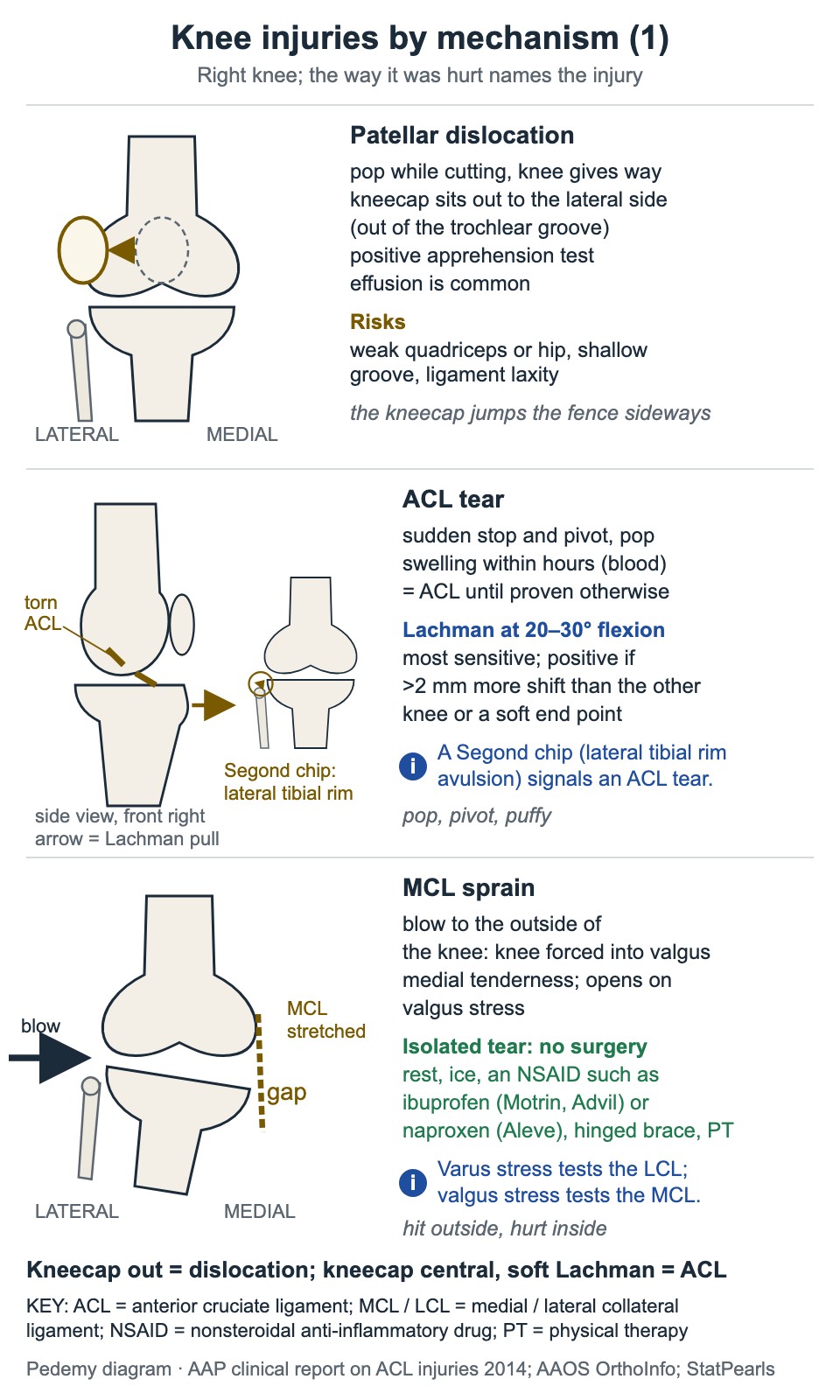
Knee injuries by mechanism (1) -
Spine & Neck
Toddler refuses to walk or bend forward, mild fever, normal WBC, high ESR, normal spine X-ray → best imaging? […]
Show answer
Toddler refuses to walk or bend forward, mild fever, normal WBC, high ESR, normal spine X-ray → best imaging? Spine MRI
Why: This is discitis (lower lumbar, mostly under 5; fever is often mild or absent): disc narrowing shows on X-ray only after 2–3 weeks, while MRI shows it early and excludes vertebral osteomyelitis. WBC is usually normal, so a normal count does not rule it out. Hook: the disc lights up on MRI before the X-ray narrows.
Source: StatPearls (NCBI Bookshelf): Diskitis; ACR Appropriateness Criteria: Back Pain-Child, 2024 Update (J Am Coll Radiol 2025). Rewritten for Pedemy in our own words, November 2026.
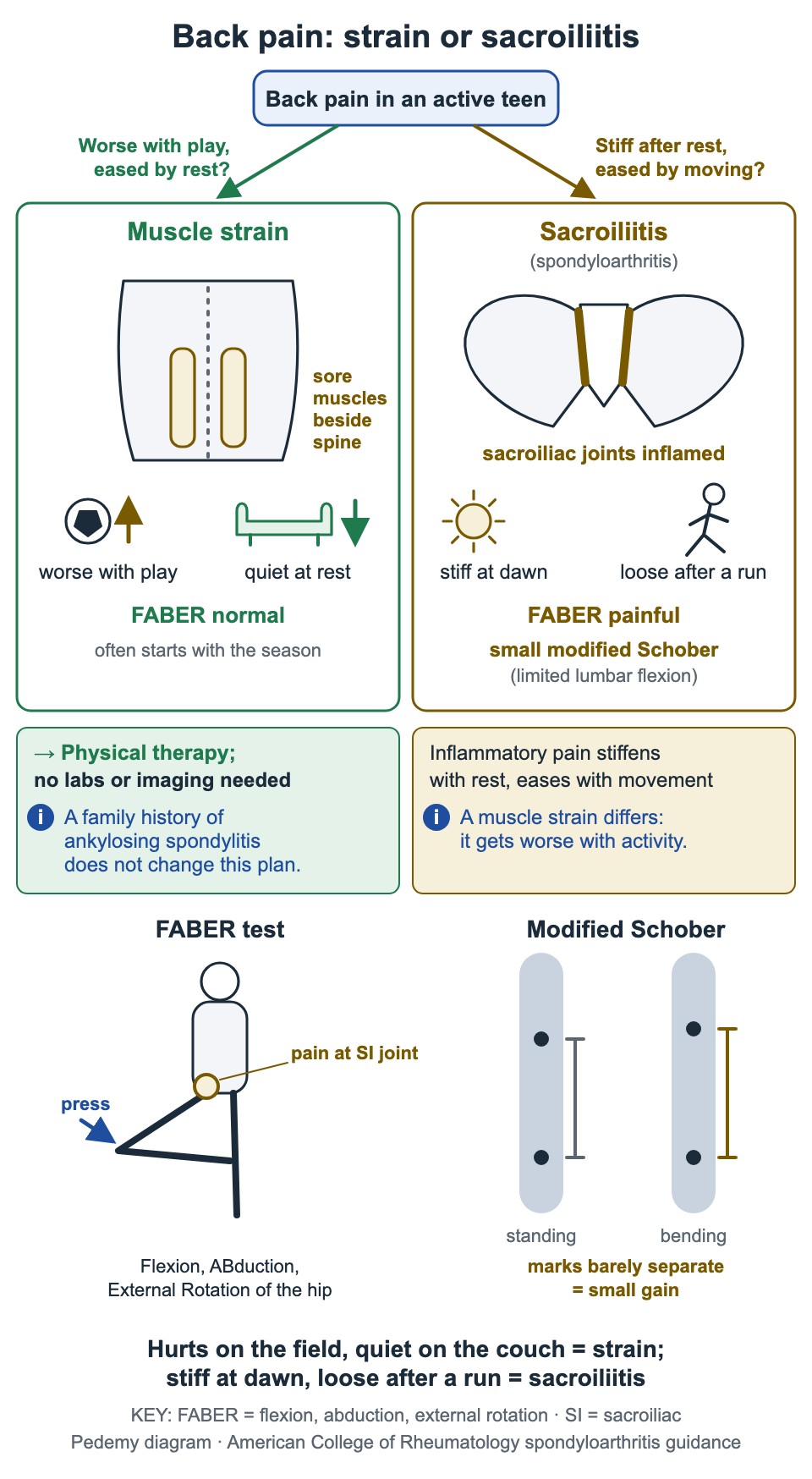
Back pain: strain or sacroiliitis -
Sports Clearance
Athlete still symptomatic from a concussion takes another head hit → rapid, often fatal brain swelling? […]
Show answer
Athlete still symptomatic from a concussion takes another head hit → rapid, often fatal brain swelling? Second impact syndrome
Why: A second blow before recovery can disrupt cerebral autoregulation and cause malignant swelling, mostly in teens; this is why no one plays while symptomatic. It is brain swelling, not a new epidural hematoma. Hook: second hit, swollen brain.
Source: AAP Clinical Report: Sport-Related Concussion in Children and Adolescents (Pediatrics 2018). Rewritten for Pedemy in our own words, November 2026.
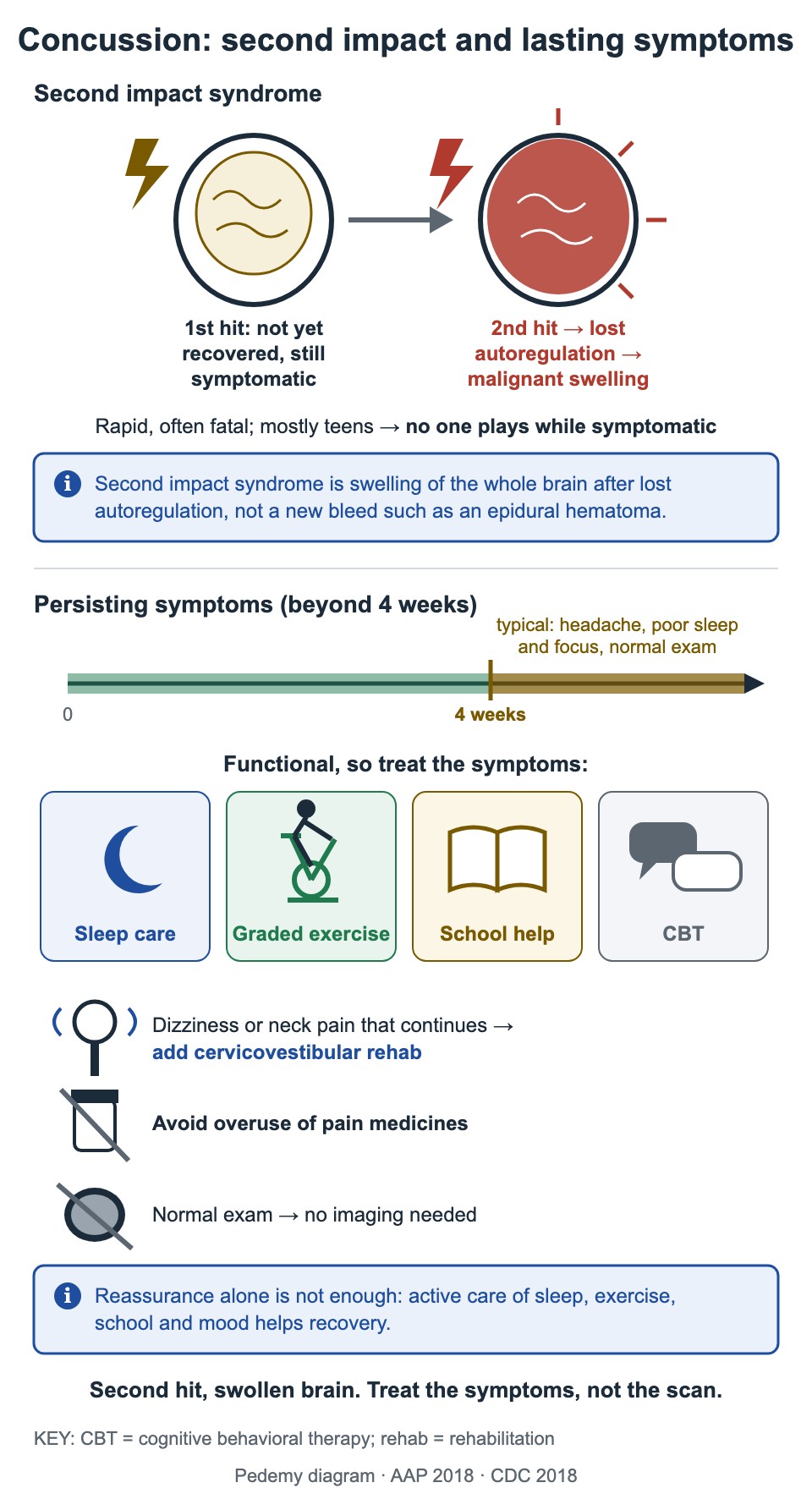
Concussion: second impact and lasting symptoms -
Sports Safety & Nutrition
Girl athlete: deeper voice, new facial hair, clitoromegaly, irregular menses → likely cause? […]
Show answer
Girl athlete: deeper voice, new facial hair, clitoromegaly, irregular menses → likely cause? Anabolic-androgenic steroid use
Why: Exogenous androgens virilize girls; the voice change and clitoromegaly may not reverse. Steroids are often taken in 6–12 week cycles, often several at once ('stacking'). PCOS causes hirsutism and irregular menses but not a deep voice or clitoromegaly. Hook: a new deep voice in a strong girl = steroids.
Source: AAP Clinical Report: Use of Performance-Enhancing Substances (Pediatrics 2016). Rewritten for Pedemy in our own words, November 2026.
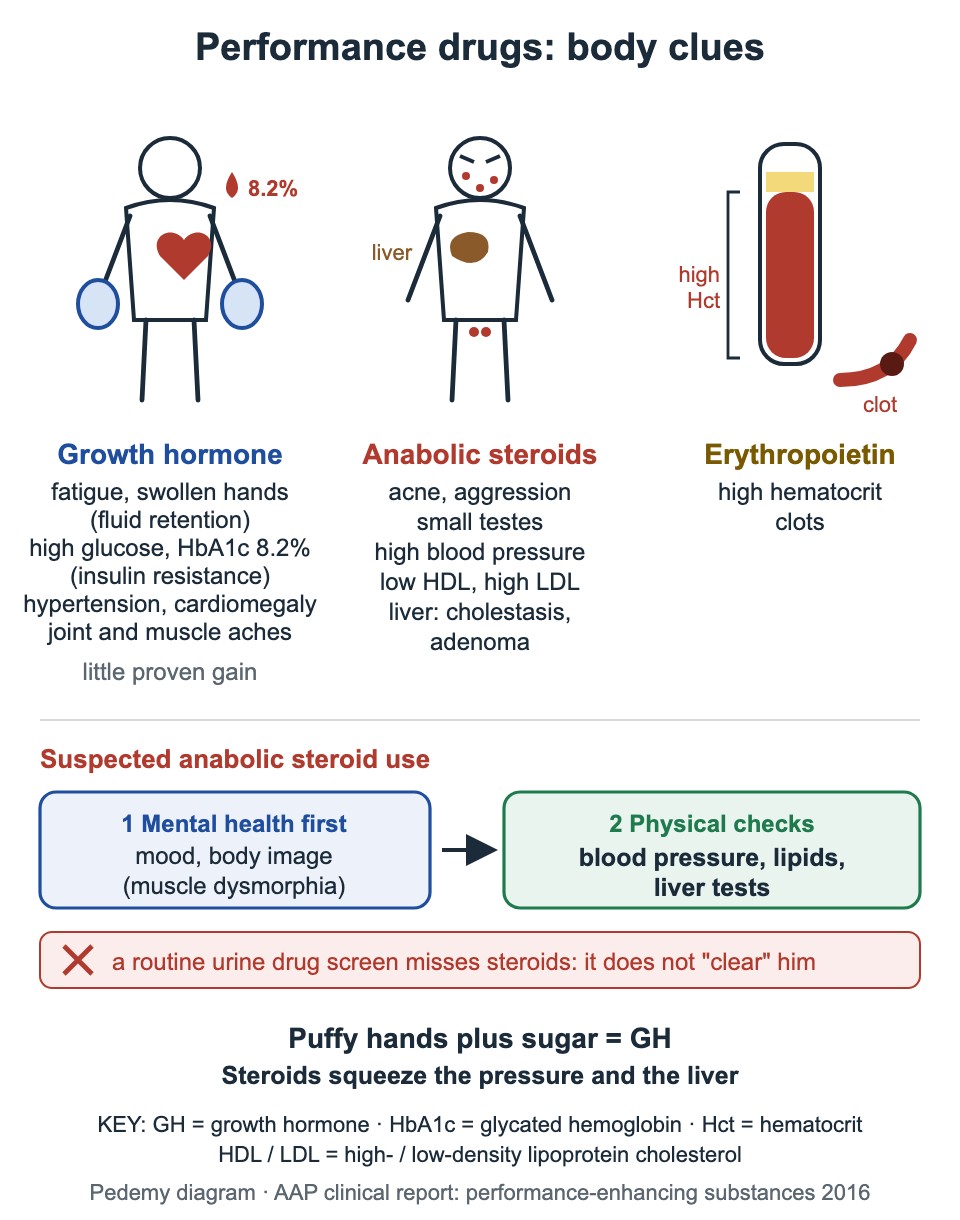
Performance drugs: body clues -
Upper Limb
Toddler won't use an arm after an unwitnessed fall; elbow swollen and point tender → before any reduction? […]
Show answer
Toddler won't use an arm after an unwitnessed fall; elbow swollen and point tender → before any reduction? Elbow X-rays
Why: A classic pulled elbow (sudden pull on the hand, no swelling, no focal tenderness) is reduced without films. A fall, swelling or point tenderness suggests a supracondylar or other fracture, which manipulation could displace, so imaging comes first. Hook: fall or swelling, film before you twist.
Source: StatPearls (NCBI Bookshelf): Nursemaid Elbow; Cochrane Review: Manipulative Interventions for Reducing Pulled Elbow in Young Children (2017). Rewritten for Pedemy in our own words, November 2026.
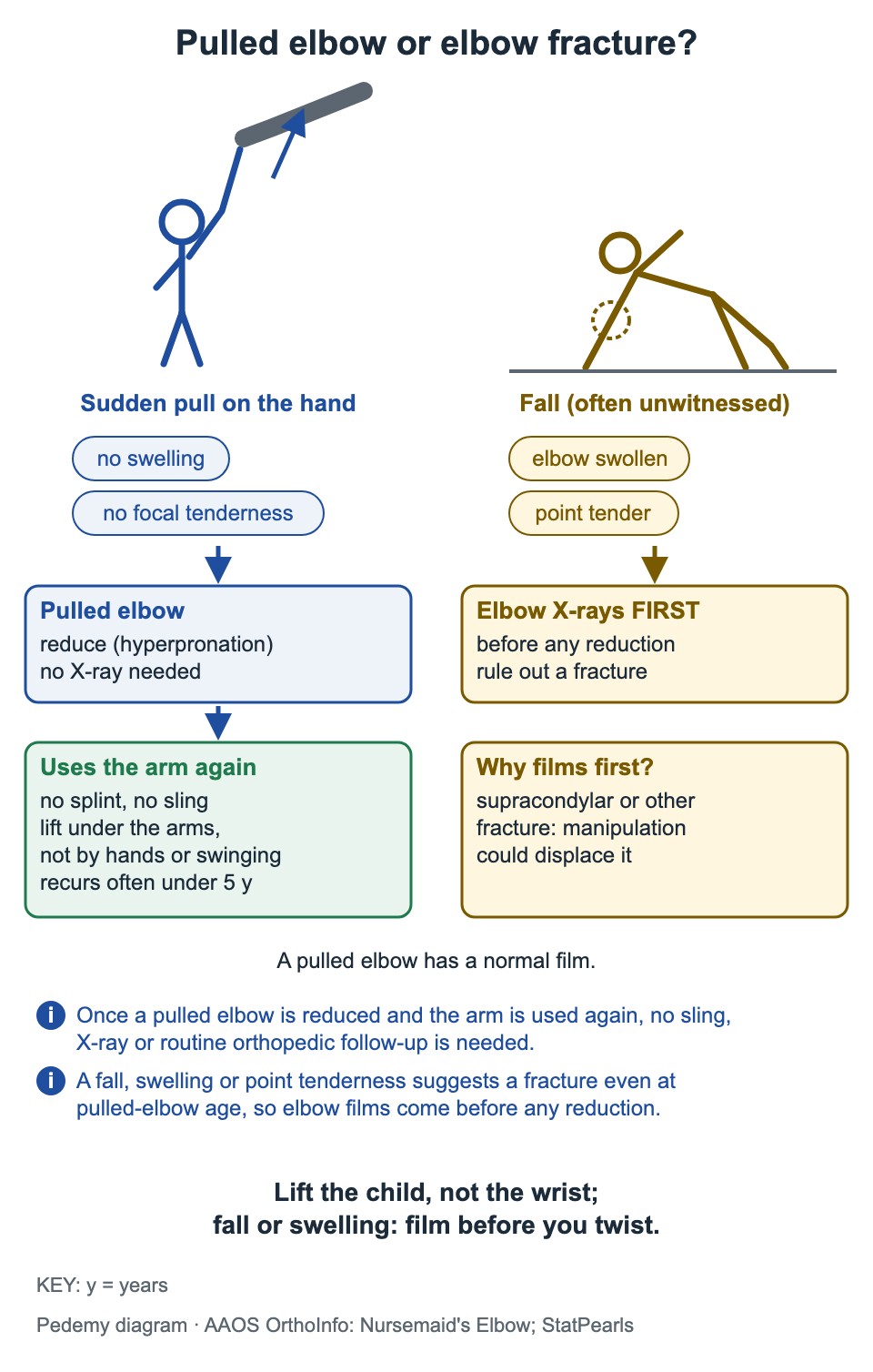
Toddler won't use an arm: pull or fall?
Topics in Musculoskeletal & Sports Medicine
- Ankle & Soft Tissue7
- Bone Lesions17
- Foot & Rotational Variants15
- Hip & Limp23
- Knee & Overuse26
- Spine & Neck23
- Sports Clearance32
- Sports Safety & Nutrition36
- Upper Limb21
Musculoskeletal & Sports Medicine study guides
- Ankle sprains and soft-tissue injuries in children
- Back pain, spine shape and neck problems in children
- Benign bone lesions in children
- Foot problems and rotational variants in children
- Knee injuries and overuse in young athletes
- Sports clearance and return to play
- Sports safety and nutrition
- The limping child and hip disorders
- Upper limb injuries in children and young athletes
Clinical tools for Musculoskeletal & Sports Medicine
Sample cards in other subjects
- Growth & Development
- Immunizations & Post-exposure Prevention
- Nutrition
- Well-Child Care & Prevention
- Emergency Medicine
- Infectious Disease
- ENT
- Mental Health
- Ophthalmology
- Adolescent Medicine
- Cardiology
- Gastroenterology
- Pulmonology
- Dermatology
- Neonatology
- Neurology
- Allergy & Immunology
- Behavioral
- Endocrinology
- Hematology
- Nephrology
- Oncology
- Urology
- Biostatistics & Epidemiology
- Genetics
- Medical Ethics
- Metabolic Disorders
- Patient Safety & Quality Improvement
- Rheumatology
- Pharmacology
Free to study without an account. Sign up free to save your spaced-repetition schedule across devices. For education only; check current guidelines before clinical use.