

Main decision tree
High potassium: real and urgent?
Key points
- High potassium on a squeezed, hemolyzed sample in a well child: repeat it on a free-flowing venous sample before treating.
- Hyperkalemia is an emergency with symptoms, ECG changes, K over 7, or K 6–7 that is still rising.
- Order of treatment: IV calcium gluconate first, then insulin with glucose and albuterol, then removal by loop diuretic, resin or dialysis.
- Hypovolemic hyponatremia has a urine sodium under 20–30 and needs isotonic saline; SIADH is euvolemic with a higher urine sodium.
- Change sodium slowly: fast rise of a chronic low sodium causes osmotic demyelination; fast fall of a high sodium causes cerebral edema (no more than 12 mmol/L per 24 hours).
- True polyuria is over 2 L/m² per day; with serum sodium over 145 or osmolality over 300 and dilute urine, skip water deprivation and give desmopressin.
- 24-hour IV fluid for a dehydrated child = Holliday-Segar maintenance + deficit (kg × % × 10).
- Symptomatic hypercalcemia: IV normal saline first. Low ionized calcium: prolonged QT interval.
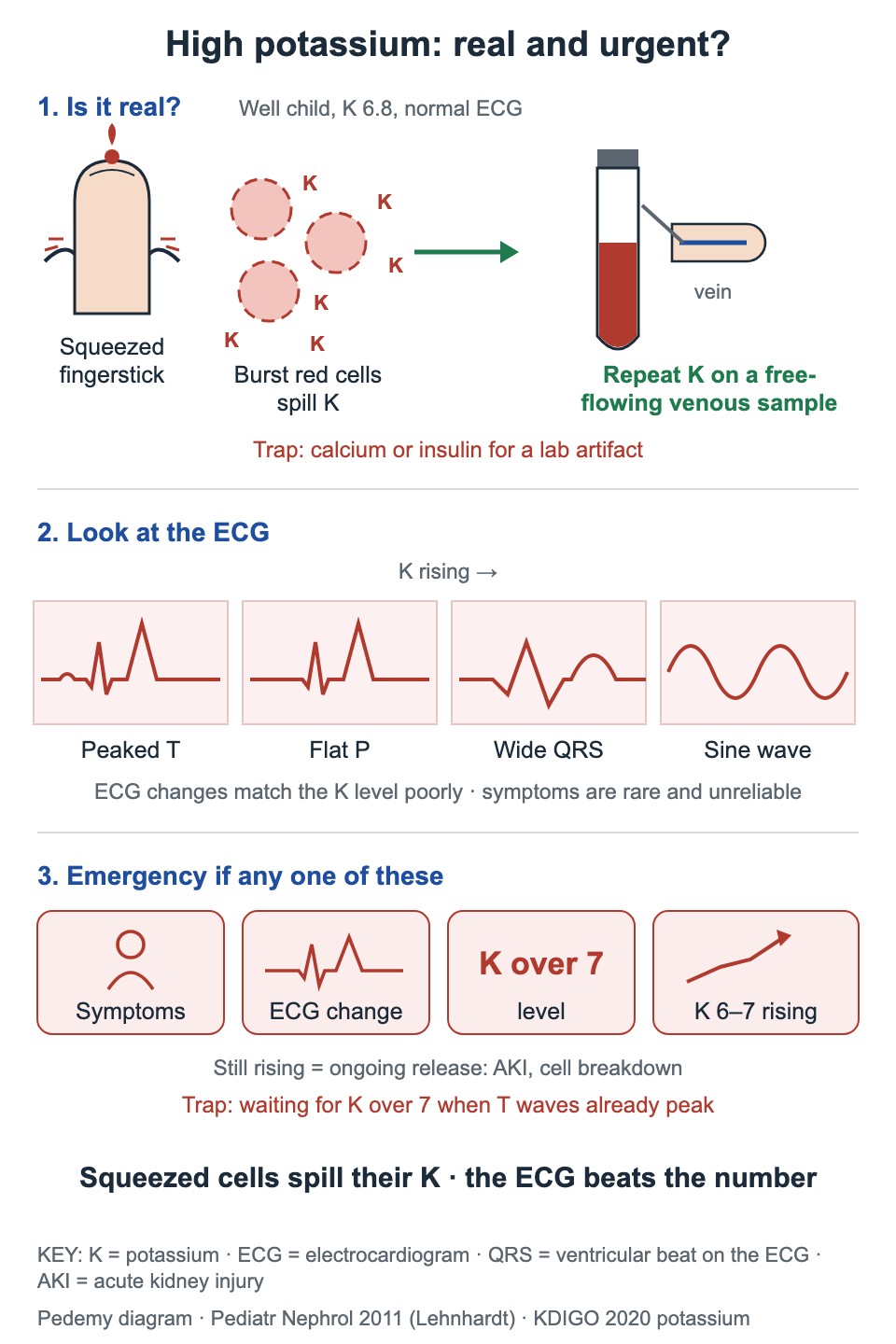
High potassium: real and urgent?
A hard squeeze on a fingerstick or slow processing breaks red cells, and they release potassium. This is pseudohyperkalemia. A well child without kidney disease or cell breakdown, with a normal ECG, needs a clean repeat on a free-flowing venous sample, not emergency drugs.
- Treat as an emergency: symptoms, ECG changes, K over 7, or K 6–7 that is still rising.
- Symptoms are rare and unreliable, so the ECG and the trend guide treatment.
- ECG changes run from peaked T waves to flat P waves, a wide QRS and a sine wave, but they match the potassium level poorly. Do not wait for K over 7 when the T waves already peak.
- Ongoing potassium release, as in acute kidney injury or cell breakdown, means the level will keep climbing.
Treating hyperkalemia in order
- A septic, oliguric child with a true K of 6.7 and peaked T waves gets IV calcium gluconate first. Sodium bicarbonate or a call for dialysis before calcium is the trap; dialysis comes later if potassium stays high.
- Never give insulin without glucose, and do not expect calcium to lower potassium.
- Shifts wear off in hours, so removal must follow. Resins act over hours to days and are not enough alone in an emergency.
- Refractory hyperkalemia with oliguric acute kidney injury needs dialysis.
- Sodium polystyrene sulfonate is contraindicated in neonates, especially preterm infants: intestinal necrosis (worse with sorbitol) and poor gut motility.
- Patiromer is labeled only from 12 years, and sodium zirconium cyclosilicate only for adults.
| Step | Treatment | What it does |
|---|---|---|
| Protect the heart | IV calcium gluconate | Stabilizes the heart muscle membrane within minutes; it does not change the potassium level |
| Shift potassium into cells | IV insulin with glucose, plus inhaled albuterol | Works within 15–30 minutes; sodium bicarbonate helps mainly when acidosis is present |
| Remove potassium from the body | Loop diuretic, cation-exchange resin, dialysis | Potassium leaves through urine, stool or dialysis; also stop all potassium in fluids and feeds |
Potassium: drugs and losses
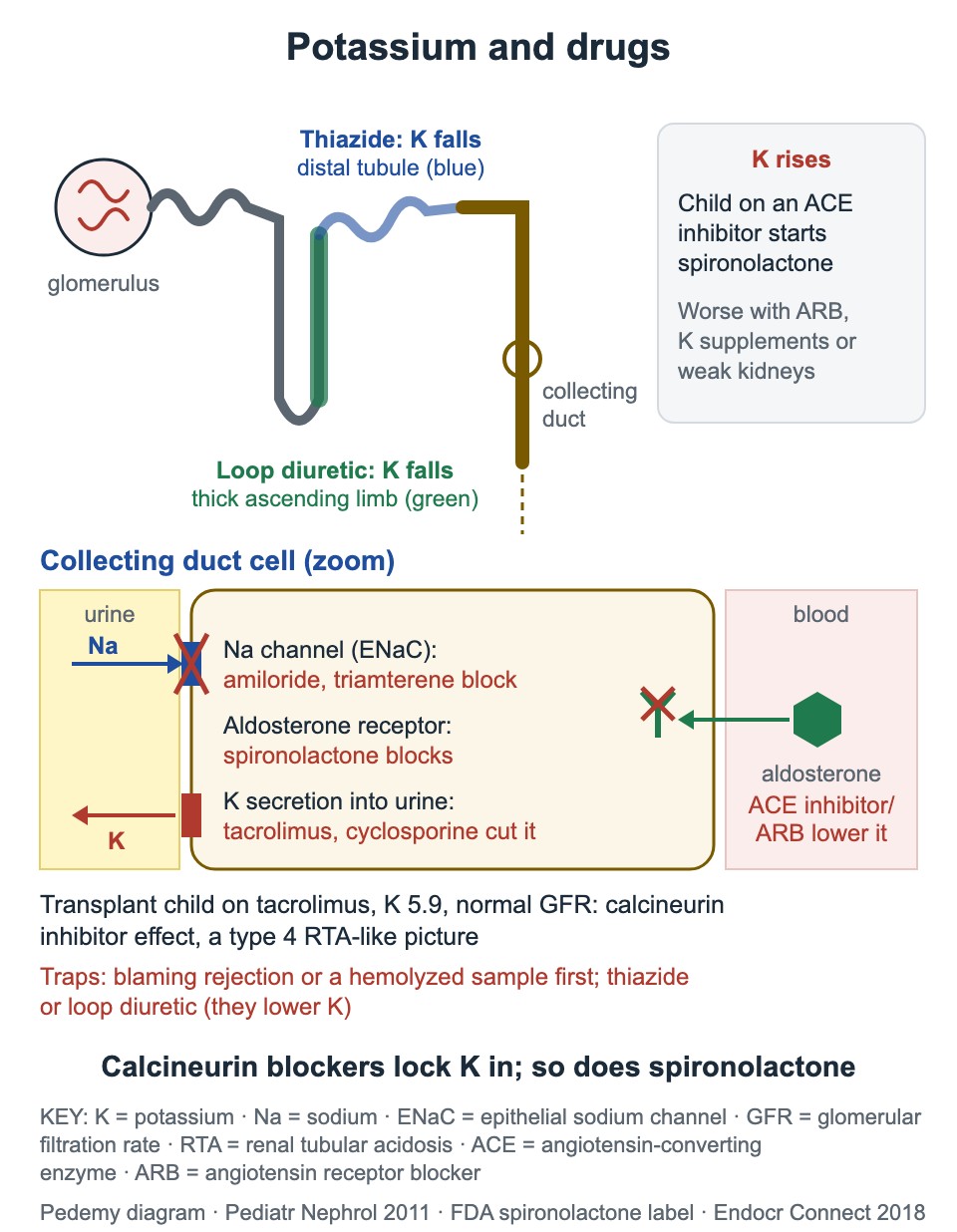
- Calcineurin inhibitors (tacrolimus, cyclosporine) reduce distal potassium secretion, a picture like type 4 renal tubular acidosis with a low aldosterone effect. In a transplant child with high potassium and a normal GFR, think of the drug before rejection or a hemolyzed sample.
- Spironolactone blocks the mineralocorticoid receptor, so the distal tubule secretes less potassium. The risk of hyperkalemia rises with an ACE inhibitor or ARB, potassium supplements or kidney impairment.
- Amiloride and triamterene raise potassium by blocking the epithelial sodium channel (ENaC). Thiazide and loop diuretics lower potassium.
Low sodium: artifact or dry child?
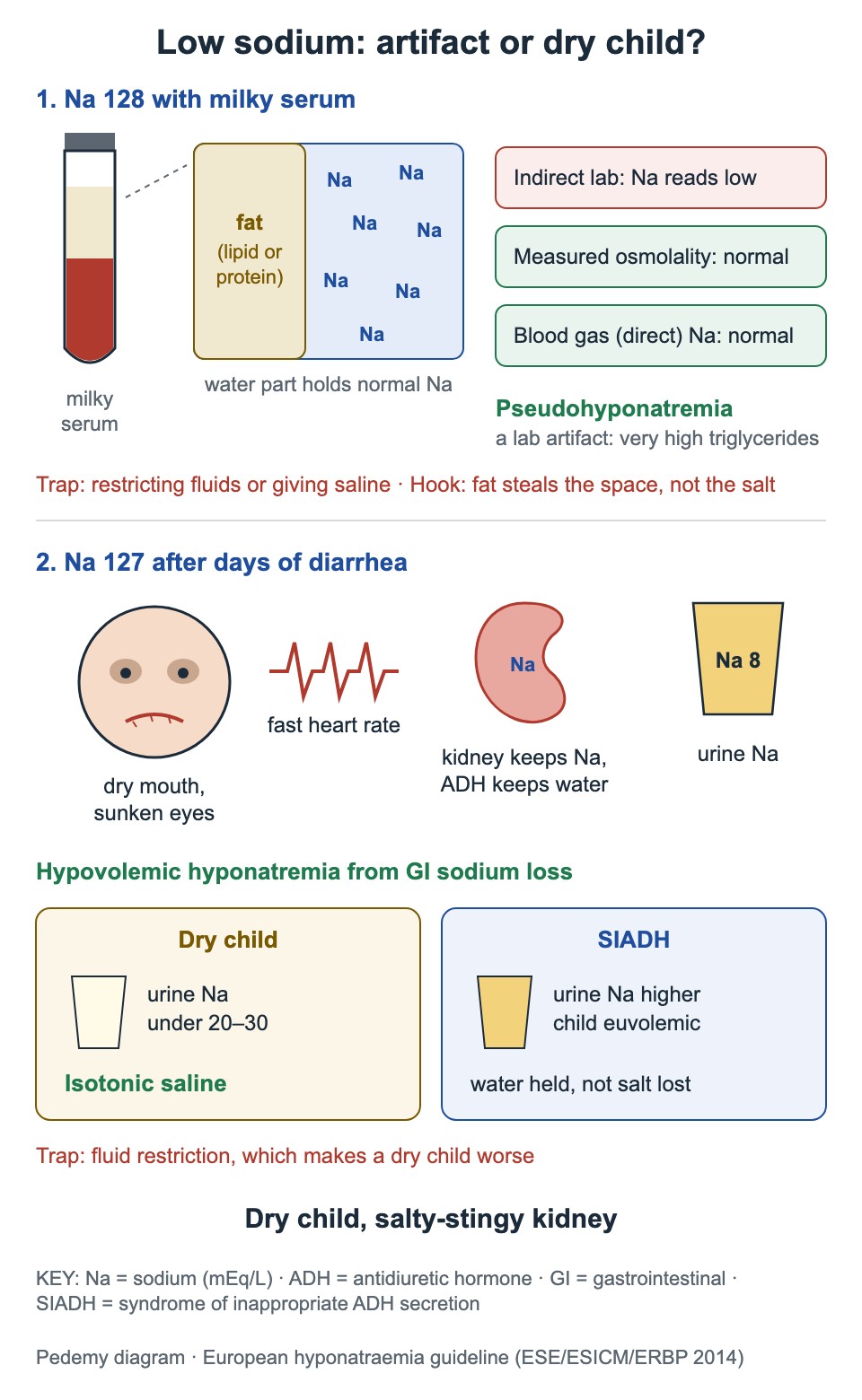
- In pseudohyponatremia, lipid or protein takes up plasma volume, so indirect lab methods under-read sodium while the true osmolality stays normal.
- In the dry child, low volume makes the kidney keep sodium and ADH keep water. Fluid restriction is the trap: it makes a dry child worse.
| Pseudohyponatremia | Hypovolemic hyponatremia | SIADH | |
|---|---|---|---|
| Setting | Milky serum with very high triglycerides, or very high protein | Days of diarrhea, dry mucosa, tachycardia | Euvolemic child |
| Key lab | Normal measured serum osmolality; sodium is normal on a direct electrode (blood gas) | Urine sodium under 20–30, because the kidney keeps sodium | Higher urine sodium |
| Treatment | None for the sodium: do not restrict fluids or give saline | Isotonic saline | No volume replacement: the child is not dry |
Exercise-associated hyponatremia
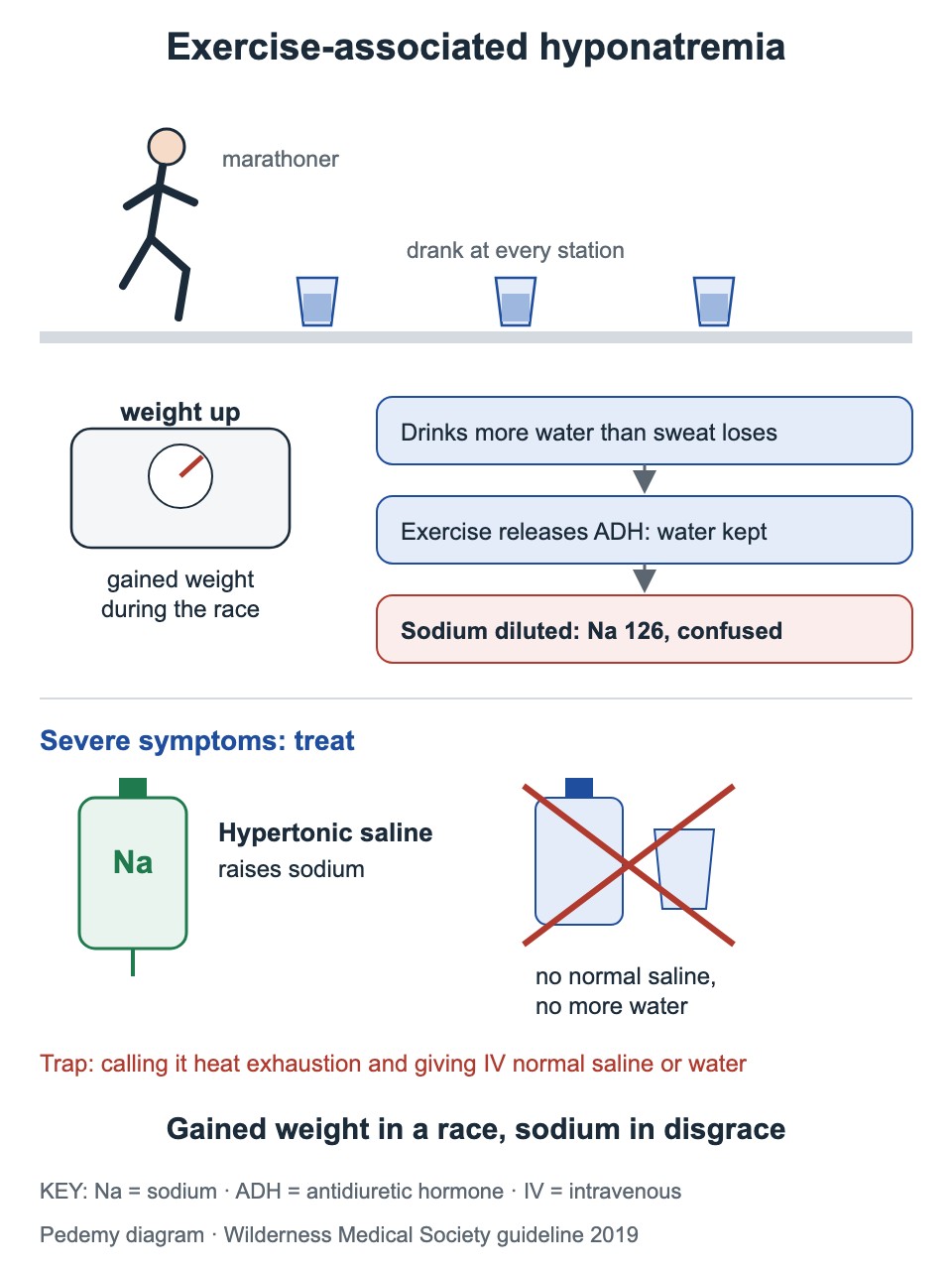
- Drinking beyond sweat losses, with ADH released by exercise, dilutes the sodium.
- The clue is weight gain during a race in a runner who drank at every station and is now confused with a low sodium.
- Severe symptoms need hypertonic saline, not more fluid.
- The trap is to call it heat exhaustion and give IV normal saline or more water.
Sodium correction speed
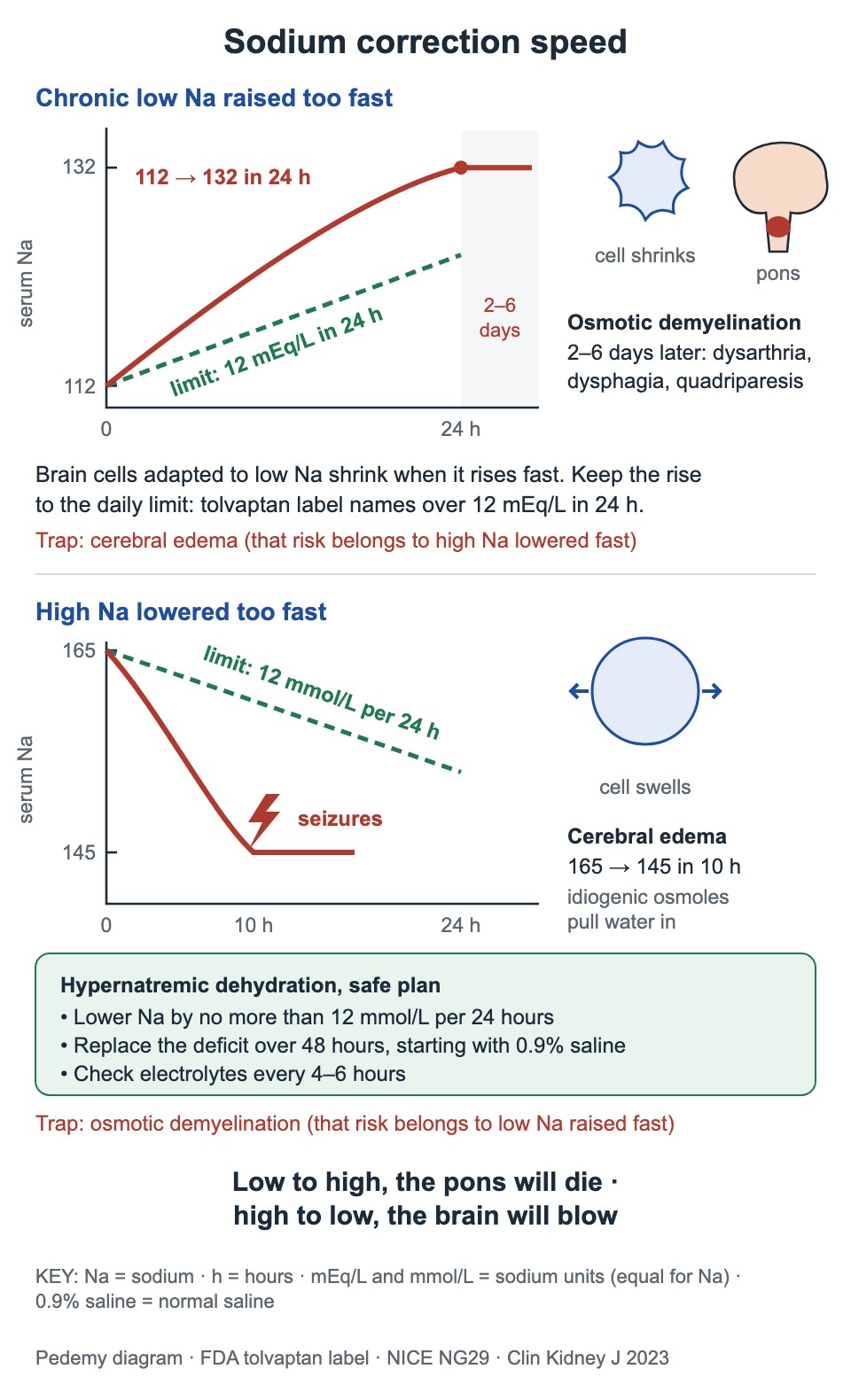
- Hypernatremic dehydration: replace the deficit over 48 hours, start with 0.9% saline, and check electrolytes every 4–6 hours.
- Do not mix up the two: low to high damages the pons; high to low swells the brain.
| Low sodium raised too fast | High sodium lowered too fast | |
|---|---|---|
| Complication | Osmotic demyelination syndrome | Cerebral edema, with seizures |
| Why | Brain cells adapted to low sodium shrink when sodium rises fast, and myelin is damaged, mainly in the pons | Brain cells make idiogenic osmoles in hypernatremia; a fast fall in sodium pulls water into them |
| Picture | Dysarthria, dysphagia and quadriparesis 2–6 days later | Seizures during correction of hypernatremic dehydration |
| Safe speed | Keep the rise within the daily limit; the tolvaptan label names over 12 mEq/L in 24 h as too fast | Lower sodium by no more than 12 mmol/L per 24 hours |
Polyuria: which test?
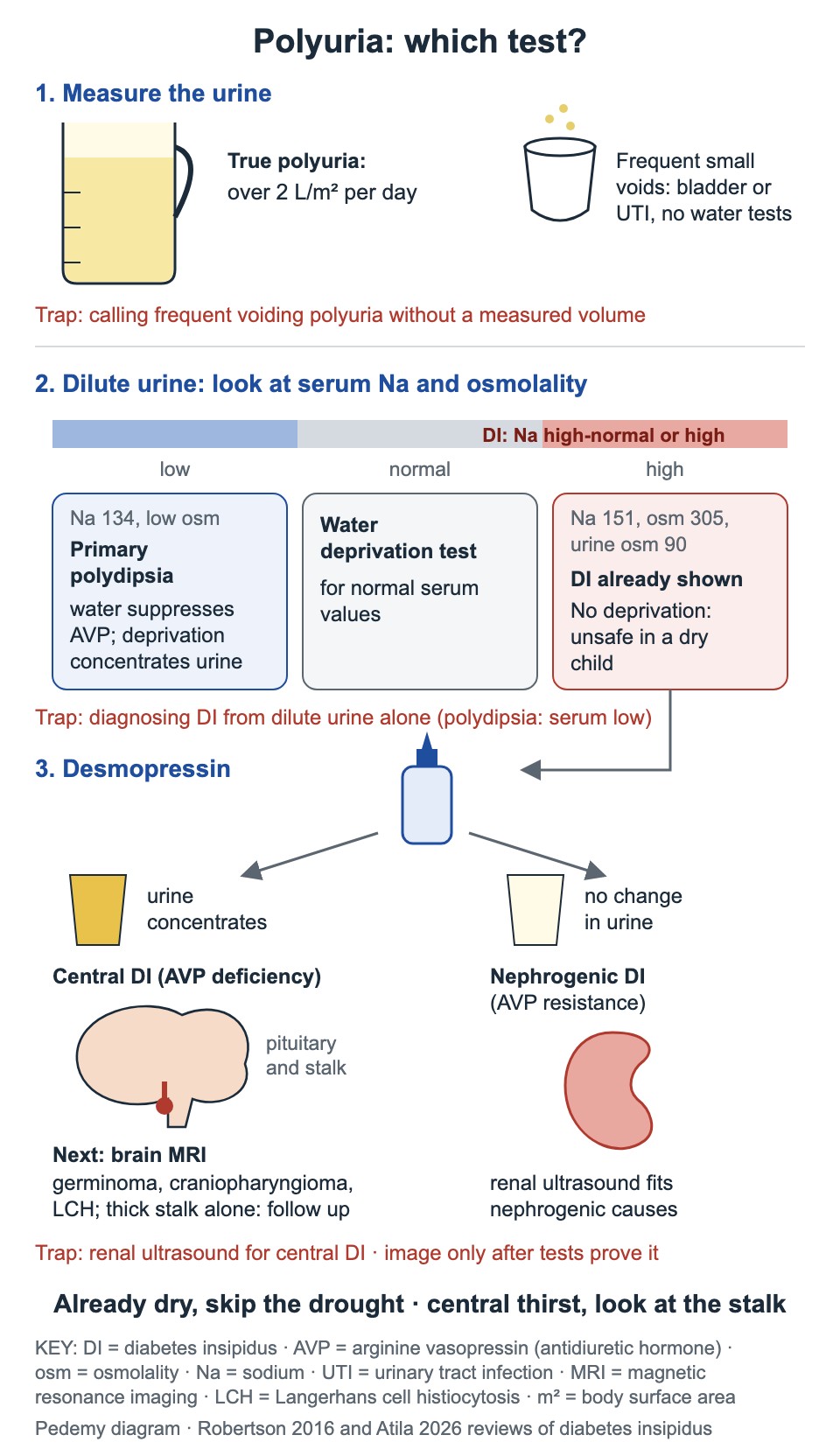
True polyuria is a urine volume over 2 L/m² per day. Measure it first: frequent small voids from bladder or urinary infection symptoms are not polyuria and need no water-balance work-up. Central diabetes insipidus is now called AVP deficiency, and nephrogenic diabetes insipidus is AVP resistance.
- Water deprivation is for children with normal serum values. In DI the serum sodium is high-normal or high, so dilute urine alone does not make the diagnosis.
- Central DI in children often signals a lesion: germinoma, craniopharyngioma or Langerhans cell histiocytosis.
- A thick pituitary stalk is not diagnostic alone and needs specialist follow-up.
- Image only after the water tests prove AVP deficiency.
| Finding | Meaning | Next step |
|---|---|---|
| Serum sodium over 145 or osmolality over 300, with dilute urine | Failure to concentrate is already proven | No water deprivation (unsafe); give a desmopressin challenge |
| Urine concentrates after desmopressin | AVP deficiency (central DI) | Brain MRI of the pituitary and stalk |
| No change after desmopressin | AVP resistance (nephrogenic DI) | Look for a kidney cause; renal ultrasound fits here |
| Dilute urine with low or low-normal serum sodium and osmolality | Primary polydipsia: too much water dilutes the serum and suppresses AVP | Water deprivation concentrates the urine |
IV fluids for a dehydrated child
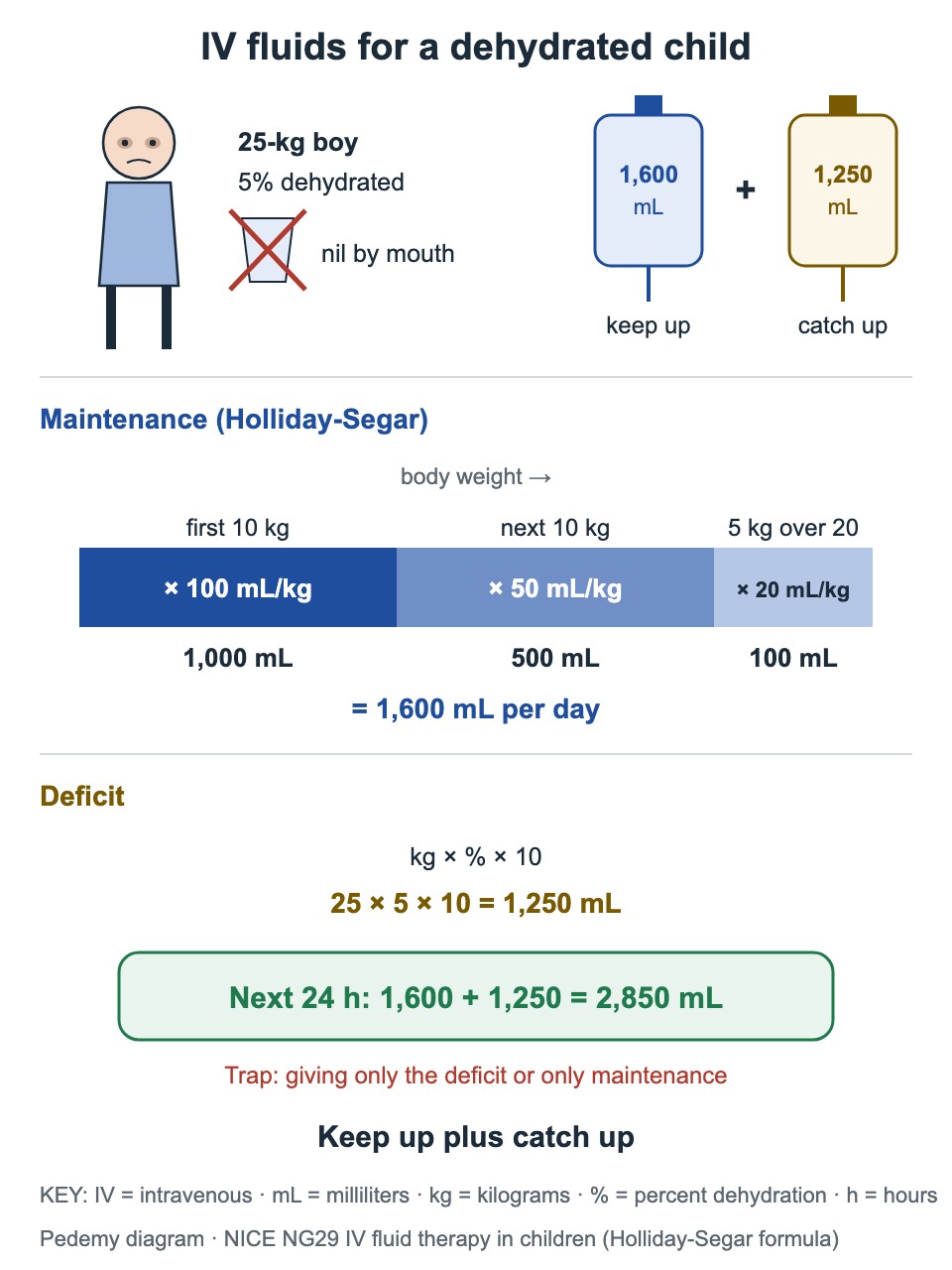
- Maintenance (Holliday-Segar): 100 mL/kg for the first 10 kg, 50 mL/kg for the next 10 kg, and 20 mL/kg for each kg above 20 kg, per day.
- Deficit in mL = weight in kg × percent dehydration × 10.
- Example: a 25-kg boy who is 5% dehydrated and nil by mouth needs 1600 mL maintenance + 1250 mL deficit = 2850 mL in the next 24 hours.
- The trap is to give only the deficit or only the maintenance.
Calcium: high and low
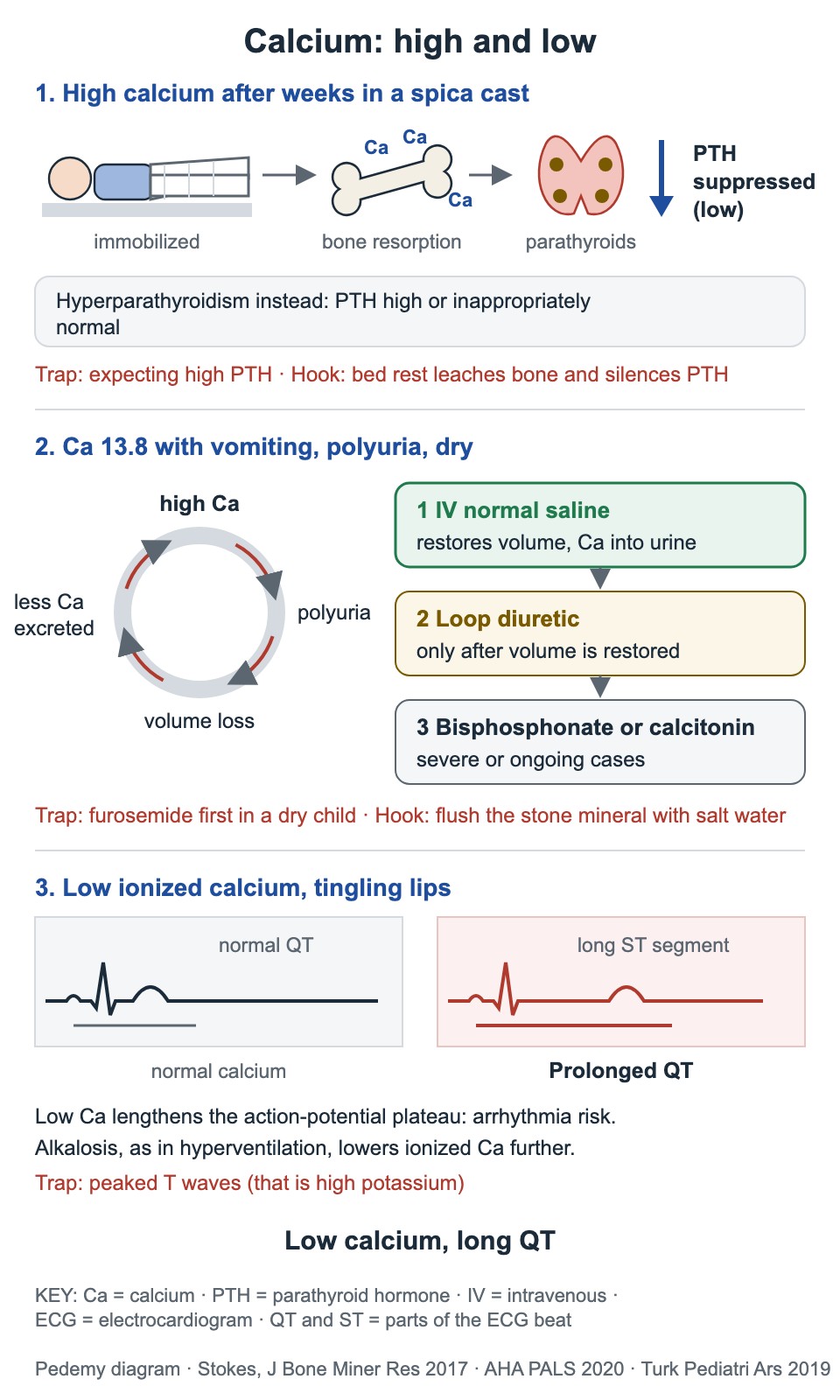
- Immobilization, such as weeks in a spica cast, speeds bone resorption. The calcium load switches off PTH, so PTH is suppressed (low).
- In hyperparathyroidism PTH is high or inappropriately normal. That difference separates the two.
- Symptomatic hypercalcemia (vomiting, polyuria, a dry child): IV normal saline first. High calcium causes polyuria and volume loss, and volume loss lowers calcium excretion; saline restores volume and pushes calcium into the urine.
- A loop diuretic comes only after volume is restored. A bisphosphonate or calcitonin is for severe or ongoing cases. Furosemide first in a dry child is the trap.
- Low ionized calcium, for example with tingling lips: the ECG shows a prolonged QT interval from a long ST segment, with a risk of arrhythmia.
- Alkalosis, as in hyperventilation, lowers ionized calcium further. Peaked T waves belong to high potassium, not low calcium.
Board traps
- Giving calcium or insulin for a hemolyzed sample in a well child.
- Starting with bicarbonate, a resin or dialysis instead of IV calcium when the ECG has changed.
- A potassium-binding resin for a preterm newborn.
- Fluid restriction for a dry child with low sodium, or saline for pseudohyponatremia.
- Normal saline or more water for a runner who gained weight and has a low sodium.
- Naming cerebral edema after fast correction of low sodium, or osmotic demyelination after fast correction of high sodium.
- Water deprivation when the serum sodium is already high, or diagnosing DI from dilute urine alone.
- Expecting a high PTH in immobilization hypercalcemia.
Common questions
What is the first drug for hyperkalemia with ECG changes in a child?
IV calcium gluconate. It protects the heart within minutes but does not lower potassium, so insulin with glucose and albuterol follow, and then potassium is removed with a loop diuretic, a resin or dialysis.
How fast can sodium be corrected in a child?
Slowly in both directions. In hypernatremic dehydration, lower sodium by no more than 12 mmol/L per 24 hours and replace the deficit over 48 hours. Raising a chronic low sodium too fast risks osmotic demyelination 2–6 days later.
How do you tell diabetes insipidus from primary polydipsia?
Both have dilute urine. In diabetes insipidus the serum sodium is high-normal or high; in primary polydipsia the serum sodium and osmolality are low or low-normal, and water deprivation concentrates the urine.
How do you calculate IV fluids for a dehydrated child?
Add maintenance and deficit. Maintenance is 100 mL/kg for the first 10 kg, 50 mL/kg for the next 10 kg and 20 mL/kg above 20 kg per day. The deficit in mL is weight in kg × percent dehydration × 10.
Study this topic
Sources
- NICE guideline NG29: Intravenous fluid therapy in children and young people in hospital (updated 2020)
- Spasovski G et al. Clinical practice guideline on diagnosis and treatment of hyponatraemia (Eur J Endocrinol 2014)
- Wilderness Medical Society clinical practice guidelines for exercise-associated hyponatremia: 2019 update
- Working Group for Renaming Diabetes Insipidus: position statement on the new names (Eur J Endocrinol 2022)
- FDA label: sodium polystyrene sulfonate (DailyMed)
Written for Pedemy in our own words from the sources above; checked November 2026. For education only, not medical advice; check doses and local protocols before treating a patient. Pedemy is independent and not affiliated with or endorsed by the organizations cited.