

Key points
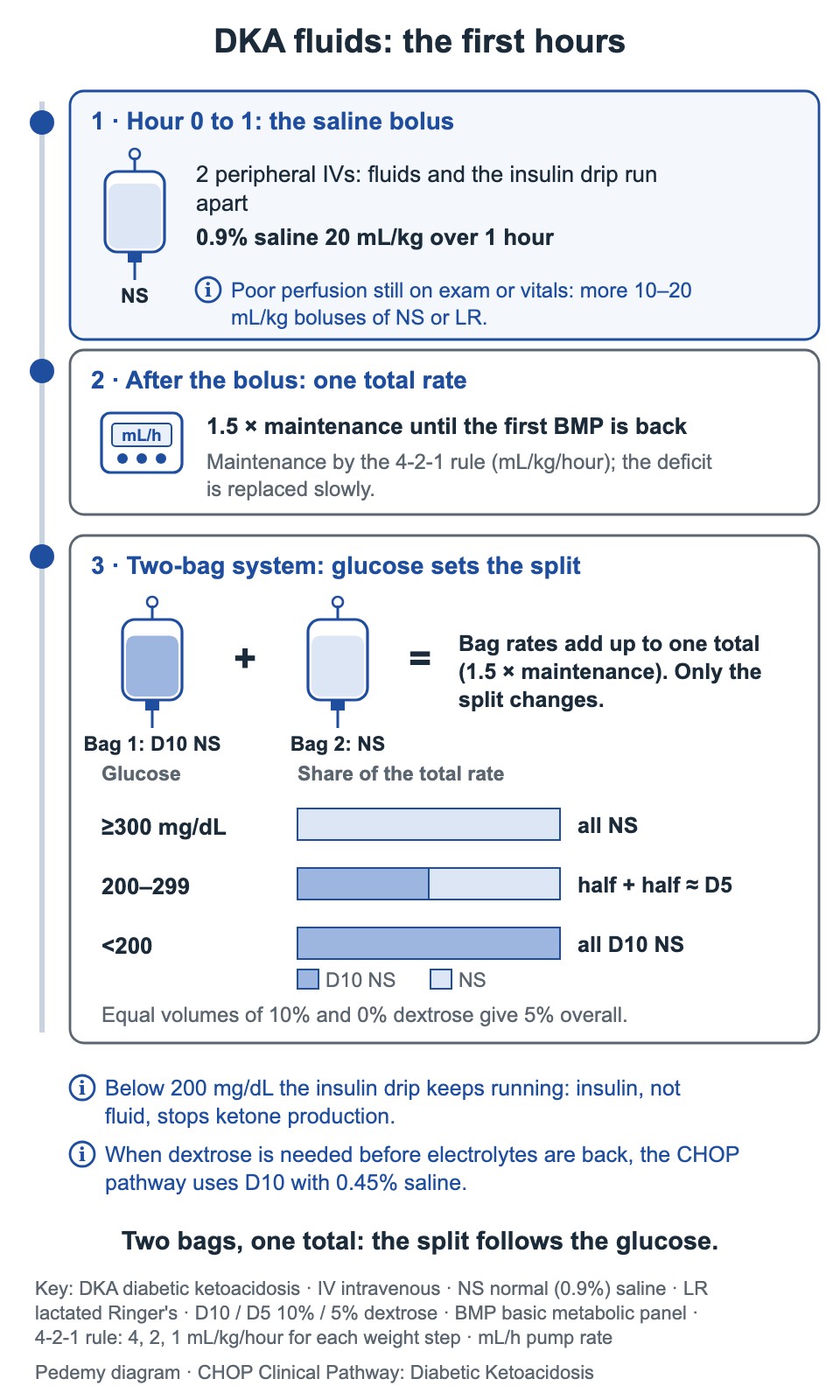
DKA fluids: the first hours
From Pedemy's flashcards. Tap to open full size; explained in “DKA fluids: the first hours and the two-bag system” below.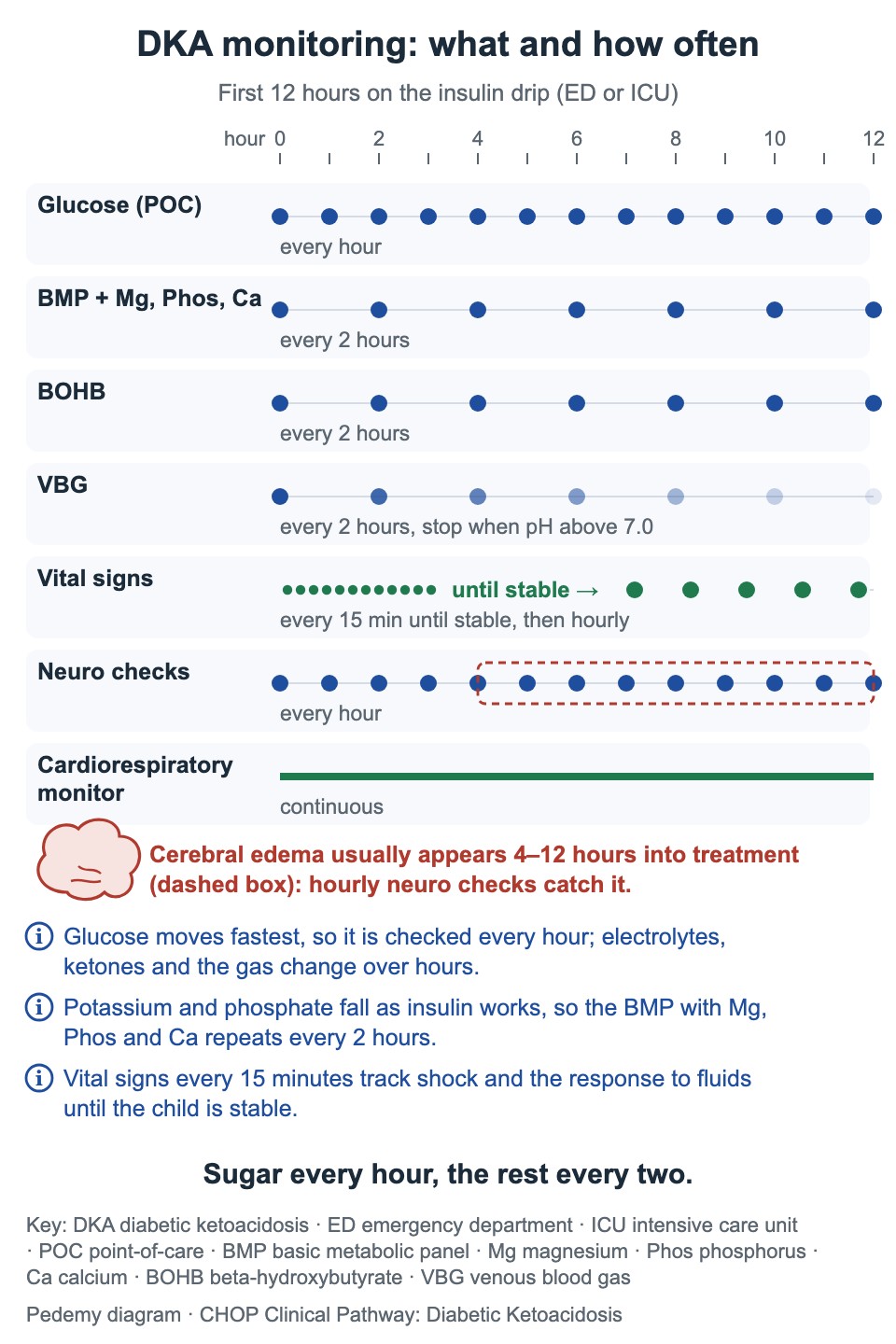
DKA start (CHOP) 2 peripheral IVs and 0.9% saline 20 mL/kg over 1 hour, then 1.5 times maintenance until the first metabolic panel returns.
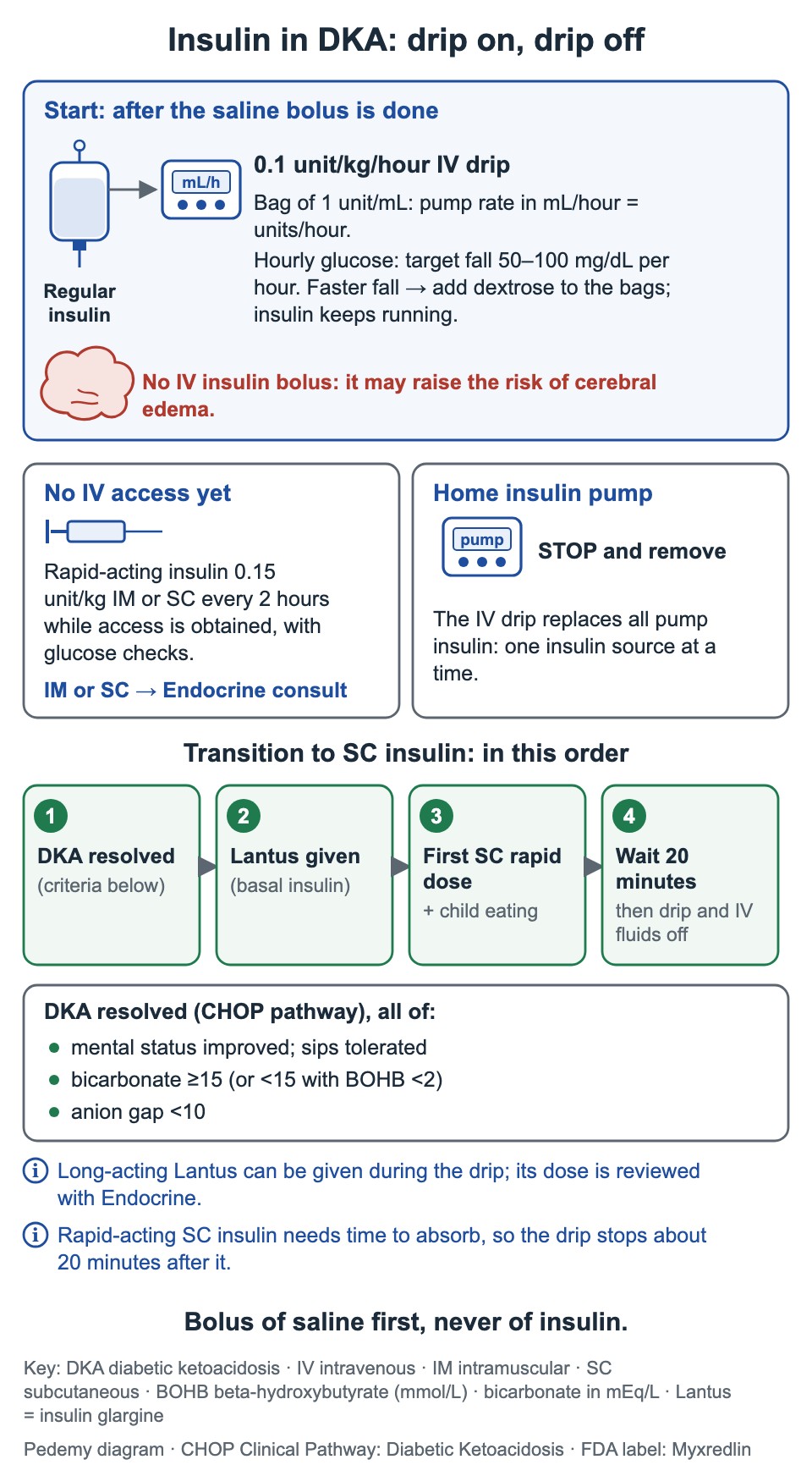
Regular insulin drip 0.1 unit/kg/hour starts after the first saline bolus; no IV insulin bolus. Glucose should fall 50–100 mg/dL per hour.
Two bags (D10 saline and saline) share one total rate: all saline at glucose 300 or more, half and half at 200–299, all D10 saline under 200.
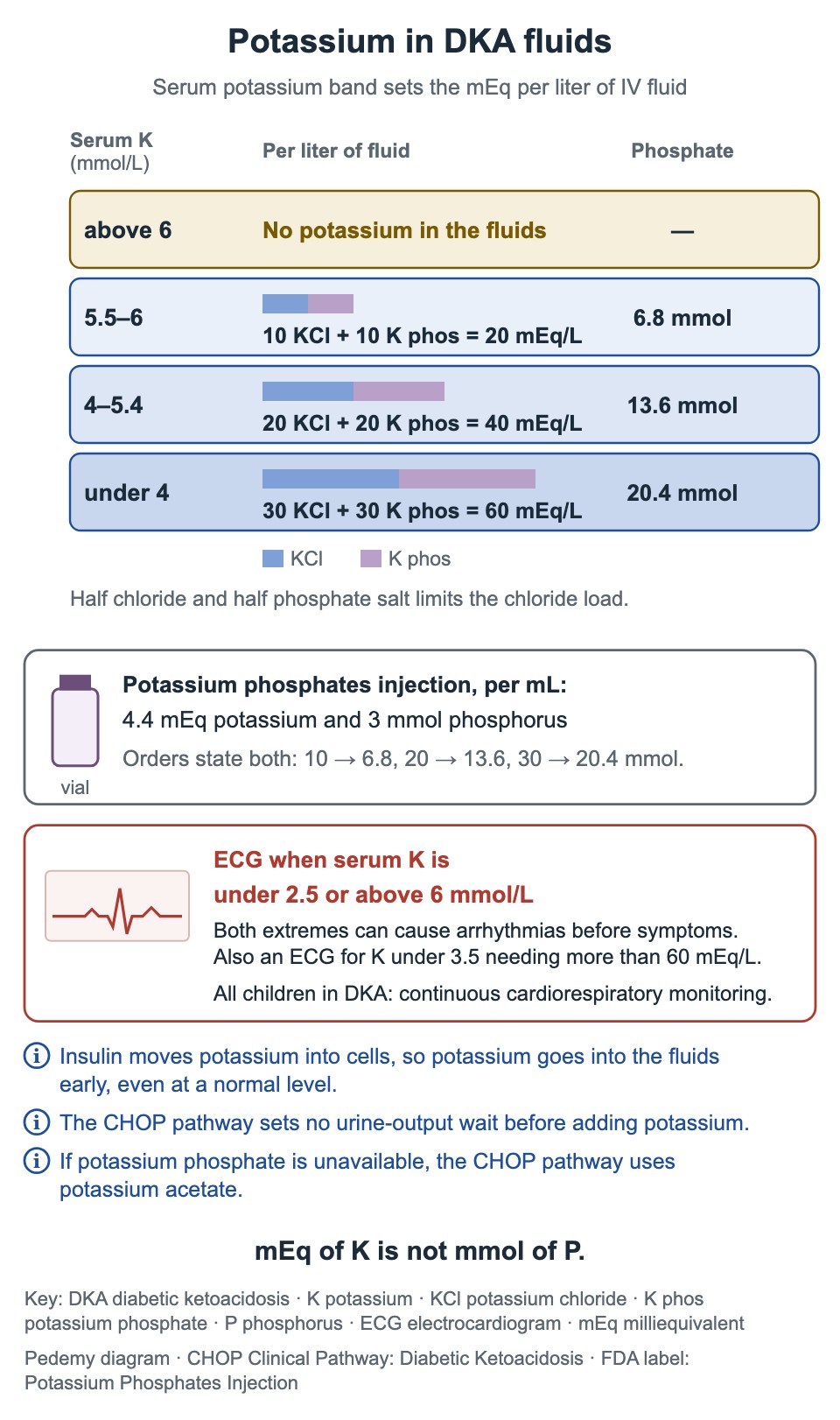
Potassium per liter by serum K under 4 → 30 + 30 mEq, 4–5.4 → 20 + 20, 5.5–6 → 10 + 10 (KCl + potassium phosphate), above 6 → none.
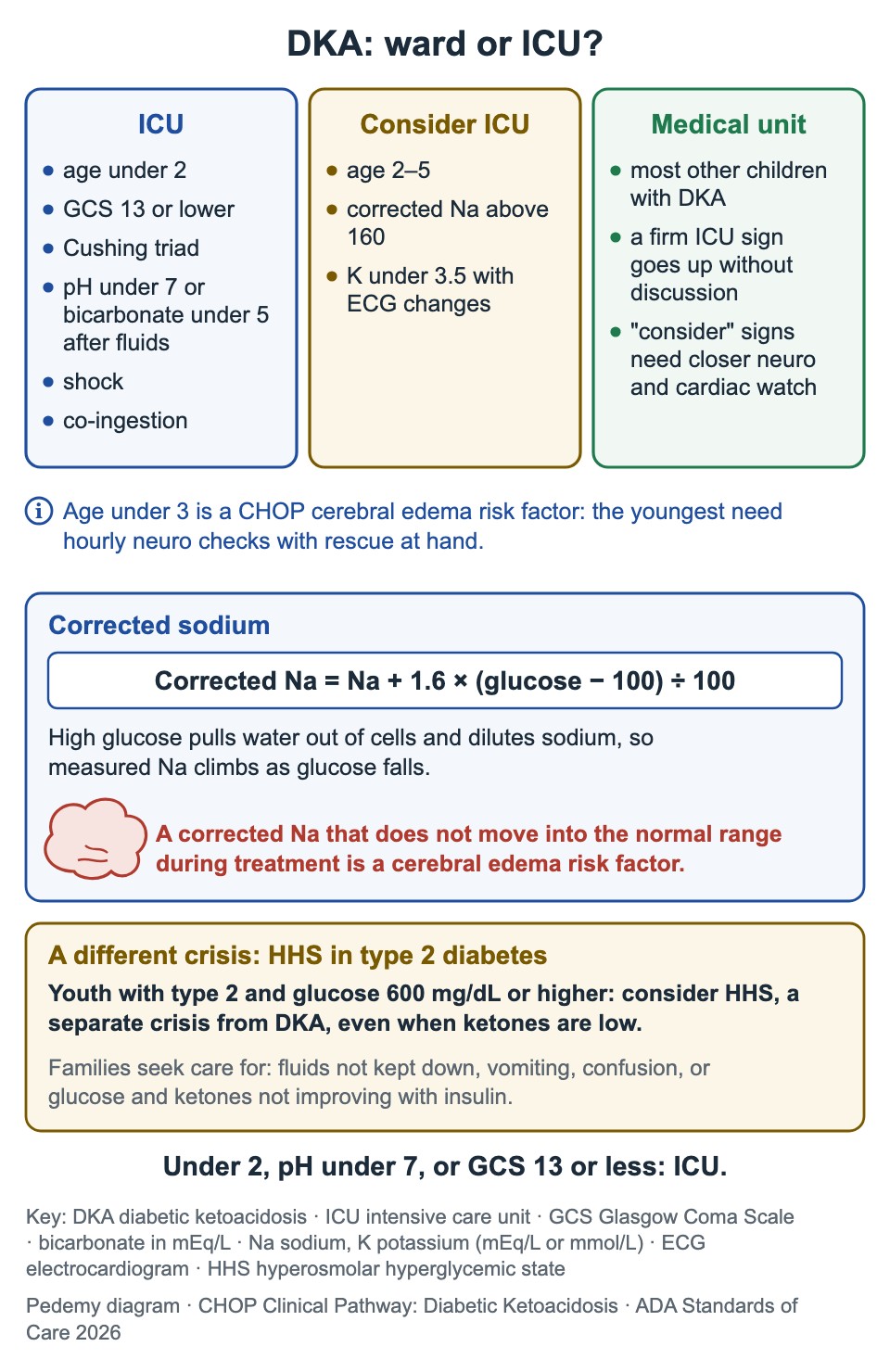
ICU for DKA age under 2, GCS 13 or lower, persistent pH under 7 or bicarbonate under 5, shock, Cushing triad or a co-ingestion.
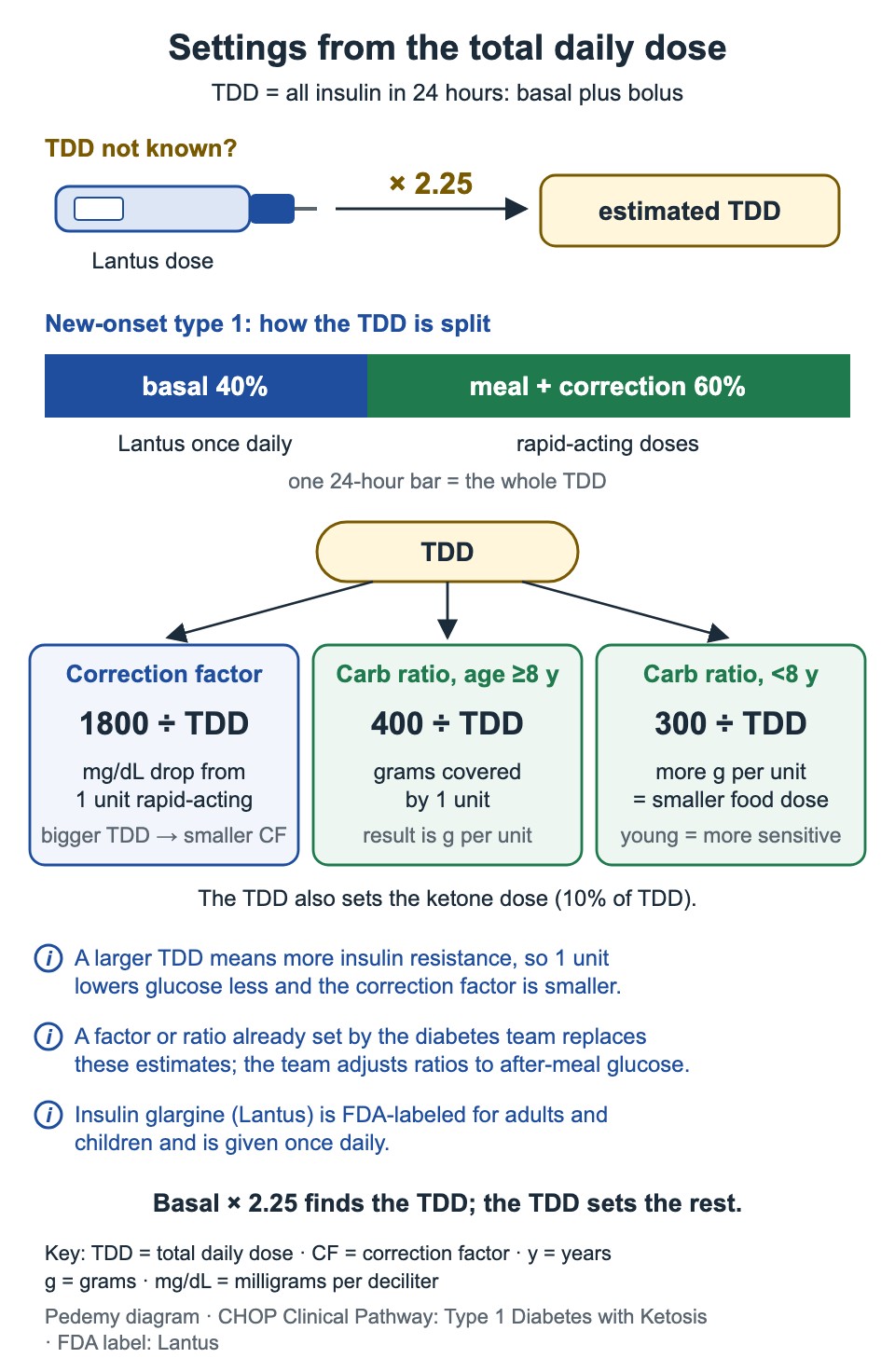
Insulin math from the total daily dose (TDD) basal 40% at new onset, carb ratio 400 ÷ TDD from age 8 (300 ÷ TDD under 8), correction factor 1800 ÷ TDD.
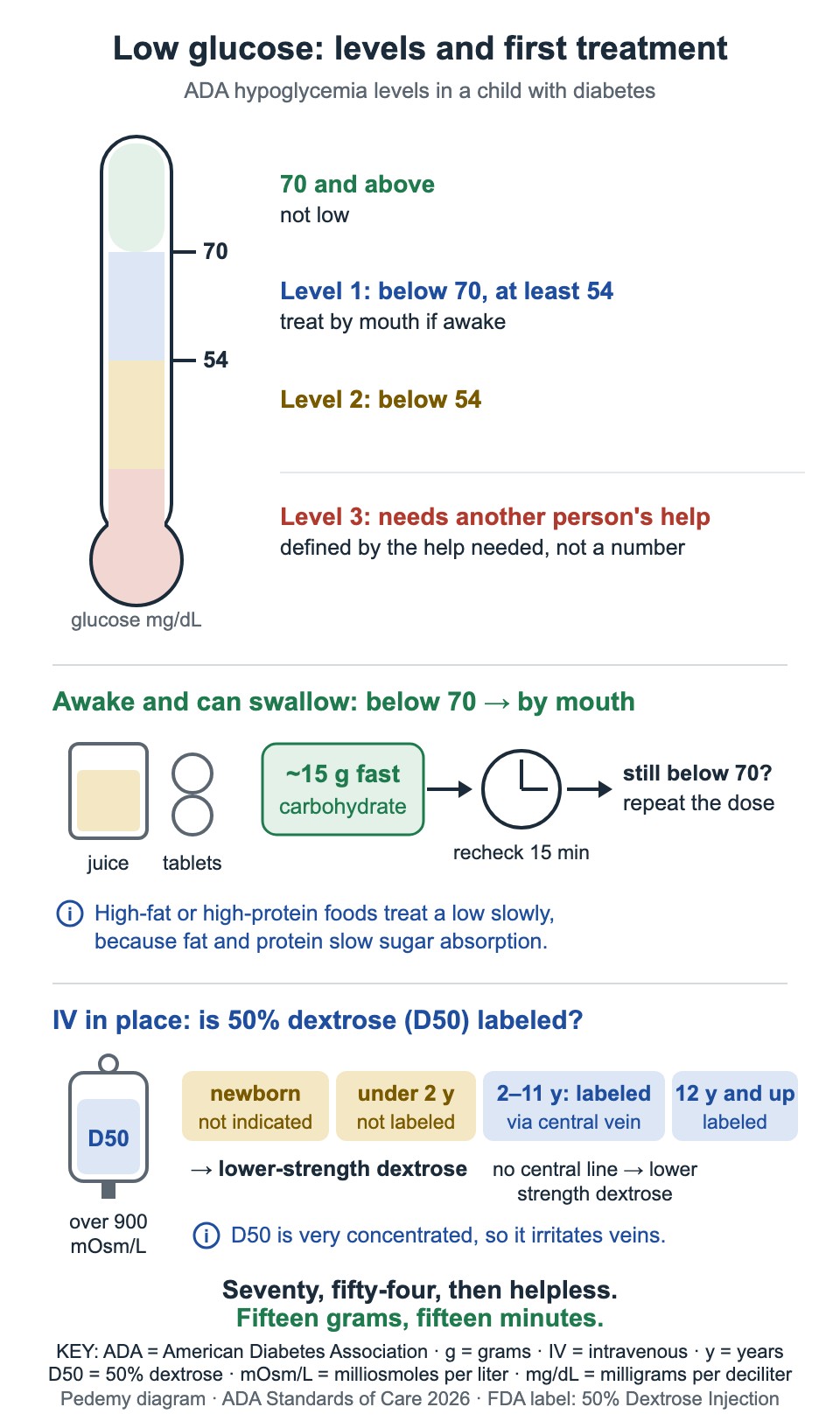
Low glucose 15 g fast carbohydrate and recheck in 15 minutes if awake; glucagon if unable to swallow, and glucagon prescribed for every child on insulin.
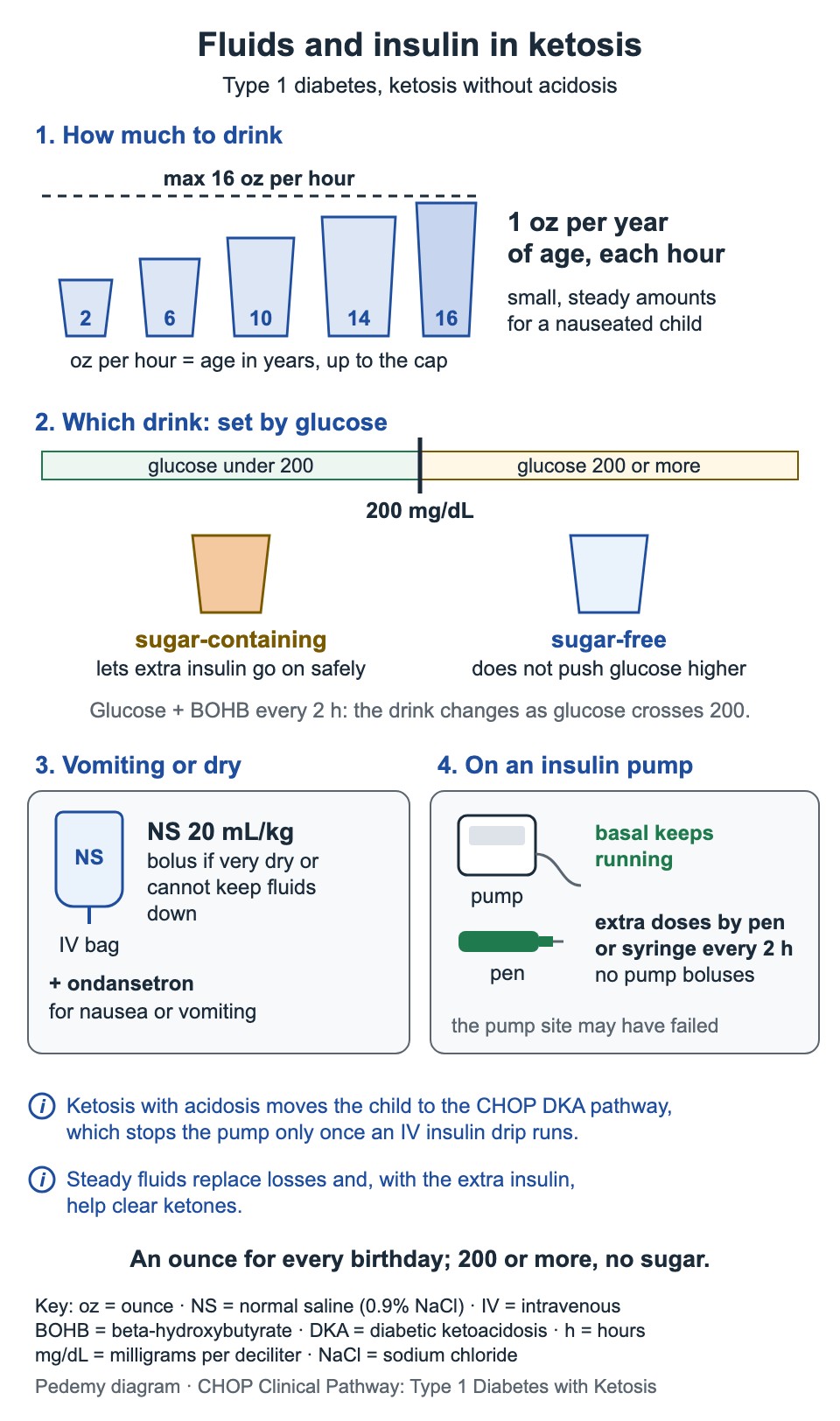
Ketosis (BOHB 1 or more) extra rapid-acting insulin 10% of TDD every 2 hours; BOHB 3 or more needs a venous gas and BMP for DKA.
DKA fluids: the first hours and the two-bag system
A child in DKA who is not in shock gets 2 peripheral IVs and 0.9% saline 20 mL/kg over 1 hour. Two lines let the fluids and the insulin drip run apart. The CHOP DKA pathway adds further 10–20 mL/kg boluses of saline or lactated Ringer's only when physical findings or vital signs still show poor perfusion.
After the bolus, the total IV rate is 1.5 times maintenance until the first metabolic panel returns. Maintenance is counted by the 4-2-1 rule in mL/kg/hour.
Bag 1 is D10 normal saline and bag 2 is normal saline. Each bag does not run at the full rate: the two bag rates add up to the prescribed total. Only the split changes as glucose falls, so the nurse can adjust dextrose at the bedside without a new fluid order or a fluid overload.
- Equal volumes of 10% and 0% dextrose deliver 5% dextrose overall.
- Dextrose is added so insulin can keep clearing ketones while glucose stays safe. Under 200 mg/dL with acidosis not resolved, insulin continues, because insulin, not fluid, stops ketone production.
- When dextrose is needed before electrolytes are back, the CHOP DKA pathway uses D10 with 0.45% saline.
| Glucose | Bag split | Dextrose overall |
|---|---|---|
| 300 mg/dL or higher | All normal saline | None |
| 200–299 mg/dL | Half D10 saline + half saline | About D5 |
| Under 200 mg/dL | All D10 saline at the full total rate | D10 |
Insulin in DKA: drip on, drip off
- Regular insulin drip: 0.1 unit/kg/hour, for example 3 units/hour at 30 kg. It starts only after the first saline bolus is done. With a 1 unit/mL bag the pump rate in mL/hour equals the units/hour.
- No IV insulin bolus: the CHOP DKA pathway says it may raise the risk of cerebral edema.
- No IV access yet: rapid-acting insulin 0.15 unit/kg IM or SC every 2 hours with glucose checks, and an Endocrine consult.
- Target glucose fall: 50–100 mg/dL per hour, seen on hourly point-of-care glucose. A faster fall is slowed with dextrose in the bags, not by stopping insulin.
- A child with a home insulin pump: stop (remove) the pump when the IV drip starts. Two insulin sources make doses unpredictable.
- Long-acting insulin (Lantus) dosing is reviewed with Endocrine, may be given during the drip, and must be given before the drip stops.
- DKA is resolved (CHOP) with improved mental status, sips tolerated, bicarbonate 15 or more (or below 15 with BOHB under 2) and anion gap under 10.
- Transition: give the first SC rapid-acting dose, let the child eat, and stop the drip and IV fluids 20 minutes after the SC dose.
Potassium and phosphate in DKA fluids
Insulin moves potassium into cells, so potassium goes into the fluids early even at a normal level. A low level means a deep total-body deficit that insulin will make worse within hours. Splitting chloride and phosphate salts limits the chloride load.
- At 5.5–6 mmol/L the smaller dose starts at once; the pathway sets no urine-output wait before adding potassium.
- Potassium phosphates injection carries 4.4 mEq potassium and 3 mmol phosphorus per mL, so mEq of potassium is not mmol of phosphate. Orders state both.
- No potassium phosphate in the pharmacy: use potassium acetate, so the potassium does not all come as chloride. Acetate is turned into bicarbonate in the liver.
- Large saline volumes can cause a hyperchloremic acidosis, which extra chloride makes worse.
- ECG for potassium below 2.5 or above 6 mmol/L, and when potassium is under 3.5 mmol/L and needs more than 60 mEq/L in the fluids.
| Serum potassium (mmol/L) | Per liter of IV fluid | Total potassium | Phosphate |
|---|---|---|---|
| Under 4 | 30 mEq KCl + 30 mEq potassium phosphate | 60 mEq/L | 20.4 mmol |
| 4–5.4 | 20 mEq KCl + 20 mEq potassium phosphate | 40 mEq/L | About 13.6 mmol |
| 5.5–6 | 10 mEq KCl + 10 mEq potassium phosphate | 20 mEq/L | 6.8 mmol |
| Above 6 | No potassium | None | None |
DKA monitoring: what to check and how often
Glucose moves fastest, so it is checked every hour; electrolytes, ketones and the gas change over hours. Potassium and phosphate fall as insulin works. Hourly neuro checks catch cerebral edema, which usually appears 4–12 hours into treatment.
| Check | How often |
|---|---|
| Point-of-care glucose | Every hour |
| BMP with Mg, Phos and Ca; BOHB | Every 2 hours |
| Venous blood gas | Every 2 hours until the pH is above 7.0 |
| Vital signs | Every 15 minutes until stable, then hourly |
| Neuro checks (ED and ICU) | Every hour |
| Cardiorespiratory monitor | Continuous for every child in DKA |
DKA: ward or ICU, corrected sodium and HHS
- ICU: age under 2 years (age alone decides), persistent pH under 7 or bicarbonate under 5 after fluids, GCS 13 or lower, shock, Cushing triad or a co-ingestion.
- Consider ICU: corrected sodium above 160 mEq/L, potassium under 3.5 mmol/L with ECG changes, or age 2–5 years.
- The CHOP DKA pathway places most other children with DKA on the medical unit. Age under 3 is one of its cerebral edema risk factors.
- Corrected Na = Na + 1.6 × (glucose − 100) ÷ 100. Measured Na 130 mEq/L with glucose 600 mg/dL gives about 138 mEq/L. Measured sodium climbs as glucose falls.
- A corrected sodium that does not move into the normal range during treatment is a cerebral edema risk factor.
- Youth with type 2 diabetes and glucose 600 mg/dL or higher: consider hyperosmolar hyperglycemic state (HHS), a separate crisis from DKA, even when ketones are low (ADA 2026).
Mealtime insulin math: food dose and correction dose
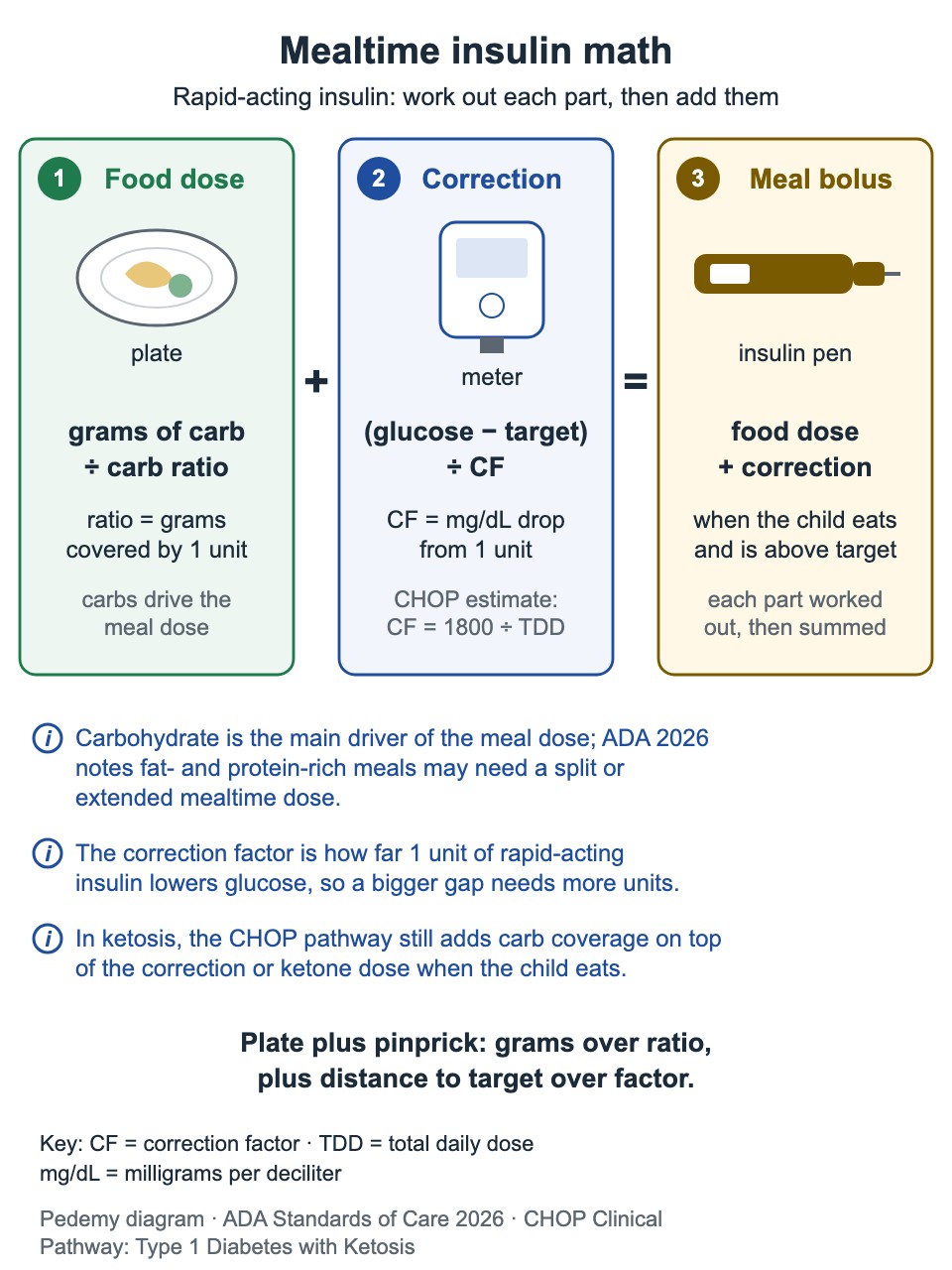
- Food dose = grams of carbohydrate ÷ carb ratio. 60 g with a ratio of 1 unit per 15 g = 4 units.
- Correction dose = (glucose − target) ÷ correction factor. Glucose 300, target 100, factor 50 mg/dL per unit = 4 units.
- The correction factor is how far 1 unit of rapid-acting insulin lowers glucose.
- Mealtime bolus = food dose + correction dose, each worked out separately. 30 g at 1:15 plus glucose 180, target 100, factor 40 = 2 + 2 = 4 units.
- Carbohydrate content is the main driver of the mealtime dose; fat- and protein-rich meals may need a split or extended dose (ADA 2026).
Insulin settings from the total daily dose
The total daily dose (TDD) is all insulin in 24 hours, basal plus bolus. It is the starting number for the carb ratio, the correction factor and the ketone dose. These CHOP estimates give way to settings the diabetes team has already set, and the team adjusts a carb ratio to the child's glucose pattern after meals.
- Young children are more insulin sensitive, so each unit covers more grams; a larger number of grams per unit means a smaller food dose.
- A larger daily dose means more insulin resistance and a smaller correction factor.
- Insulin glargine (Lantus) is FDA-labeled for adults and children, given once daily.
| Setting | CHOP estimate | Example |
|---|---|---|
| TDD when only the basal dose is known | Lantus × 2.25 | Lantus 20 units → about 45 units |
| Basal (Lantus) at new onset | 40% of TDD | TDD 40 → 16 units |
| Carb ratio, age 8 and older | 400 ÷ TDD (grams per unit) | TDD 40 → 1 unit per 10 g |
| Carb ratio, age 0–7 | 300 ÷ TDD (grams per unit) | TDD 15 → 1 unit per 20 g |
| Correction factor (1800 rule) | 1800 ÷ TDD (mg/dL per unit) | TDD 30 → 60 mg/dL per unit |
Insulin types on the ward
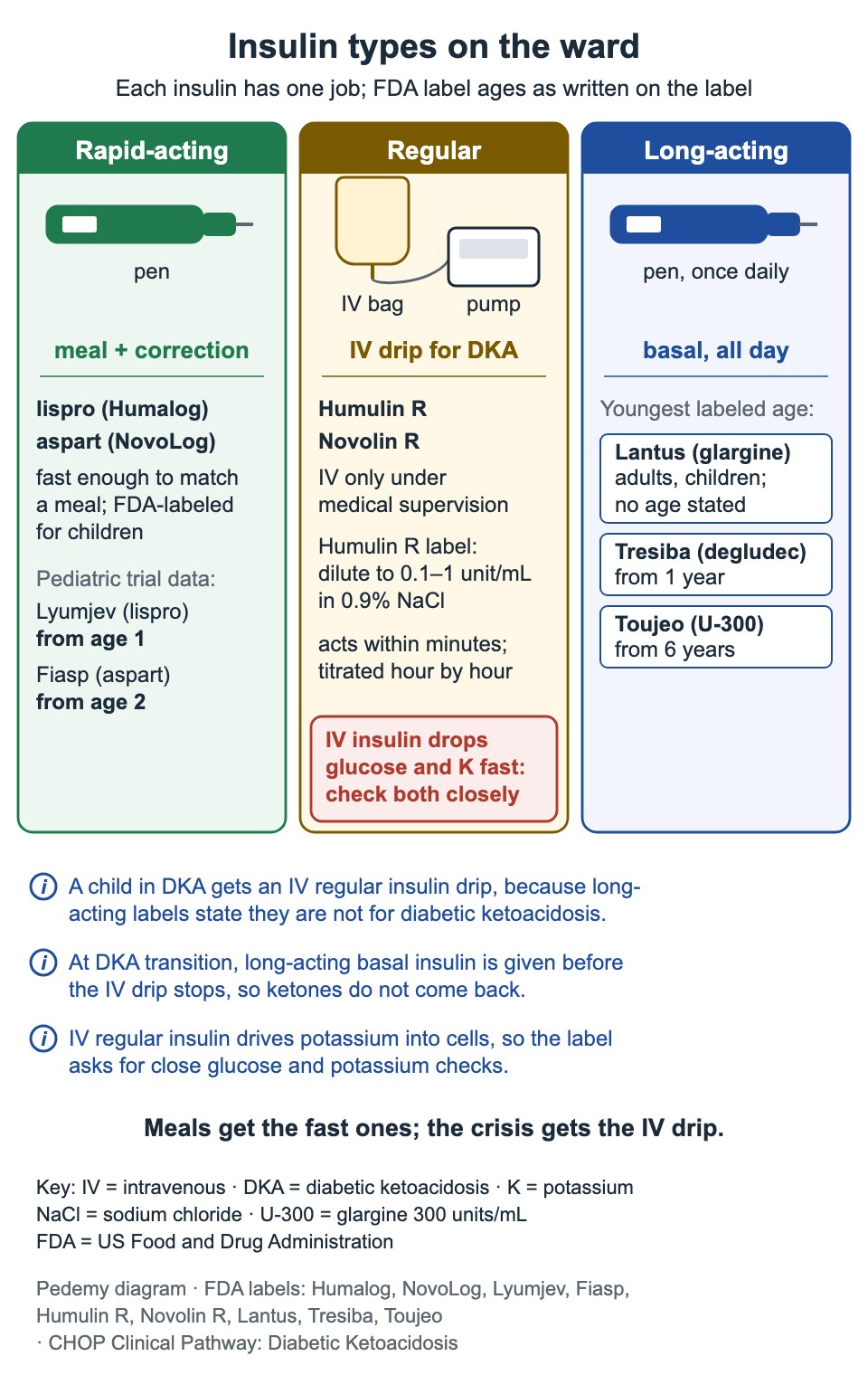
- Meal and correction doses: rapid-acting lispro (Humalog) or aspart (NovoLog), both FDA-labeled for children with diabetes. Lyumjev (lispro) has pediatric trial data from age 1 and Fiasp (aspart) from age 2.
- IV regular insulin (Humulin R, Novolin R): acts within minutes and drives potassium into cells, so the label requires close glucose and potassium checks, under medical supervision. The Humulin R label dilutes it to 0.1–1 unit/mL in 0.9% sodium chloride.
- Basal insulins: degludec (Tresiba) from 1 year; glargine U-300 (Toujeo) only from age 6; glargine U-100 (Lantus) for adults and children with no age floor in its current wording.
- Long-acting glargine and degludec do not treat DKA: their labels say so, and their slow action cannot be titrated hour by hour. The IV regular insulin drip treats DKA, and basal insulin is given before the drip stops so ketones do not return.
Low glucose: levels and first treatment
- Awake and able to swallow with glucose below 70 mg/dL: about 15 g fast carbohydrate, recheck in 15 minutes, and repeat if still under 70. High-fat or high-protein foods slow absorption.
- Glucagon is kept for a child unable to swallow.
- Dextrose 50% (D50) is labeled for insulin-induced lows only from age 2 and is not indicated in newborns; an 18-month-old gets a lower-strength dextrose. For ages 2–11 the label asks for a central vein, or a lower-concentration dextrose when none is available, because its osmolarity above 900 mOsm/L irritates veins.
| ADA level | Definition |
|---|---|
| Level 1 | Below 70 and at least 54 mg/dL |
| Level 2 | Below 54 mg/dL |
| Level 3 | Any low that needs another person's help (not a glucose number) |
Glucagon for a severe low: dose by product
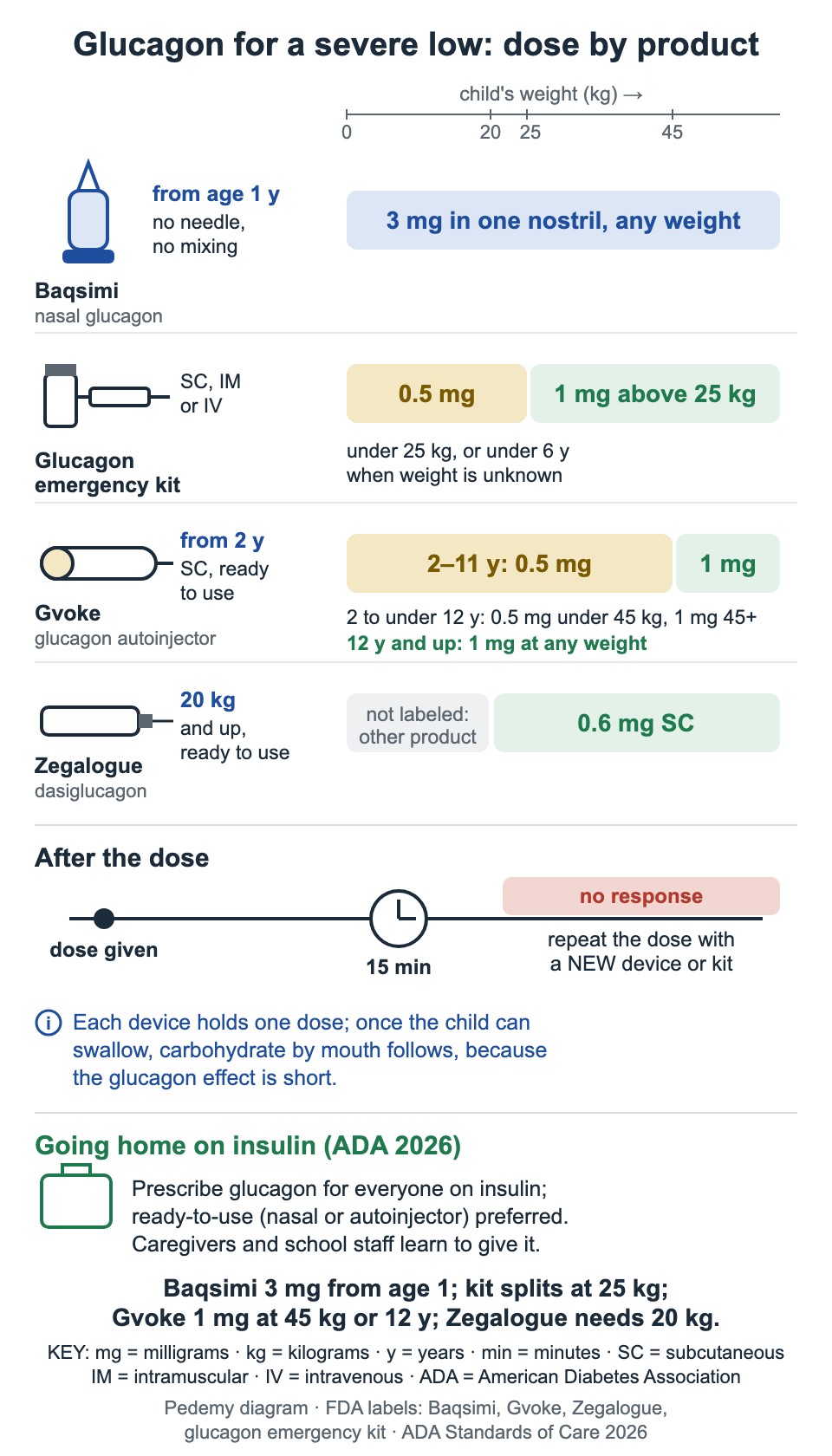
- No response after 15 minutes (Baqsimi, Zegalogue or the kit): repeat the dose with a new device. Each device holds a single dose.
- Glucagon frees liver glycogen within minutes, but the effect is short: a child who wakes gets carbohydrate by mouth once able to swallow.
- Baqsimi and Gvoke are ready to use with no mixing; nasal Baqsimi needs no needle.
- Every child going home on insulin gets a glucagon prescription, ready-to-use forms (nasal or autoinjector) preferred, and caregivers and school staff should know how to give it (ADA 2026).
| Product | Labeled patients | Dose |
|---|---|---|
| Nasal glucagon (Baqsimi) | Age 1 year and older | 3 mg in one nostril, no weight band |
| Glucagon emergency kit | Weight decides the dose | 0.5 mg SC, IM or IV under 25 kg (or under age 6 if weight unknown); 1 mg above 25 kg |
| Glucagon autoinjector (Gvoke) | Age 2 years and older | Age 2 to under 12: 0.5 mg SC under 45 kg, 1 mg at 45 kg or more; age 12 and older: 1 mg |
| Dasiglucagon (Zegalogue) | Weighing at least 20 kg | 0.6 mg SC |
Ketones in a sick child with type 1 diabetes
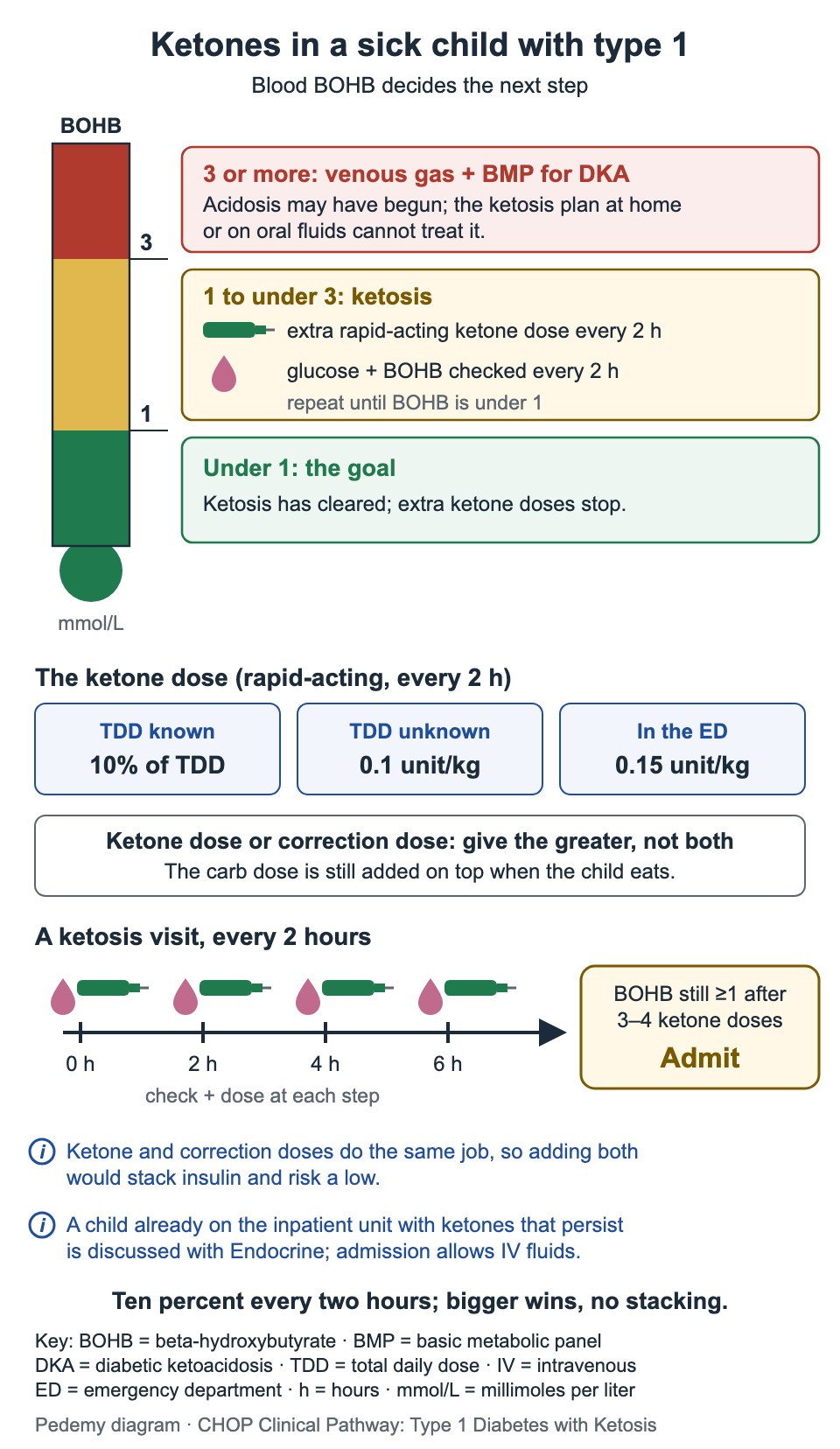
- Ketosis starts at a blood BOHB of 1 mmol/L. The goal is a BOHB under 1, with glucose and BOHB checked every 2 hours.
- BOHB 3 or more: get a venous gas and BMP to look for DKA, because acidosis may have begun. Ketosis with acidosis moves the child to the DKA pathway.
- Ketone dose: rapid-acting insulin 10% of TDD every 2 hours until BOHB is under 1 (TDD 30 → 3 units). TDD unknown: 0.1 unit/kg. In the emergency department the CHOP ketosis pathway uses 0.15 unit/kg.
- Ketone dose or correction dose: give only the greater one, not both (ketone 3 units and correction 2 units → 3 units). Adding both risks a low. The carb dose is still added when the child eats.
- BOHB still 1 or more after 3–4 ketone doses: admit. A child already on the inpatient unit is discussed with Endocrine.
Fluids and insulin pumps in ketosis
- Oral fluid goal: 1 oz per year of age per hour, max 16 oz per hour (6 oz per hour at age 6), taken in small steady amounts if nauseated.
- Glucose 200 mg/dL or more: sugar-free fluids. Below 200: sugar-containing fluids so the extra insulin can continue safely.
- Significantly dehydrated or unable to keep fluids down: consider a normal saline 20 mL/kg bolus, and ondansetron for nausea or vomiting.
- Insulin pump in ketosis without acidosis: keep the pump basal running, give extra doses by pen or syringe every 2 hours, and no pump boluses, because ketosis on a pump can mean a failed site. The pump is stopped only once DKA is treated with an IV insulin drip.
New diabetes on the ward and going home
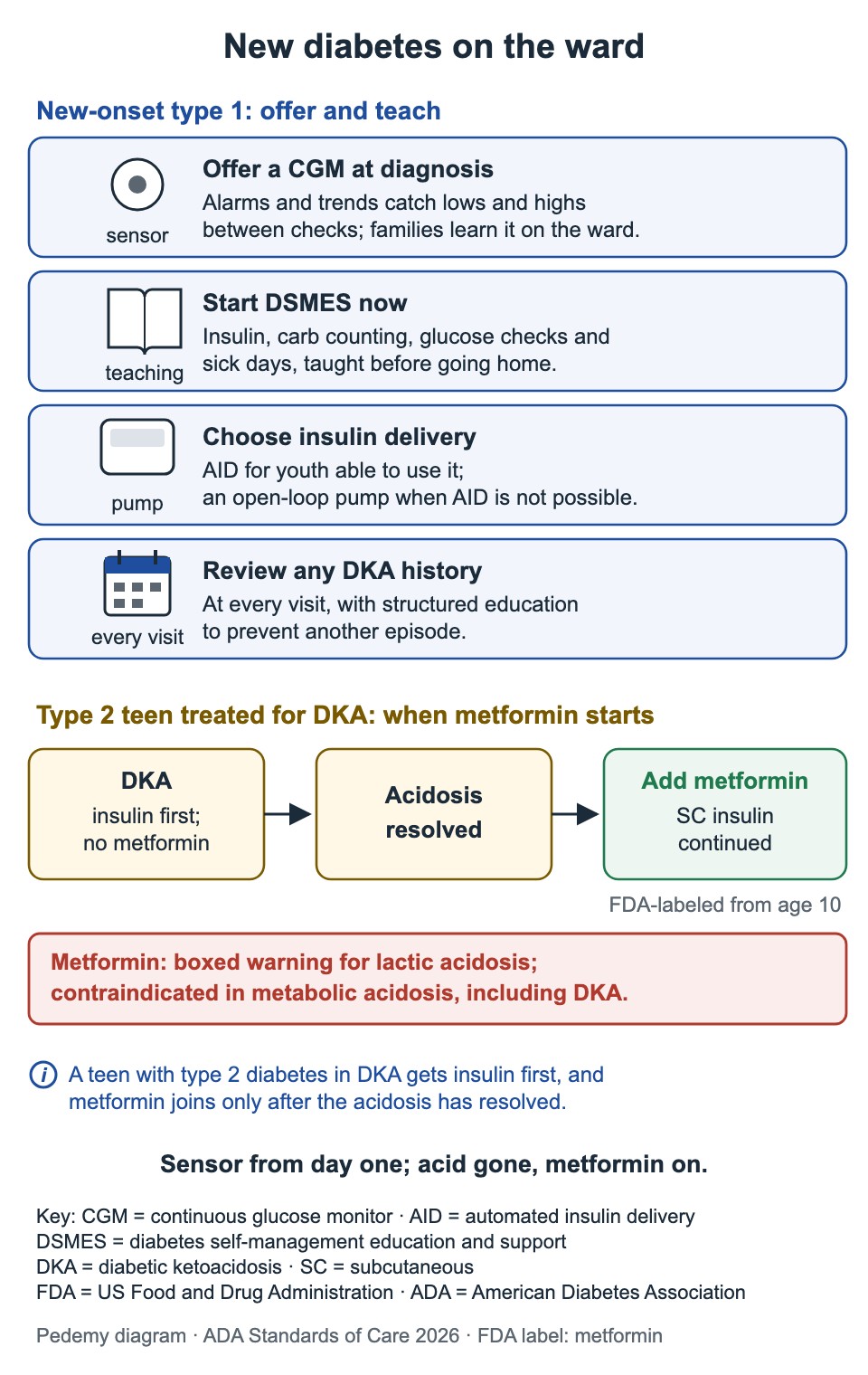
- Offer a continuous glucose monitor (CGM) at diagnosis; alarms and trends catch lows and highs between checks, and families learn it during the admission (ADA 2026).
- Offer automated insulin delivery to youth able to use it, and an open-loop pump when that is not possible.
- Start diabetes self-management education and support (DSMES) at diagnosis: insulin, carb counting, glucose checks and sick days.
- Review any history of DKA at every visit and give structured education to prevent another.
- Families should seek care when a child cannot keep fluids down, is vomiting, is confused, or glucose and ketones do not improve with insulin.
- Type 2 diabetes after DKA: start insulin for the ketoacidosis, then add metformin once acidosis resolves, with SC insulin continued. Metformin is contraindicated in metabolic acidosis including DKA, carries a boxed warning for lactic acidosis, and is FDA-labeled from 10 years.
Common questions
Should a child in DKA get an IV insulin bolus?
No. On the CHOP DKA pathway the regular insulin drip starts at 0.1 unit/kg/hour after the first saline bolus is done, with no IV insulin bolus, because a bolus may raise the risk of cerebral edema.
How much potassium goes in DKA fluids?
It depends on serum potassium: under 4 mmol/L, 30 mEq KCl + 30 mEq potassium phosphate per liter; 4–5.4, 20 + 20; 5.5–6, 10 + 10; above 6, none. Potassium acetate replaces potassium phosphate when it is not available.
When can the insulin drip stop?
When DKA is resolved (improved mental status, sips tolerated, bicarbonate 15 or more or below 15 with BOHB under 2, anion gap under 10), long-acting insulin has been given, and the child has had the first SC rapid-acting dose and is eating. The drip and IV fluids stop 20 minutes after that SC dose.
How do I estimate a correction factor and carb ratio?
Correction factor = 1800 ÷ total daily dose. Carb ratio = 400 ÷ total daily dose from age 8, or 300 ÷ total daily dose under 8. Settings already set by the diabetes team come first.
Which glucagon dose for a 20 kg child?
Glucagon emergency kit 0.5 mg SC, IM or IV (under 25 kg), or nasal glucagon (Baqsimi) 3 mg in one nostril from age 1. Repeat with a new device after 15 minutes if there is no response.
What to do with blood ketones in a sick child with type 1 diabetes?
BOHB 1 or more is ketosis: give rapid-acting insulin 10% of the total daily dose every 2 hours, oral fluids 1 oz per year of age per hour (max 16 oz), and recheck glucose and BOHB every 2 hours. BOHB 3 or more needs a venous gas and BMP for DKA.
Study this topic
Sources
- CHOP Clinical Pathway: Diabetic Ketoacidosis (DKA) — Emergency Department, ICU and Inpatient
- CHOP Clinical Pathway: Diabetes Mellitus (DM) and Acute Illness or Ketosis without Acidosis
- CHOP Clinical Pathway: Calculating Subcutaneous Insulin Dose (Rapid-Acting and Long-Acting)
- ADA Standards of Care in Diabetes—2026, Section 14: Children and Adolescents
- ADA Standards of Care in Diabetes—2026, Section 6: Glycemic Goals and Hypoglycemia
- FDA label (DailyMed): glucagon nasal powder (Baqsimi)
Written for Pedemy in our own words from the sources above; checked November 2026. For education only, not medical advice; check doses and local protocols before treating a patient. Pedemy is independent and not affiliated with or endorsed by the organizations cited.